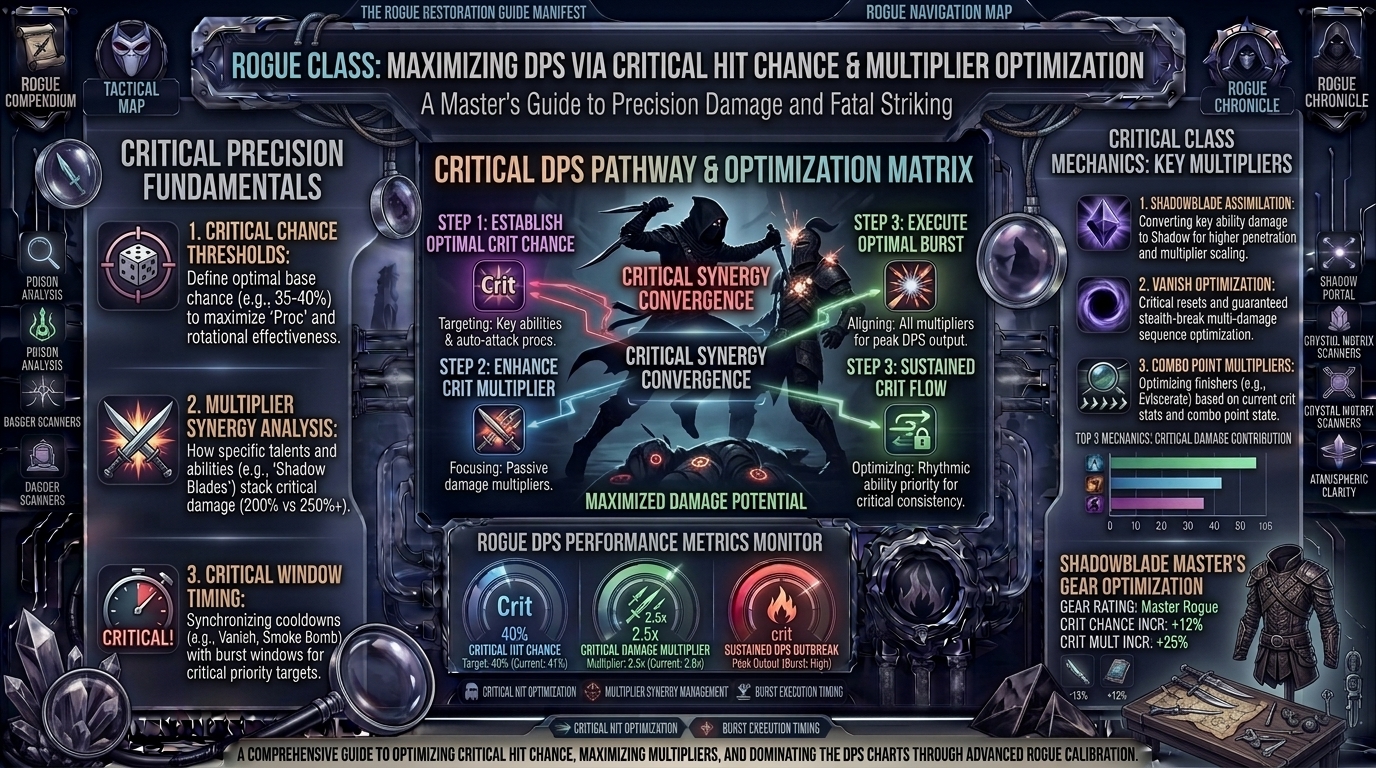
What Are the Best Critical Hit Chance and Critical Damage Multipliers for Maximizing Rogue Class DPS Output
Welcome to The Gamer Buzz, your definitive nexus for high-performance action RPG optimization, tactical breakdown guides, and advanced class builds. Whether you are cutting down foes in dark fantasy isometric worlds or securing high-tier endgame clears across New York, California, and Washington, mastering your damage output is the ultimate key to progression.
For players running the Rogue Class, speed, precision, and multiplicative scaling reign supreme. Among all offensive attributes, Critical Hit Chance (CHC) and Critical Damage Multiplier (CHD) form the bedrock of elite damage-per-second (DPS) architecture.
In this exhaustive guide, we dissect the mathematical sweet spots, gear breakpoints, and multiplier synergies required to turn your Rogue into an unstoppable DPS powerhouse.
1. The Anatomy of Rogue Damage: Understanding the Core Pillars
To maximize your Rogue’s output, you first need to understand how damage calculation handles critical strikes. In most modern ARPGs (such as Diablo IV or similar fast-paced fantasy titles), damage is not just an additive stack; it relies heavily on bucket-based multiplicative scaling.
Your final damage calculation generally looks like this:
$$\text{Final Damage} = \text{Base Weapon/Skill Damage} \times \text{Core Stat Multiplier} \times \text{Damage vs. Conditional Buckets} \times (\text{1 + [CHC} \times \text{CHD])}$$
Critical Hit Chance (CHC) vs. Critical Damage (CHD)
- Critical Hit Chance (CHC): Dictates how frequently your attacks land as a critical strike. Without a stable baseline of CHC, massive critical damage modifiers are rendered useless because they rarely trigger.
- Critical Damage Multiplier (CHD): Determines the bonus magnitude of damage dealt when a critical strike occurs.
The golden rule of optimization is avoiding diminishing returns through stat imbalance. Stacking pure Critical Damage while leaving your Critical Hit Chance at 5% results in terrible, inconsistent DPS. Conversely, having 100% CHC with base-level CHD leaves immense amounts of damage on the table.
2. Determining the Ideal Breakpoints for CHC and CHD
What are the actual target numbers you should aim for on your gear, paragon boards, and passive trees? While exact numbers fluctuate depending on specific patches and scaling caps, elite endgame theorycrafting points to several clear benchmarks:
The Critical Hit Chance Sweet Spot
- Early to Mid Game: Aim for 35% to 45% CHC. At this stage, your attack speed is moderate, and consistent triggers are needed to smooth out clear times.
- Endgame / Tier-Max Content: Push for 55% to 75+% unbuffed CHC, scaling up to near-cap limits (or 100% via temporary buffs, skill activations, and specific item aspects like Zan Gar or precision procs).
The Critical Damage Multiplier Ratio
Because critical damage often suffers from additive pooling with other vulnerable or core damage buckets in modern scaling systems, you want to maintain a healthy ratio.
- A reliable historical benchmark for balanced output is maintaining roughly a 1:3 or 1:4 ratio between your overall independent damage multipliers and raw critical strike stats, ensuring that every point of CHC translates to an exponential leap in average DPS.
3. Gear Affixes: Where to Find Critical Stats
Maximizing your stats requires knowing precisely which gear slots can roll Critical Hit Chance and Critical Damage.
| Equipment Slot | Priority Stat 1 | Priority Stat 2 | Optimization Note |
| Head / Helmet | Critical Hit Chance | Cooldown Reduction / Max Energy | Essential slot for securing base CHC. |
| Gloves | Critical Hit Chance | Attack Speed / Skill Ranks | Look for Greater Affixes (GA) here. |
| Rings | Critical Hit Chance | Critical Damage / Vulnerable Dmg | Rings are your primary vehicle for scaling crits. |
| Amulet | Movement Speed / CDR | Passive Ranks / Critical Multipliers | Look for percentage-based multiplier aspects. |
| Weapons | Critical Damage / Vulnerable | Dexterity / Core Skill Damage | Two-handed weapons double your output values. |
4. Leveraging Rogue Skill Trees and Specializations
Gear is only half the battle. The Rogue class toolkit features inherent passives and specializations designed to artificially inflate or completely bypass standard stat limitations.
- Exploit / Precision / Control Passives: Utilizing passives that scale damage based on how frequently you land critical strikes or crowd-control enemies will drastically multiply your baseline output.
- Specialization Synergy: Align your chosen specialization (such as Preparation, Combo Points, or Inner Sight) with high-attack-speed weapon setups (Daggers and Swords). Higher attack speeds naturally result in more check-rolls for Critical Hit Chance per second.
- Imbuements: Shadow, Poison, or Cold imbuements often interact uniquely with critical strikes, causing chain reactions, spreading damage, or triggering massive burst multipliers against vulnerable elites.
5. Advanced DPS Strategies: Attack Speed and Lucky Hits
Many Rogue players make the mistake of isolating CHC and CHD from other mechanical stats. In reality, Attack Speed and Lucky Hit Chance act as multipliers to your critical engine.
- The Attack Speed Velocity Principle: If character A hits 2 times per second with a 40% CHC, and character B hits 4 times per second with a 40% CHC, character B triggers twice as many critical events in the same timeframe, stabilizing their overall DPS output and triggering on-crit passives much faster.
- Lucky Hit Integration: Many elite Rogue builds rely on critical hits to trigger Lucky Hit effects (such as resource restoration, cooldown resets, or barrier generation). Ensuring your CHC is high keeps your resource loops infinitely sustained during extended boss fights.
10 Frequently Asked Questions (FAQ)
1. Should I stack Critical Damage or Vulnerable Damage first?
In contemporary meta builds, damage buckets are often balanced or adjusted via balance patches. Generally, you should balance them out; stacking too much into a single bucket causes diminishing returns. Aim to keep critical stats scaling in tandem with your core damage multipliers.
2. Is 100% Critical Hit Chance necessary for a Rogue?
Not strictly necessary, but getting as close to 75–85% sustained (with temporary buffs pushing you to 100%) ensures maximum consistency and eliminates bad RNG streaks during high-tier progression.
3. Do damage-over-time (DoT) builds benefit from Critical Strike Damage?
Traditionally, raw periodic damage ticks (like pure poison stacking) do not critically strike unless specified by unique items or specific legendary aspects designed to make DoTs crit. If you run a direct-hit core skill build (like Twisting Blades or Rapid Fire), CHC and CHD are mandatory.
4. How does Attack Speed affect my critical DPS?
Attack speed does not change the damage of an individual critical hit, but it increases the frequency of your attack rolls, drastically improving your real-world DPS and proc rates.
5. What are Greater Affixes and why do they matter for crits?
Greater Affixes represent max-rolled, enhanced versions of standard stats found on endgame gear items. Finding a ring or glove with a Greater Affix in Critical Hit Chance provides a massive baseline jump to your damage calculations.
6. Why is my Rogue dealing low damage despite high Critical Damage?
If your Critical Damage is sitting at 400% but your Critical Hit Chance is only 10%, you are only critting 1 out of every 10 attacks. Lower your raw critical damage slightly in exchange for boosting your Critical Hit Chance baseline.
7. Which weapons give the best inherent stat baselines for a Rogue?
Swords typically provide inherent Critical Strike Damage or percentage-based boosts, making them top-tier choices for off-hand or main-hand slot optimization depending on your preferred core setup.
8. How do Paragon Boards influence my critical build?
Endgame Paragon boards feature specialized legendary nodes and glyphs (such as Exploit, Canny, or Pride) that scale your damage exponentially based on your total Dexterity and critical strike metrics.
9. Can defensive stats ruin my offensive critical output?
While you need survivability (Armor, Resistances, Damage Reduction), sacrificing too many offensive affix slots on rings, gloves, and weapons will severely throttle your clear speeds. Balance defensive layers primarily on your chest, pants, and amulet slots.
10. Where can I test my Rogue’s actual DPS output?
The best testing ground is high-tier training dummies or repeating standardized endgame boss encounters, tracking your average time-to-kill (TTK) while adjusting individual gear pieces and passive setups.
Conclusion
Maximizing your Rogue class DPS output is a delicate science of mathematical balancing. By prioritizing a stable, high baseline of Critical Hit Chance (55%+), pairing it with scaling Critical Damage Multipliers, and supporting your engine with rapid attack speeds and balanced damage buckets, you will transform your gameplay experience. Implement these gear priorities, fine-tune your skill trees, and watch your damage numbers soar to the absolute top of the leaderboards!
Leave a Reply