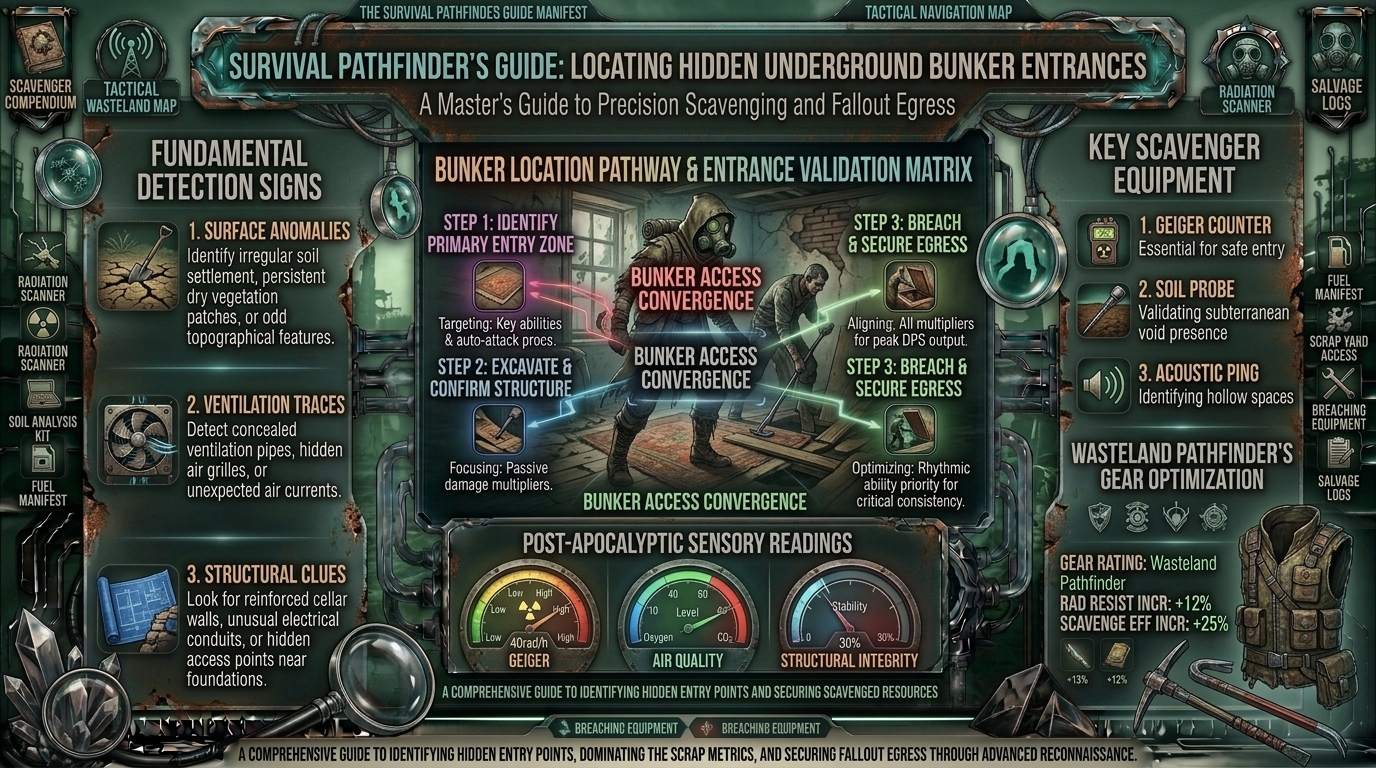
How to Find Hidden Underground Bunker Entrances Beneath Abandoned Farmhouses in Post-Apocalyptic Open Worlds
Welcome to The Gamer Buzz, your ultimate tactical gaming portal connecting survivalists and open-world explorers from the tech hubs of San Francisco, New York, and Seattle to the wide-open landscapes of Texas and California.
When you drop into a desolate wasteland, a nuclear-ravaged sandbox, or a zombie-infested rural countryside, your survival depends entirely on scavenging. Among all the structures scattered across the map, abandoned farmhouses hold the greatest potential rewards. Beneath their decaying floorboards, overgrown yards, and rusted-out tractor sheds often lie hidden pre-war underground bunkers packed with military-grade gear, rare crafting blueprints, and gripping environmental lore.
In this master-level, exhaustive guide, we dive deep into the psychology of map design, environmental storytelling cues, systematic grid searches, and advanced breach tactics required to find every hidden bunker in your favorite post-apocalyptic open worlds.
1. The Architectural Psychology of Wasteland Bunkers
Game developers do not scatter underground bunkers at random. Environmental artists and level designers rely on realism and pre-war civilian psychology to dictate where players will find hidden subterranean shelters. Understanding why a farmer or local militia built a bunker in a specific spot gives you an instant advantage when scouting from a distance.
The Logic Behind Rural Shelters
- Discretion and Isolation: Constructing a massive underground vault requires heavy machinery (backhoes, cement mixers, and cranes). Dense urban areas or busy roads make secrecy impossible. Rural farmhouses offer privacy, wide acreage, and visual cover.
- The “Cover Story” Infrastructure: Every bunker needs a plausible reason for its surface-level footprint. Barns, root cellars, dairy processing shacks, and old grain silos provided natural camouflage for construction noise, excavated earth removal, and steel deliveries.
- Resource Proximity: Preppers built shelters near natural water tables, arable land, and livestock yards. If a farmhouse has a dried-up well or a stream nearby, look closely at the surrounding earth.
2. Top 10 Environmental Indicators of a Hidden Bunker
Developers always leave breadcrumbs. If you approach an abandoned farmhouse and notice any of the following ten environmental anomalies, you are standing directly on top of a hidden underground entrance:
- Unusual Concrete Pours: Mismatched concrete slabs inside a rusted root cellar or tractor shed usually seal off a vertical shaft or emergency escape hatch.
- Abnormal Ground Depressions: Earth naturally settles over underground cavities. A circular or rectangular indentation in a flat field or behind a barn indicates a hollow space below.
- Double-Wide Drainage or Septic Lines: If surface pipes lead away from the house toward a dead end in the yard, follow them. They frequently run parallel to hardened air-filtration shafts.
- Impossibly Heavy Debris Piles: A stack of rusted tractors, heavy iron machinery, or collapsed hay bales sitting directly over flat earth is often a developer’s way of masking a heavy steel hatch.
- Mismatched Vegetation Growth: Unnatural weed patches, dead rings of grass, or exceptionally green patches can indicate that topsoil depth has been altered by a buried concrete bunker roof.
- Surplus Electrical Infrastructure: Look for buried utility conduits, heavy-duty fuse boxes running underground, or old telegraph poles leading away from the main house toward an outbuilding.
- Disguised Air Vents: Fake hand-pumps, decorative yard wishing wells, or hollow wooden tree stumps frequently serve as disguised intake or exhaust pipes for deep subterranean shelters.
- Locked Outbuildings with No Loot: If an auxiliary shed contains zero items and features reinforced steel doors or heavy padlocks, it is often a staging room or elevator shaft leading down.
- Low-Frequency Audio Cues: In games with immersive audio design, walking near hidden air vents can reveal a faint, low electrical hum or an air-filtration fan whirring underground.
- Environmental Notes & Diaries: Pay close attention to pre-war terminal entries, crumpled notes on desks, or graffiti left by previous survivors mentioning “old man Miller’s storm shelter.”
3. Systematic Search Strategies: The Quadrant Grid Sweep
Don’t wander aimlessly across rural maps hoping to trip over a hatch. Elite open-world scavengers use a systematic Quadrant Grid Sweep to clear farmsteads efficiently and safely:
[Phase 1: Perimeter Recon] ➔ [Phase 2: Outbuilding Audit] ➔ [Phase 3: Sub-Floor Inspection] ➔ [Phase 4: Audio/Tool Scan]
- Phase 1: Perimeter Reconnaissance (The 100-Meter Radius): Circle the farmhouse at a wide distance using scoped weapons or binoculars. Look for broken fences, hidden access roads, or clearings in the tree line where heavy trucks could have parked during pre-war construction.
- Phase 2: Outbuilding Audit: Clear all auxiliary structures (barns, silos, tool sheds, pigsties). Check behind stacked hay bales, underneath workbench tables, and behind sliding barn doors.
- Phase 3: Sub-Floor and Cellar Inspections: Access the main farmhouse basement. Many underground military or civilian bunkers connect via a false wall, a sliding bookshelf, or a bricked-off cellar tunnel in the basement’s deepest corner.
- Phase 4: Metal Detector & Audio Scans: If the game mechanics permit, utilize audio cues or scanning tools to detect underground metallic density changes.
4. Unlocking the Vault: Bypass Mechanics and Puzzles
Once you locate the physical entrance—whether it’s a heavy steel bulkhead door, a biometric security pad, or a chained hatch—you need to know how to open it.
- Power Restoration Puzzles: Many high-tier bunkers require you to restore local power before the entrance mechanism unlocks. Look for emergency generator units outside, fuel cans in nearby sheds, or junction boxes requiring electrical fuses.
- Hacking and Lockpicking Minigames: Ensure your inventory is stocked with bobby pins, digital decrypters, or lockpicks. Farmhouse bunkers often feature intermediate to master-tier mechanical locks guarding high-tier loot caches.
- Explosive Breaching: If standard entry fails, check for structural weak points. Frag grenades, remote charges, or heavy melee weapons can sometimes blast through rotted wooden floor hatches or brittle concrete seals.
5. Loot Tiering and Risk Assessment
What can you expect to find once you break through? The risk-reward payout scales with how well-hidden the bunker is:
| Bunker Type | Common Security Level | Key Loot Class | Danger Rating |
| Civilian Storm Cellar | Low (Wooden Hatch / Simple Padlock) | Canned food, basic medical supplies, civilian handguns | Low (Feral wildlife, basic infected) |
| Survivalist Prepper Vault | Medium (Code Lock / Heavy Steel Door) | Military surplus rifles, ammunition, tactical gear, water purifiers | Medium (Booby traps, automated turrets) |
| Government/Contractor Cache | High (Biometric Scanner / Power Restoration) | Prototype weapons, high-tier armor schematics, rare lore tapes | High (Heavy security bots, elite hostiles) |
10 Frequently Asked Questions (FAQ)
1. Do all open-world games feature underground bunkers?
No, it depends entirely on the game’s setting. Post-apocalyptic, nuclear wasteland, and zombie-survival genres (like Fallout, State of Decay, or DayZ) heavily feature them, while high-fantasy settings rarely do.
2. Can I get permanently trapped inside a farmhouse bunker?
Generally, no. Modern game design ensures that once you open a bunker entrance, an interior exit path or fast-travel trigger unlocks so you don’t get stuck.
3. What tools should I always carry when hunting for bunkers?
Always pack lockpicks, a supply of fuel cans, a melee weapon for tight corridors, a flashlight or night-vision mod, and spare medical items.
4. Are bunkers marked on the map automatically?
Rarely. Most high-value bunkers remain completely unmarked until you physically discover the entrance, read a localized map note, or unlock regional radio tower recon syncs.
5. How do I deal with interior booby traps?
Keep your eyes locked on doorframes and floors. Many prepper bunkers use tripwires connected to shotgun shells, landmines, or flashbangs. Disarm them carefully to harvest the components.
6. Why is a specific outbuilding locked with no obvious key?
The key is usually hidden nearby. Search the main farmhouse desk, check pockets of infected wandering the perimeter, or look inside a nearby doghouse or vehicle trunk.
7. Do bunkers respawn loot over time?
In persistent online survival titles, loot containers typically respawn after a set server reset timer. In single-player RPGs, loot is usually a one-time find per playthrough.
8. What is the best time of day in-game to search farmhouses?
Daytime is vastly superior for outdoor visual scanning (spotting subtle ground depressions and shadows), while nighttime can make interior bunker exploration more atmospheric and dangerous.
9. Can zombies or hostile NPCs spawn inside closed bunkers?
Yes. Many high-tier bunkers serve as instanced dungeon dens where hostile factions, mutants, or ghouls sleep or wait in ambush. Always breach rooms with your weapon raised.
10. Where can I find more survival guides and game breakdowns?
Bookmark The Gamer Buzz and check back regularly for our comprehensive database of hidden maps, loot tables, and advanced tactical open-world guides!
Conclusion
Mastering the art of finding hidden underground bunkers beneath abandoned farmhouses is what separates casual scavengers from true wasteland survival legends. By training your eyes to spot unnatural environmental changes, systematically sweeping property quadrants, and preparing for interior security challenges, you will unlock some of the best gear and lore-rich experiences your game has to offer. Gear up, stay vigilant, and happy hunting out there in the wasteland!
Leave a Reply