Welcome to The Gamer Buzz, your premier tactical database for endgame PvE progression, high-end strategy guides, and elite meta breakdowns. Whether you are coordinating a late-night raid squad from your home setup in New York, San Francisco, Seattle, Austin, or Los Angeles, stepping into high-difficulty multiplayer dungeons requires more than just high item-level gear. It requires surgical precision, balanced roles, and flawless team synergy.
Taking down punishing raid bosses with friends is the ultimate test of communication and class optimization. In this exhaustive, master-level guide, we break down the definitive team composition strategies, role architectures, and synergy frameworks used by world-first raiding guilds to effortlessly melt endgame dungeon encounters.
1. The Holy Trinity of Raid Architecture: Tanks, Healers, and DPS
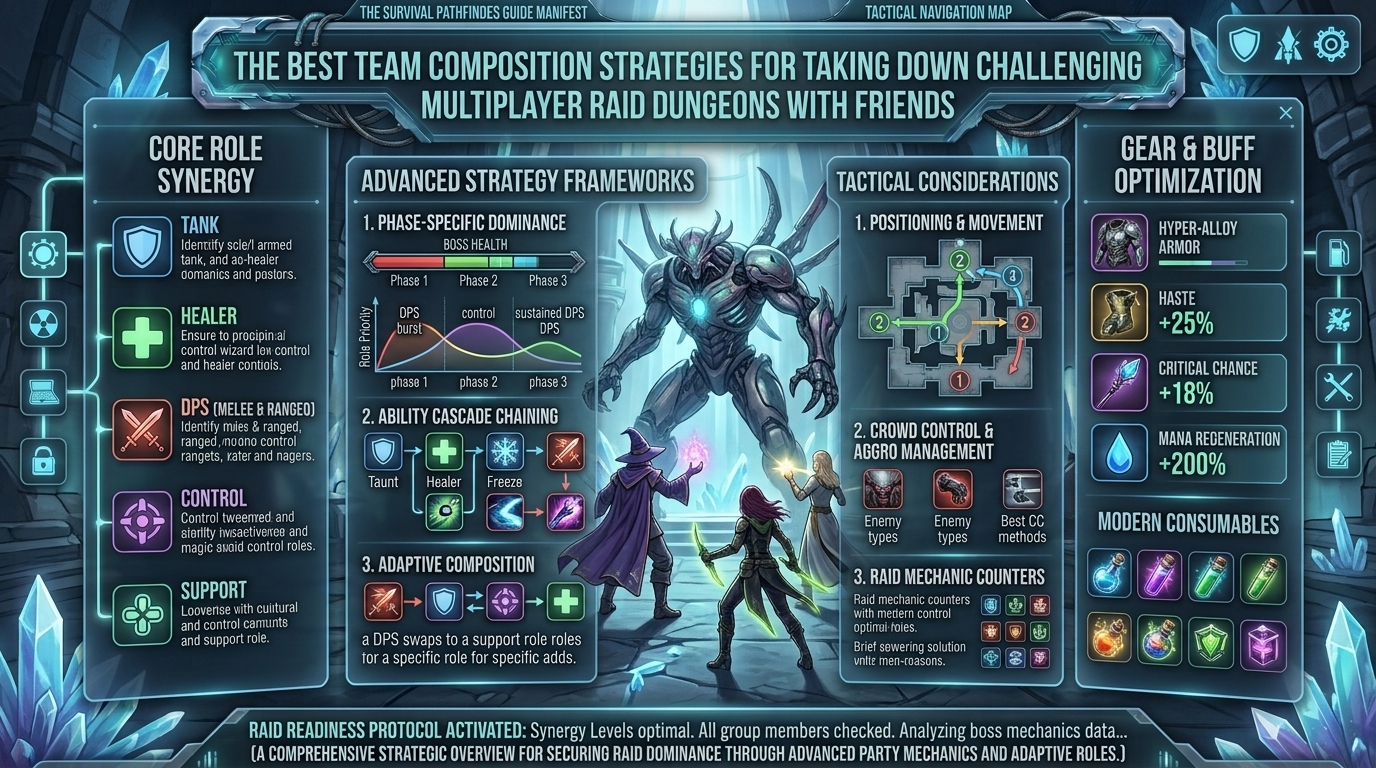
At the core of almost every successful multiplayer raid dungeon lies the classic Holy Trinity framework. While modern game designs occasionally experiment with hyper-offensive, role-agnostic comps, structured dungeon design heavily rewards a balanced distribution of core responsibilities.
The Breakdown of Core Responsibilities
- The Anchor (Main Tank): Responsible for manipulating boss positioning, managing aggro tables (threat generation), and soaking devastating single-target tank-buster mechanics. A good tank minimizes boss movement so that stationary DPS classes can channel maximum output.
- The Lifeblood (Healers & Support): Tasked with counteracting raid-wide environmental damage, dispensing targeted spot-healing during critical phases, and providing vital defensive/offensive buffs (such as damage reduction, haste, or resource regeneration).
- The Engine (Damage Dealers / DPS): Divided into burst damage, sustained damage, single-target specialists, and target-swapping trash clearers. Their primary objective is pushing damage phases quickly to skip lethal boss mechanics.
2. Advanced Synergy Frameworks: Buff Stacking and Debuff Windows
Elite raid groups do not just bring high individual damage numbers; they engineer multiplier buckets through coordinated class stacking.
Key Synergy Concepts to Implement:
- Armor Shred and Vulnerability Windows: Always ensure your composition features at least one class capable of applying major armor reduction or damage amplification debuffs. Aligning high-burst cooldowns with a synchronized debuff window multiplies overall team output exponentially.
- Resource and Mana Batteries: Long raid encounters inevitably lead to resource starvation. Including specs that restore energy, mana, or cooldown speeds to nearby teammates keeps your damage dealers cycling rotations without awkward downtime.
- Aura and Passive Layering: Stack physical-oriented support buffers in physical-heavy sub-groups, and magic-scaling amplifiers with caster-heavy setups to maximize passive yield.
3. Designing for Encounters: Fixed vs. Flex Compositions
When building a static roster for your regular gaming group, flexibility is your greatest asset. Boss encounters generally fall into three distinct tactical archetypes:
| Boss Encounter Type | Primary Team Focus | Recommended Composition Adjustments |
| Single-Target DPS Check | Pure output velocity, high boss uptime | Lean heavy into sustained DPS classes; minimize unnecessary utility. |
| Add-Heavy / Swarm Control | Area-of-Effect (AoE) disruption, crowd control | Include hybrid specs with strong cleave, target pulling, and root utilities. |
| Mechanic-Heavy Endurance | Mobility, active mitigation, complex movement | Balance ranged vs. melee ratios to ensure seamless platform execution. |
4. Communication and Callout Hierarchies
Even the most mathematically optimized team composition will wipe repeatedly if communication is cluttered. Establishing a clean Command Structure before pulling the boss is critical:
- The Raid Leader (Shot Caller): Usually played by the main tank or a veteran support player, this person dictates overall strategy, positioning shifts, and burn phases.
- The Utility Lead: Coordinates interrupt rotations, cleansing schedules, and defensive cooldown spacing for raid-wide wipe mechanics.
- Clear Radio Discipline: Keep non-essential chatter to absolute zero during high-intensity burn windows. Clean audio channels save lives.
10 Frequently Asked Questions (FAQ)
1. Is a balanced Holy Trinity team required for every game?
Not always. Some action RPGs or hybrid titles allow full-DPS or self-sustaining builds to clear content, but structured endgame raid dungeons almost always require dedicated threat management and healing support.
2. How many tanks should we run in a standard raid group?
For standard 5-player dungeons, you need 1 tank. For larger 8-to-10-player raids, 2 tanks are standard (one active boss tank and one off-tank for mechanics or add management).
3. What is a “DPS Check” and how do we beat it?
A DPS check is a mechanic where the boss enrages or wipes the party if its health pool is not depleted within a specific timer. Beat it by dumping all offensive cooldowns simultaneously during designated vulnerability phases.
4. Should we stack duplicate classes or maintain class diversity?
While stacking multiple copies of the absolute strongest meta class can maximize raw output, maintaining reasonable diversity prevents gear distribution bottlenecks and ensures you have access to diverse utility kits.
5. How important is positioning during raid boss encounters?
Critical. Poor positioning can cleave the entire melee group, pull boss frontal cones toward ranged players, or drag the boss out of ground-targeted damage zones.
6. What causes most endgame raid wipes?
Greed. Players trying to squeeze in “one more cast” instead of respecting mechanics, dodging lethal floor indicators, or executing necessary target switches account for the vast majority of wipes.
7. How do we fix low healing output during sustained raid fights?
Check your healers’ stat priorities (such as haste, critical strike, or spirit regeneration) and ensure utility cooldowns like barrier shields and damage reduction circles are being rotated sequentially rather than overlapping.
8. Are ranged DPS safer to run than melee DPS?
Ranged DPS generally have an easier time maintaining uptime while dodging ground hazards, but melee classes frequently possess superior burst potential and crucial interrupt toolkits. Balance is key.
9. How should we handle loot distribution among friends?
Establish a fair loot philosophy early—whether rolling main-spec over off-spec, utilizing a point system, or rotating drops transparently to prevent burnout and friction within the group.
10. Where can I find more raid guides and advanced strategies?
Keep checking back right here at The Gamer Buzz for comprehensive dungeon walkthroughs, boss breakdown guides, and cutting-edge meta analysis!
Conclusion
Conquering challenging multiplayer raid dungeons with friends is one of the most rewarding experiences in gaming. By mastering the fundamental trinity roles, engineering intelligent buff-and-debuff synergies, and maintaining clean communication protocols, your group will transform from a casual squad into a well-oiled progression machine. Form your squad, study the mechanics, and go claim those world-first victories!
Leave a Reply