Welcome to The Gamer Buzz, your ultimate competitive performance nexus. Whether you are grinding competitive ladders from the high-paced esports hubs of San Francisco and New York, dialing in your hardware setups across Texas and California, or tuning your gear in Washington, mastering precision mechanics is the ultimate pathway to climbing ranks.
In tactical first-person shooter (FPS) games—such as Counter-Strike 2, Valorant, Rainbow Six Siege, or hardscaped tactical tactical shooters—raw mechanical execution separates casual players from elite competitors. While in-game deathmatch servers help, dedicated aim trainers (like KovaaK’s, Aimlabs, or Aimbeast) offer surgical, isolated environments designed to fast-track your muscle memory.
In this exhaustive, master-level guide, we break down the definitive routines, sensitivity metrics, tracking techniques, and training frameworks required to permanently elevate your aim and tracking accuracy.
1. The Mechanics of Aim: Flicking vs. Tracking vs. Target Switching
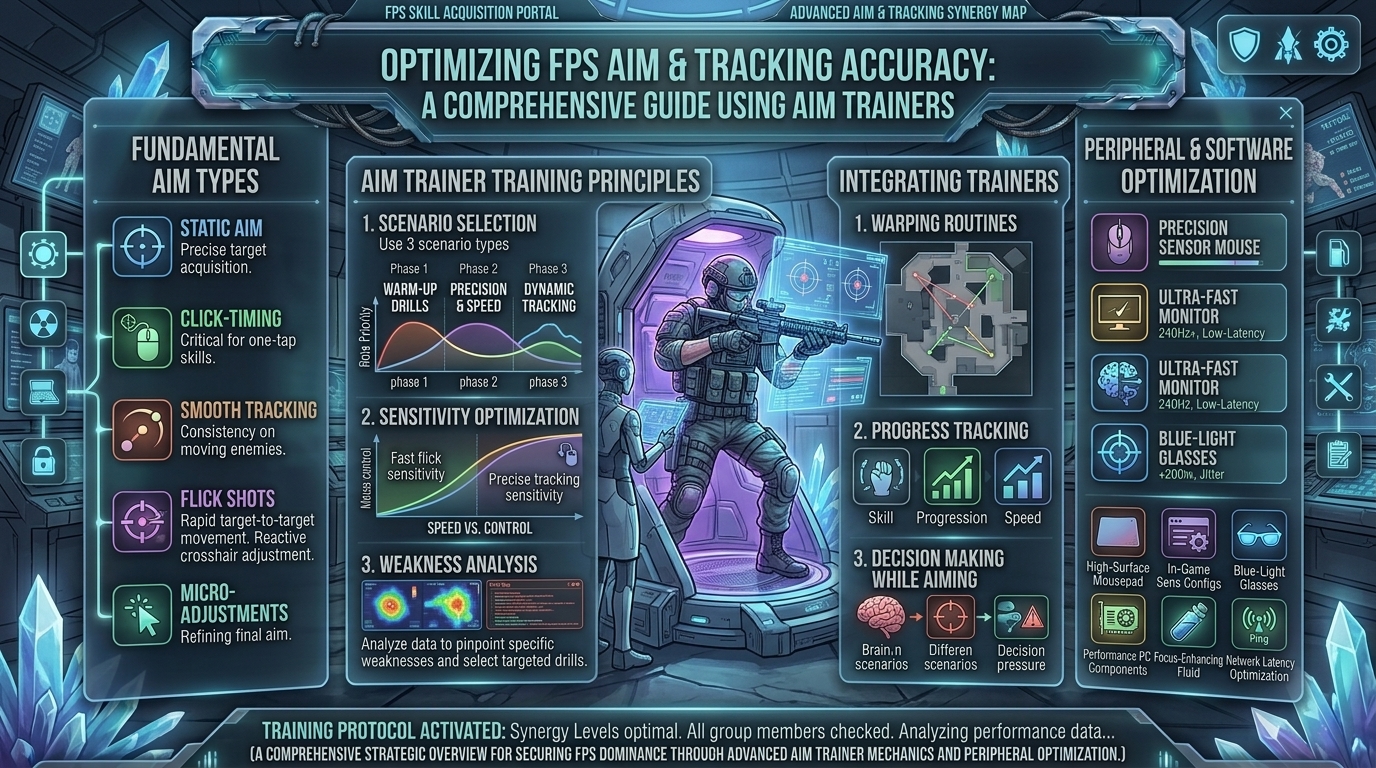
Before jumping into a training routine, you must understand the three fundamental pillars of mouse control. Different tactical scenarios demand distinct physical mechanics:
- Flicking (Ballistic Aim): Rapidly transitioning your crosshair from point A to point B in a straight line. Essential for holding angles, reacting to unexpected peeks, and executing fast entry frags.
- Tracking (Smooth Pursuit): Keeping your crosshair locked onto a moving target at a consistent speed. Crucial for tracking targets strafing across open corridors or dealing with movement abilities.
- Target Switching: Fluidly shifting your crosshair from one eliminated target to the next. Vital for multi-kill spray transfers and dealing with chaotic multi-opponent engagements.
In tactical shooters, smooth tracking combined with precise first-bullet accuracy dictates your win rate in dual-gunfights.
2. Optimizing Your Hardware and Sensitivity Baseline
You cannot build consistent muscle memory on an unstable foundation. Before opening an aim trainer, audit your physical gaming environment:
The Golden Rule of Sensitivity: eDPI
Your effective DPI (eDPI)—calculated as your Mouse DPI multiplied by your In-Game Sensitivity—determines your rotational arc.
- Tactical Shooter Standard: Most elite tactical FPS pros run a low-to-medium eDPI (equivalent to roughly 200 to 400 DPI with a 1.5 to 3.0 in-game sensitivity in games like Valorant).
- The Arm vs. Wrist Debate: Low sensitivities force you to use your entire forearm for large sweeps and your wrist/fingers for micro-adjustments. This minimizes erratic shaking during high-stress gunfights.
Ergonomics and Gear Checklist
- Mousepad Real Estate: Use a large desk-mat style mousepad (at least 450mm x 400mm) to allow unobstructed arm movement.
- Posture: Sit with your elbow at a 90-degree angle, resting your forearm comfortably on the desk surface without pinching your wrist nerve.
3. Designing an Effective Daily Aim Training Routine
Aim training is like going to the gym; mindless repetition leads to plateauing or injury (wrist fatigue). Structure your 30-to-45-minute daily routine using this proven framework:
[Phase 1: Warm-Up & Micro-Adjustments] ➔ [Phase 2: Fluid Tracking] ➔ [Phase 3: Dynamic Flicking] ➔ [Phase 4: In-Game Transfer]
Phase 1: Warm-Up and Micro-Adjustments (5–10 Minutes)
- Focus on slow, deliberate crosshair placement. Do not rush.
- Use static grid scenarios to practice stopping your crosshair on target without over-flicking (overshooting).
Phase 2: Smooth Tracking Mastery (10–15 Minutes)
- Select reactive tracking and smooth tracking scenarios (e.g., Pasu, Cataic Teleport, or Smoothbot routines).
- Focus on keeping your crosshair glued to the center of the moving target rather than aggressively twitching back and forth.
Phase 3: Dynamic Flicking and Speed (10 Minutes)
- Integrate scenarios featuring targets that change direction or spawn unpredictably.
- Push your speed threshold until you miss roughly 20% of your shots, then dial back slightly to maintain control.
Phase 4: In-Game Transfer (5 Minutes)
- Jump immediately into a deathmatch or unrated match in your primary tactical shooter to apply your fresh muscle memory to actual geometry, recoil patterns, and head-height crosshair placement.
4. Common Aim Training Mistakes to Avoid
Even dedicated players often stunt their growth by falling into bad habits inside aim trainers:
- The “Score-Chasing” Trap: Constantly grinding the exact same easy scenario just to see a high score on a leaderboard does not build functional skill. Challenge your weaknesses.
- Ignoring Crosshair Placement: In tactical shooters, holding crosshairs at head height and anticipating enemy angles beats raw flick speed 90% of the time. Combine aim training with map awareness.
- Tensing the Wrist and Arm: Keeping your hand rigid restricts micro-adjustments. Stay loose, breathe evenly, and initiate movements smoothly.
5. Tailoring Aim Workouts for Specific Tactical Shooters
| Game Genre / Title | Primary Aim Focus | Recommended Training Task Types |
| Tactical Snipers / Hold Angles | First-bullet accuracy, crosshair stability | Static clicking, micro-adjustments, target acquisition |
| Movement-Heavy Shooters | Vertical tracking, rapid target switching | Reactive tracking, bounce tracking, multi-target switches |
| Recoil-Based Control | Smooth horizontal tracking, pacing | Static control grids, sustained tracking runs |
10 Frequently Asked Questions (FAQ)
1. Which aim trainer is better: Aimlabs or KovaaK’s?
Both are exceptional tools. Aimlabs is free and features robust analytics and data breakdown, while KovaaK’s is renowned for its vast community-created scenario workshop and fine-tuned physics engine. Choose the one that fits your workflow.
2. How many hours a day should I spend in an aim trainer?
For optimal improvement without burning out your wrist, 30 to 45 minutes a day before your regular gaming session is more than enough. Consistency beats marathon sessions.
3. Will aim training instantly make me a rank-one player in tactical shooters?
No. Aim is only one pillar of tactical FPS success. Game sense, positioning, economy management, utility usage, and team communication account for the rest of your performance.
4. Should I change my sensitivity between games and aim trainers?
Never. Always match your exact eDPI across your aim trainer and your primary tactical shooter to ensure true 1:1 muscle memory transfer.
5. Why does my hand hurt after aim training?
Hand or wrist pain is a sign of excessive tension or poor posture. Stop immediately, stretch your wrists, lower your grip intensity, and ensure your arm rests naturally on your desk.
6. Is it normal for my accuracy to feel worse immediately after training?
Yes! Sometimes your hand experiences temporary fatigue right after a rigorous training routine. Give your muscles a 10-minute break before jumping into ranked matches.
7. How long does it take to see noticeable improvements in-game?
With a disciplined, structured daily routine, most players notice a tangible improvement in their confidence, crosshair stability, and duel win-rates within 2 to 4 weeks.
8. What is “smoothness” in tracking and why does it matter?
Smoothness refers to eliminating jittery, micro-corrections when following a moving target. High smoothness results in consistent damage output and prevents missed shots during chaotic strafe battles.
9. Should I use visual effects or custom crosshairs in aim trainers?
Keep your visual settings clean and distraction-free. Use a simple, high-visibility crosshair (like a small cyan or green dot/cross) that mirrors what you use in your main games.
10. Where can I find advanced daily playlists and benchmark routines?
Check out community-driven benchmark routines like the Voltaic or RiddBott playlists, and bookmark The Gamer Buzz for more expert guides, hardware breakdowns, and competitive tips!
Conclusion
Improving your aim and tracking accuracy in tactical first-person shooters is a marathon, not a sprint. By optimizing your physical setup, maintaining a disciplined daily routine across dedicated aim trainers, and balancing your raw mechanics with tactical game sense, you will shatter your previous performance ceilings. Lock in your sensitivity, fire up your training playlist, and start dominating those competitive lobbies!
Leave a Reply