Welcome to The Gamer Buzz, your ultimate competitive performance and mindset hub. Whether you are grinding ranked ladders from high-pressure servers in San Francisco, New York, and Seattle, or tightening your execution across Texas, California, and Washington, every competitive gamer shares a universal enemy.
That enemy isn’t the enemy team’s smurf, bad hit registration, or awkward map architecture. It is tilt—and the toxic teammates who trigger it.
In competitive multiplayer titles (such as Counter-Strike 2, Valorant, League of Legends, Apex Legends, and Overwatch 2), solo-queuing is a psychological lottery. You will encounter griefers, keyboard warriors, mic-spammers, and people who give up after losing the pistol round. If you lack the mental armor to handle them, toxicity acts like a virus, dragging your personal performance down right along with theirs.
In this exhaustive, master-level guide, we break down the neuro-psychology of tilt, the mechanics of emotional containment, step-by-step de-escalation tactics, and the framework required to protect your mental focus and climb the ranked ladder.
1. The Psychology of Tilt: What Happens to Your Brain Under Stress
Before you can fight tilt, you need to understand what it actually is. Coined originally from poker, tilt describes a state of mental or emotional frustration where a player adopts suboptimal strategies, acts aggressively, and experiences a steep drop in cognitive control.
The Arousal-Performance Curve
In sports psychology, the Yerkes-Dodson Law dictates a curvilinear relationship between arousal (stress) and performance.
- A mild amount of stress keeps you alert, focused, and reacting quickly.
- However, when a toxic teammate starts screaming, insulting your family, or throwing rounds, your stress crosses the tipping point. Your heart rate spikes, your breathing becomes shallow, your muscles tense up, and your brain’s prefrontal cortex (responsible for tactical decision-making and spatial awareness) effectively short-circuits.
You stop thinking about map control, crosshair placement, or win conditions. Instead, your internal monologue shifts entirely to anger, revenge, and self-doubt. When you tilt, you are essentially playing handicapped.
2. The 3-Tier Tilt Management Framework
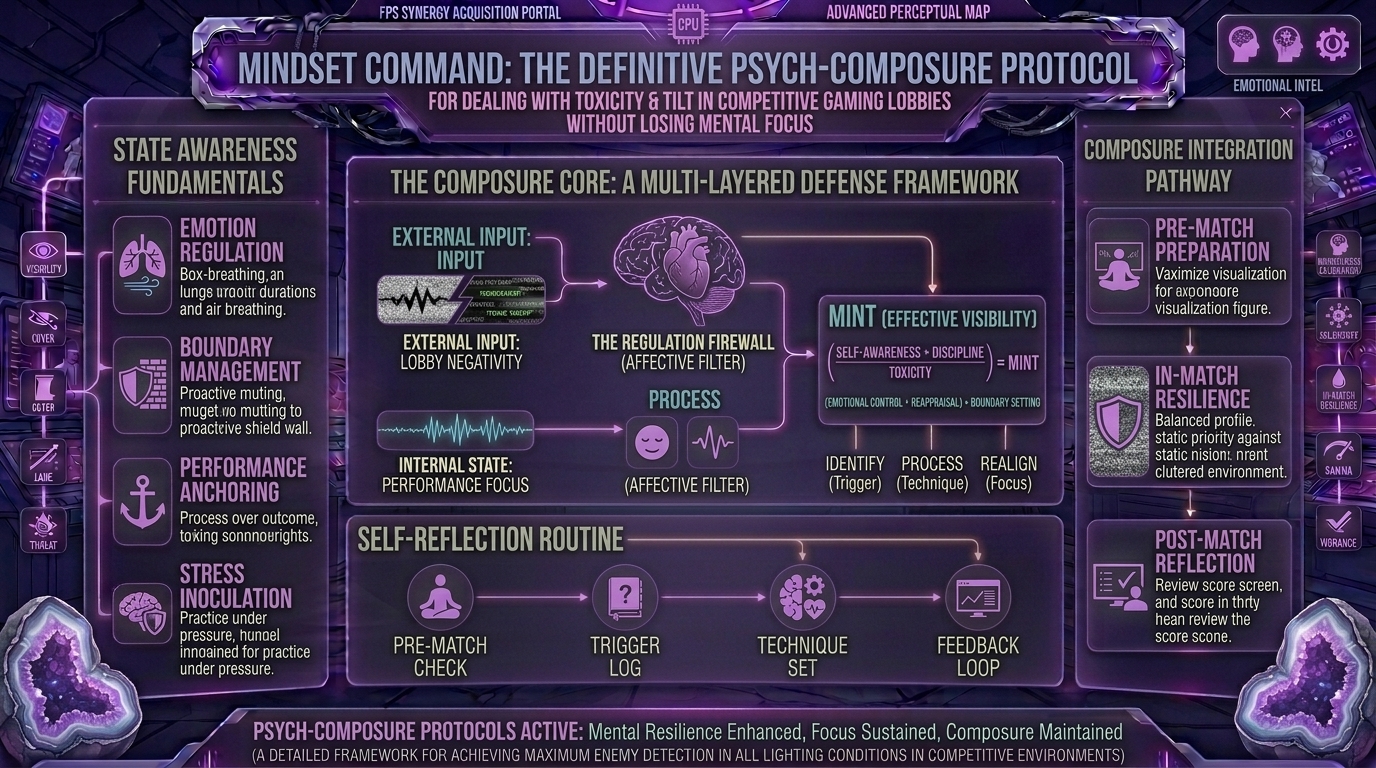
Mastering your mental game requires an active defense system. Elite esports competitors rely on a structured, three-tiered framework to catch and kill tilt before it snowballs.
[Tier 1: Early Detection] ➔ [Tier 2: Immediate Containment] ➔ [Tier 3: The Hard Reset Protocol]
Tier 1: Early Physical Detection
Your body will always recognize tilt before your conscious mind admits it. Watch out for these warning signs:
- A sudden tightening or “death-grip” on your mouse.
- Hunched shoulders or stiffened wrists.
- Sighing heavily or feeling a sudden surge of heat in your chest.
- The urge to type an angry response back into chat.
Tier 2: Immediate Containment (The Non-Engagement Rule)
The number one law of surviving a toxic lobby is simple: Do not feed the fire.
- Toxic players thrive on validation and reactions. If you type a paragraph defending yourself or scream back over voice comms, you have handed them total control over your emotional state.
- The Mute Button is a Weapon: The second someone proves they are more interested in venting than winning, mute their text and voice channels instantly. Every second you spend listening to a toxic player complain is processing power stolen from your mini-map awareness.
Tier 3: The Hard Reset Protocol (Between Rounds)
If a round goes disastrously wrong because of teammate mistakes, use a physical micro-reset:
- Take your hands completely off your mouse and keyboard for 3 seconds.
- Take a deep, deliberate breath in through your nose for 4 seconds, and exhale slowly through your mouth.
- Say a short internal trigger phrase to anchor yourself back to reality, such as: “Reset. Next play. Focus on my own game.”
3. Advanced Tactical Strategies for De-Escalating Lobbies
Sometimes, a teammate isn’t a lost cause—they are just frustrated, having a rough day, or misinterpreting the game state. If you want to pull a lobby back from the brink of collapse, deploy these psychological tactics:
- Kill ‘Em with Neutral Data: If a teammate starts yelling about how everyone else is trash, do not argue about their skill level. Respond with flat, objective tactical data to redirect their attention: “We have site control, let’s just group up for the trade”.
- Acknowledge Good Plays: Even if someone is obnoxious, if they clutch a round or secure a clean entry frag, drop a brief “nice shot”. Positive reinforcement can instantly disarm defensive players and turn a toxic teammate into a cooperative asset.
- Protect the Silent Majority: In almost every toxic lobby, 1 or 2 players are screaming while the other 2 or 3 are sitting in silence, miserable and scared to use their mics. By keeping your comms calm, clear, and positive, you create a safe space for the quiet players to re-engage.
4. Setting Session Boundaries: The 2-Loss Rule
No matter how mentally strong you are, accumulated fatigue and persistent bad luck will eventually wear you down. Setting structural boundaries prevents a single tilt-heavy session from destroying your overall rank progress.
| Boundary Strategy | Rule Parameters | Purpose / Benefit |
| The Two-Loss Rule | If you lose 2 consecutive matches due to griefers or heavy tilt, stop queuing immediately. | Prevents emotional carryover (“revenge queueing”) into your next match. |
| The 5-Minute Reset | Take a mandatory 5-minute break between every match to stand up, stretch, and drink water. | Flushes out adrenaline residue and physical muscle tension. |
| The Daily Cap | Set a hard limit on ranked matches per day (e.g., max 4 to 5 intense matches). | Protects your overall cognitive sharpness and prevents burnout. |
10 Frequently Asked Questions (FAQ)
1. What is the single best thing to do when a teammate starts screaming in voice chat?
Mute them immediately. Do not waste energy trying to reason with an irate stranger; your priority is preserving your own mental clarity and auditory focus.
2. Is it ever worth arguing back to prove I am right?
Never. Even if you are match-MVP and your teammate is playing terribly, arguing back destroys team synergy, ensures nobody makes useful callouts, and guarantees a loss.
3. How do I stop letting a loss ruin my mood for the rest of the day?
Practice the 5-Minute Rule. Once you close the game, walk away from your desk, do something physical (like making tea or stretching), and consciously separate your self-worth from your digital ranking icon.
4. What causes some players to become toxic instantly?
Most toxic players are projecting their own insecurity, performance anxiety, or frustration from previous losses. Recognizing that their outbursts are about them—not you—makes it much easier to ignore.
5. Should I report toxic players if it feels like nothing happens?
Always report them. Even if automated systems don’t instantly ban them, filing a report fulfills a psychological need for justice, helping you process your frustration and move on cleanly.
6. How can I stay calm when I am personally playing badly?
Accept that variance and bad games happen to everyone, including esports professionals. Focus entirely on utility usage and supporting your teammates rather than forcing flashy hero plays to fix your score.
7. Does playing with a duo partner help reduce tilt?
Massively. Having a calm, trusted friend in your voice party isolates you from the erratic mood swings of random solo-queue teammates and keeps morale grounded.
8. How do I recover my confidence after a massive losing streak?
Take a 24-hour break from ranked modes. Play a casual game mode, watch a replay to analyze structural mistakes objectively, or focus purely on mechanical aim training without rank pressure.
9. What is “queue anxiety” and how do I beat it?
Queue anxiety is the fear of losing rank. Combat it by shifting your mental focus away from your rank icon and onto personal improvement goals (e.g., “In this match, I am going to focus entirely on positioning cleanly”).
10. Where can I find more mental training guides and competitive tips?
Bookmark The Gamer Buzz and check back regularly for our comprehensive database of competitive psychology articles, hardware breakdowns, and rank-up strategy guides!
Conclusion
Toxicity and tilt are inevitable constants in ranked competitive gaming, but letting them dictate your performance is entirely optional. By understanding the neuroscience of stress, establishing a rigid 3-tier tilt management protocol, protecting your focus with the mute button, and setting strict session boundaries, you take total control of your competitive destiny. Guard your mental space, stay level-headed, and climb those ranks with absolute confidence!
Leave a Reply