Welcome to The Gamer Buzz, your ultimate competitive performance authority. Whether you are grinding ranked matches from high-performance gaming rigs in San Francisco, New York, and Seattle, or locking down tactical lobbies across Texas, California, and Washington, you have undoubtedly run into that one hyper-aggressive enemy player.
You know the type: they sprint around corners, shoulder-peek with lightning speed, and instantly melt you before your brain even registers that they are on your screen. You feel like you never even had a chance to react.
In competitive multiplayer titles (such as Counter-Strike 2, Valorant, Rainbow Six Siege, and Apex Legends), 50/50 gunfights against aggressive players are won long before the first bullet leaves your barrel. They are won through spatial geometry, elite peek mechanics, and pixel-perfect crosshair placement.
In this exhaustive, master-level guide, we break down the physics of peeker’s advantage, the anatomy of proper clearing techniques, and step-by-step strategies to turn those terrifying 50/50 duels into consistent wins.
1. The Physics of Combat: Understanding Peeker’s Advantage
Why does it always feel like an enemy pushing around a corner sees you a fraction of a second before you see them? The answer lies in network code and human response loops, commonly known as peeker’s advantage.
Network Latency and Interpolation
- The Data Journey: When a stationary player holds an angle, their client sends their position to the server, and the server relays it to the moving enemy. When an attacker swings around a corner, their movement inputs hit the server before the server has time to update the stationary defender’s screen.
- The Time Delta: This creates a temporal window of roughly 50 to 150 milliseconds where the attacker sees the defender before the defender sees the attacker on their monitor.
- The Fix: Because you cannot completely eliminate network delay, you must adapt your defensive and offensive positioning so that peeker’s advantage works for you—or cannot hurt you. Never hug a wall tightly when holding an angle; stand further back to leverage perspective geometry.
2. The Core Anatomy of Elite Crosshair Placement
If you find yourself constantly flicking wildly across your mousepad to hit enemies, your baseline habits are broken. Crosshair placement is the art of eliminating the need to flick.
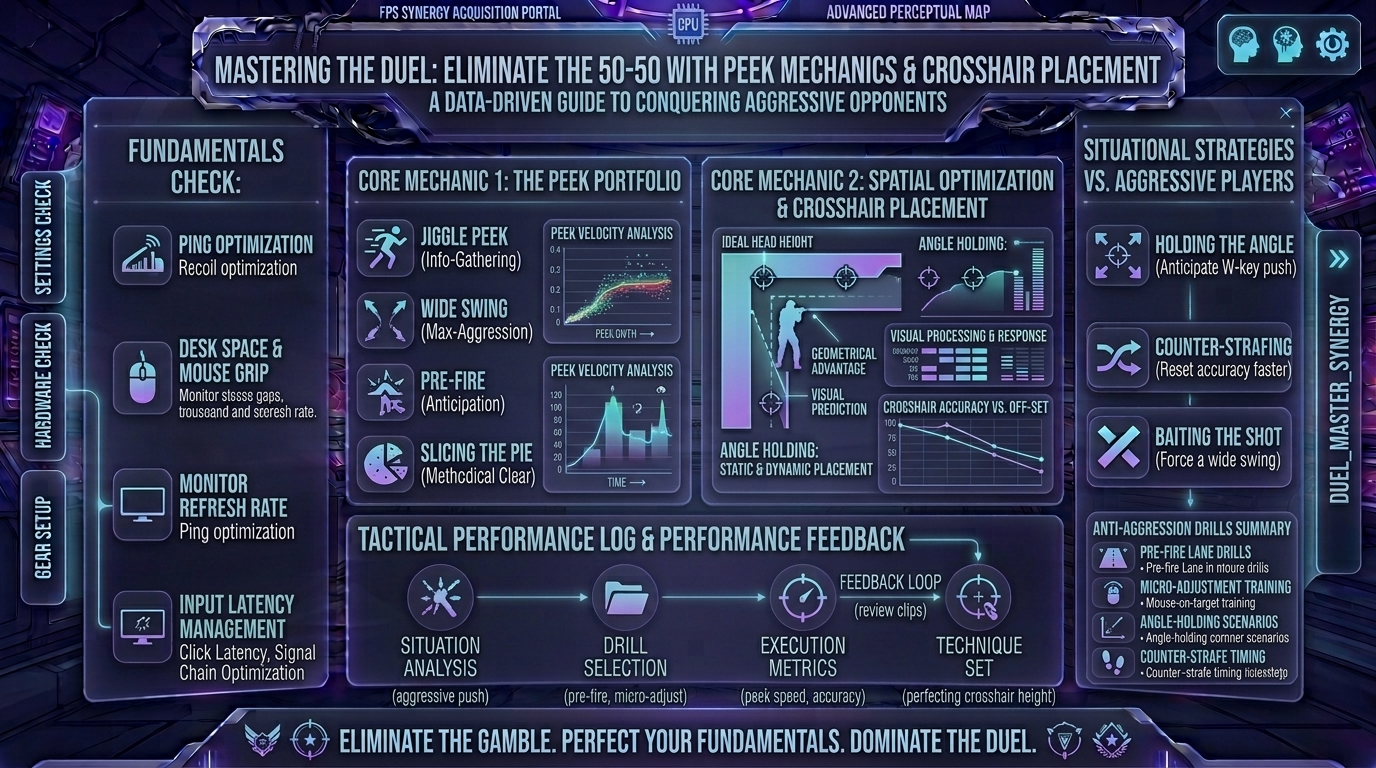
[Default Head-Height Discipline] ➔ [Pre-Aiming Common Angles] ➔ [Clearing Slices of Geometry]
1. Head-Height Discipline
- Most players keep their crosshairs drifting toward the floor or mid-torso while running across the map. This forces a vertical mouse movement every time an enemy appears, wasting critical milliseconds.
- The Rule: Keep your crosshair locked permanently at estimated enemy head height, accounting for steps, ramps, and elevated platforms. Make it a subconscious habit.
2. Pre-Aiming Map Geometry
- Never look at an open expanse of a wall when clearing a corner. Trace your crosshair along the exact edge of the wall, doorframe, or box where an enemy’s head is statistically likely to appear. When you clear a room, your crosshair should “sweep” the geometry dynamically.
3. Mastering Advanced Peek Mechanics
Different situations demand different peeking tools. Relying exclusively on a wide, clumsy run around a corner makes you an easy target for an angle-holder. Master these four fundamental peek types:
1. The Info / Shoulder Peek (Baiting Shots)
- How to execute: Tap your movement keys to flash just your shoulder or arm past the corner edge for a fraction of a second, then immediately counter-strafe back into cover.
- Purpose: To bait an enemy sniper or rifle-holder into wasting a shot or revealing their exact position without risking your life.
2. The Wide Swing (Punishing Passive Holders)
- How to execute: A swift, uninterrupted movement across a wide arc past a doorway or corner, keeping your momentum high.
- Purpose: Used when you know an enemy is holding a tight, static angle. By swinging wide, you break their crosshair placement expectation, forcing them to adjust their aim rapidly while you shoot while stable.
3. The Jiggle Peek (Clearing Information Safely)
- How to execute: Rapidly tapping A-D-A-D (or left-right movement keys) back and forth across a threshold without fully committing your body.
- Purpose: Gathers spatial intel on multiple enemy positions without allowing opponents time to lock onto your hitbox.
4. The Dead-Stop Counter-Strafe
- How to execute: Moving in one direction, tapping the opposite movement key for a single frame to cancel your velocity entirely, and firing a clean 1-to-3 bullet burst at the exact moment of absolute stillness.
4. Comprehensive Matrix: Choosing the Right Peek for Every Scenario
| Scenario / Threat | Optimal Peek Technique | Key Tactical Objective |
| Suspected Enemy Sniper Holding Lane | Shoulder Peek / Jiggle Peek | Force a missed shot; gather visual confirmation. |
| Close-Quarters Room Entry | Slicing the Pie (Step-by-Step Clearing) | Isolate individual angles one micro-slice at a time. |
| Pushing a Passive Defending Anchor | Wide Swing Momentum Peek | Overwhelm their reaction time and break pre-aim alignment. |
| Retaking a Site with Multiple Angles | Utility-Backed Flash Peek | Blind or displace defenders before exposing your hitbox. |
5. Common Mistakes That Cost 50/50 Duels
- Moving While Shooting: Firing your weapon while your movement keys are still depressed introduces extreme bullet spread randomness. Always ensure your counter-strafe stop is absolute before pulling the trigger.
- Crouch-Spamming Out of Panic: Pressing the crouch button the millisecond you see an enemy locks your movement speed to zero and lowers your head directly into their pre-aimed crosshair height, turning you into a stationary target.
- Staring at Your Crosshair Instead of the Target: Focus your visual attention on the enemy player model, using your peripheral vision to guide your crosshair placement rather than staring blankly at the center dot of your screen.
10 Frequently Asked Questions (FAQ)
1. What is the absolute best sensitivity for mastering crosshair placement?
A medium-to-low sensitivity range (allowing roughly a 360-degree rotation across your entire mousepad) gives you the fine motor control required for precise micro-adjustments and head-height tracking.
2. Why do I get killed instantly even when I feel like I reacted first?
This is typically due to peeker’s advantage combined with delayed server registration. If you were holding a static angle right against a wall, the aggressor saw you before your screen updated.
3. How do I practice counter-strafing effectively?
Spend 10 minutes daily in a deathmatch or custom practice map focusing purely on the rhythm of tapping A, stopping, firing one bullet, and tapping D.
4. Is crouching ever a good idea during a duel?
Crouch-peeking can occasionally throw off an enemy’s initial headshot crosshair, but it should be used sparingly as a situational mix-up, not a default habit.
5. How can I stop myself from panicking and flinching during gunfights?
Focus on your breathing and treat individual gunfights as mechanical execution drills rather than high-stakes emotional moments. Desensitize yourself by playing more deathmatches.
6. What does “slicing the pie” mean in tactical shooters?
It is a corner-clearing technique where you walk in a wide arc around a doorway, opening up tiny “slices” of the room sequentially so you only expose yourself to one angle at a time.
7. Should I use dynamic crosshairs or static crosshairs?
Always use a static crosshair. Dynamic crosshairs expand and contract based on movement, creating visual clutter and distracting your eye focus during frantic gunfights.
8. How do I win 50/50 duels against players with much faster reaction times?
By relying on positioning and pre-aiming. If your crosshair is already resting on the exact pixel where their head must appear, you don’t need a fast reaction time—you just click.
9. Why does my aim feel shaky when peeking aggressive players?
Tension in your hand and wrist causes micro-jitters. Relax your grip on your mouse, keep your forearm loose, and focus on smooth, controlled momentum.
10. Where can I find more advanced combat and mechanic guides?
Bookmark The Gamer Buzz and check back regularly for our comprehensive database of professional esports guides, hardware tips, and competitive tactical breakdowns!
Conclusion
Mastering peek mechanics and crosshair placement turns you from a reactive target into an aggressive, calculated threat in 50/50 competitive duels. By understanding peeker’s advantage, maintaining strict head-height crosshair discipline, utilizing intelligent shoulder and wide swings, and eliminating panicked movement, you will dominate your ranked lobbies. Step into your next match with confidence, lock your crosshair on target, and climb the competitive ladder!
Leave a Reply