Welcome to The Gamer Buzz—your ultimate source for elite performance guides, deep-dive game mechanics, and advanced combat optimizations, proudly serving gaming communities from New York and San Francisco to Texas, Washington, and California.
Whether you are stepping foot into Lordran, the Lands Between, Krat, or brand-new dark fantasy realms, nothing defines a playthrough quite like the raw, satisfying crunch of a high-damage melee build. While magic spam and ranged exploits have their place, mastering close-quarters combat is the true crucible of any Soulslike action RPG.
However, modern Soulslikes and action RPGs with deep progression systems rarely just hand you massive damage numbers. You have to sculpt them. From choosing the correct core attributes and unlocking passive skill tree nodes to mapping out scaling soft-caps and stacking counter-hit multipliers, optimizing a melee build requires precision.
This comprehensive, expert-backed guide covers everything you need to know to build the ultimate melee powerhouse, maximize your damage output, and flatten bosses in seconds.
1. Understanding the Anatomy of Melee Damage Scaling
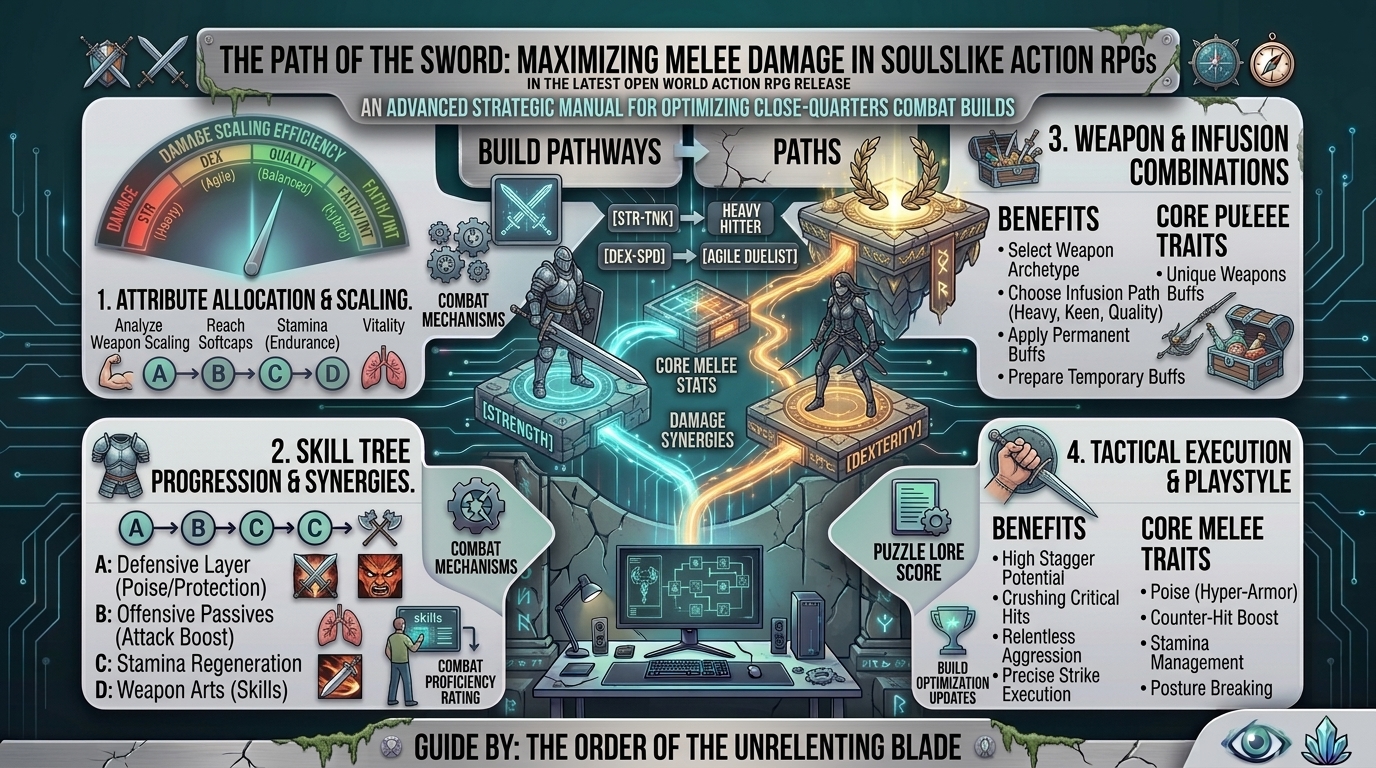
To build a character that hits like a freight train, you must first understand how damage is calculated beneath the hood of most action RPGs.
- Base Weapon Damage vs. Scaling (Letter Grades): Weapons possess a flat base damage value, which is then multiplied by your character’s attributes (Strength, Dexterity, or specialized stats like Blood/Arcane) using scaling grades ranging from S (highest) to E (lowest).
- Soft-Caps and Hard-Caps: Pumping a single stat indefinitely yields diminishing returns. Most games feature strict soft-caps (typically around the 40, 60, or 80 attribute thresholds). Knowing where your weapon’s scaling plateaus prevents you from wasting precious skill points.
- Motion Values (MVs): Different attacks within a weapon’s move set (e.g., a heavy jump attack vs. a light running poke) carry different motion values. Maximizing melee damage isn’t just about stats; it’s about chaining attacks that exploit high MVs.
2. Choosing Your Archetype: Strength vs. Dexterity vs. Quality
When building out your skill tree or stat allocation path, you generally choose one of three primary melee routes:
The Pure Strength Juggernaut (Colossal & Heavy Weapons)
- Playstyle: High risk, high reward. Slow wind-ups paired with devastating stagger damage and posture breaks.
- Stat Priority: Strength (STR), Vigor (HP), and Endurance (Stamina/Equip Load).
- Why It Maximizes Damage: Strength builds often benefit from a 1.5x multiplier when two-handing a weapon, effectively allowing you to bypass high stat requirements early and hit maximum damage soft-caps much faster than other builds.
The Agile Dexterity Blademaster (Fast & Fluid Weapons)
- Playstyle: Hit-and-run tactics, rapid multi-hit combos, status effect stacking (Bleed, Poison, Frost), and critical ripostes.
- Stat Priority: Dexterity (DEX), Endurance, and Vigor.
- Why It Maximizes Damage: While individual strikes deal less raw burst damage than a colossal hammer, DEX weapons excel at proccing status ailments that chunk massive percentages of a boss’s health bar.
The Quality / Hybrid Build (Versatility)
- Playstyle: Spreading stats evenly between Strength and Dexterity to wield a massive array of standard weaponry.
- Stat Priority: Balanced STR and DEX.
- Why It Maximizes Damage: Best utilized in mid-to-late game cycles when your character level is high enough to push both offensive attributes past their primary soft-caps.
3. Essential Skill Tree Nodes and Passive Perks to Prioritize
If the action RPG features a dedicated talent grid, constellation, or passive skill tree (such as those found in modern hybrid titles), prioritize nodes that feed directly into offensive loops:
- Stagger/Posture Damage Boosters: In modern Soulslike titles, breaking an enemy’s posture opens them up for critical ripostes that often out-damage standard combos threefold. Prioritize nodes that increase poise-breaking capabilities.
- Stamina Regeneration & Cost Reduction: Melee combat relies entirely on your stamina bar. Talents that accelerate stamina recovery or reduce attack stamina costs allow you to squeeze in an extra swing before dodging.
- Counter-Hit / Momentum Multipliers: Look for passive skills that grant temporary damage buffs upon successfully landing consecutive hits, dodging an attack at the last frame, or executing a successful parry/deflect.
4. Summary Table: Melee Build Archetypes Compared
| Build Archetype | Primary Stat | Best Weapon Class | Strengths | Weaknesses |
| Strength (STR) | Strength | Greatswords, Hammers, Colossal Swords | Massive stagger potential, high burst damage, two-hand stat bonus. | Slow attack animations, vulnerable recovery frames. |
| Dexterity (DEX) | Dexterity | Katanas, Curved Swords, Daggers | Fast recovery, excellent status affliction scaling (Bleed), high DPS windows. | Lower per-hit stagger; struggles against heavy armor. |
| Quality | Balanced STR/DEX | Straight Swords, Halberds, Greatspears | Access to the widest weapon pool in the game. | Stat-starved in early game; weaker until high levels. |
| Status / Bleed Hybrid | DEX / Arcane | Twinblades, Blood-infused Katana | Devastating percentage-based health chunking on bosses. | Ineffective against enemies immune to status effects. |
5. Pro Tips for Maximizing Melee DPS in Combat
- Master Animation Canceling and Buffs: Always apply weapon greases, resins, or spell buffs before entering a boss arena. Utilizing consumable attack-boosting items (like high-tier physical damage flasks or blood pellets) multiplies your base output.
- Leverage Charged Heavy Attacks: Many players fall into the trap of spamming light attacks. Fully charged heavy attacks carry immense motion values and break boss stances exponentially faster.
- Optimize Your Talisman / Ring Loadout: Never run a purely defensive gear setup. Equip damage-amplifying rings such as those that boost attack power with consecutive hits, increase damage when health is full, or enhance counter-attack windows.
6. Frequently Asked Questions (FAQ)
1. What is the single best stat to level first for melee damage?
Vigor and weapon upgrade levels. Early on, upgrading your weapon at a blacksmith yields vastly higher damage returns than pouring points into scaling stats before your weapon has decent scaling letters.
2. Is Strength better than Dexterity in Soulslike games?
Neither is objectively better; Strength offers higher burst stagger and single-hit damage, while Dexterity offers faster attack speeds and status-effect utility.
3. How do weapon infusions or elements affect physical melee builds?
Infusing a weapon with magic or elemental damage splits your attack rating (AR). Unless you are heavily investing in intelligence or faith, standard physical infusions coupled with physical buffs usually yield superior damage against armored late-game bosses.
4. Why does two-handing a weapon increase my damage?
Two-handing a weapon in most action RPGs applies a 1.5x virtual multiplier to your Strength stat, allowing you to hit higher damage thresholds and stagger enemies much more easily.
5. What are soft-caps, and why do they matter?
Soft-caps are specific attribute levels where the damage return per point invested drops significantly. Pumping a stat past its soft-cap is inefficient compared to leveling Vigor or Endurance.
6. Do status effects like Bleed scale with my melee stats?
Yes. In many titles, status buildup scales directly with specialized attributes like Arcane or Dexterity, making hybrid melee-status builds exceptionally powerful.
7. How do I break boss postures faster with melee attacks?
Use heavy jump attacks, charged heavy strikes, and weapons belonging to heavy hammer or colossal sword classes, which inherently deal high poise damage.
8. Should I focus on heavy armor or light roll mobility for melee builds?
Maintaining a medium or light roll is generally recommended to ensure dodge iframe windows remain optimal, though certain heavy armor builds rely on high poise to trade blows.
9. Can I respec my stats if I mess up my melee build?
Most modern Soulslike action RPGs feature a respec mechanic that allows you to reallocate your attribute points using a rare in-game currency item.
10. What is the most common mistake players make with melee builds?
Neglecting Vigor (health). Trying to build a “glass cannon” melee character usually results in constant deaths because close-quarters combat requires absorbing occasional mistakes.
7. Conclusion
Maximizing your melee damage in Soulslike action RPGs is a science that blends smart attribute allocation, passive skill tree synergies, weapon upgrade management, and aggressive combat execution. By focusing on your weapon scaling, mastering heavy strike motion values, and keeping your survivability high, you can transform your character into an unstoppable force of nature.
Leave a Reply