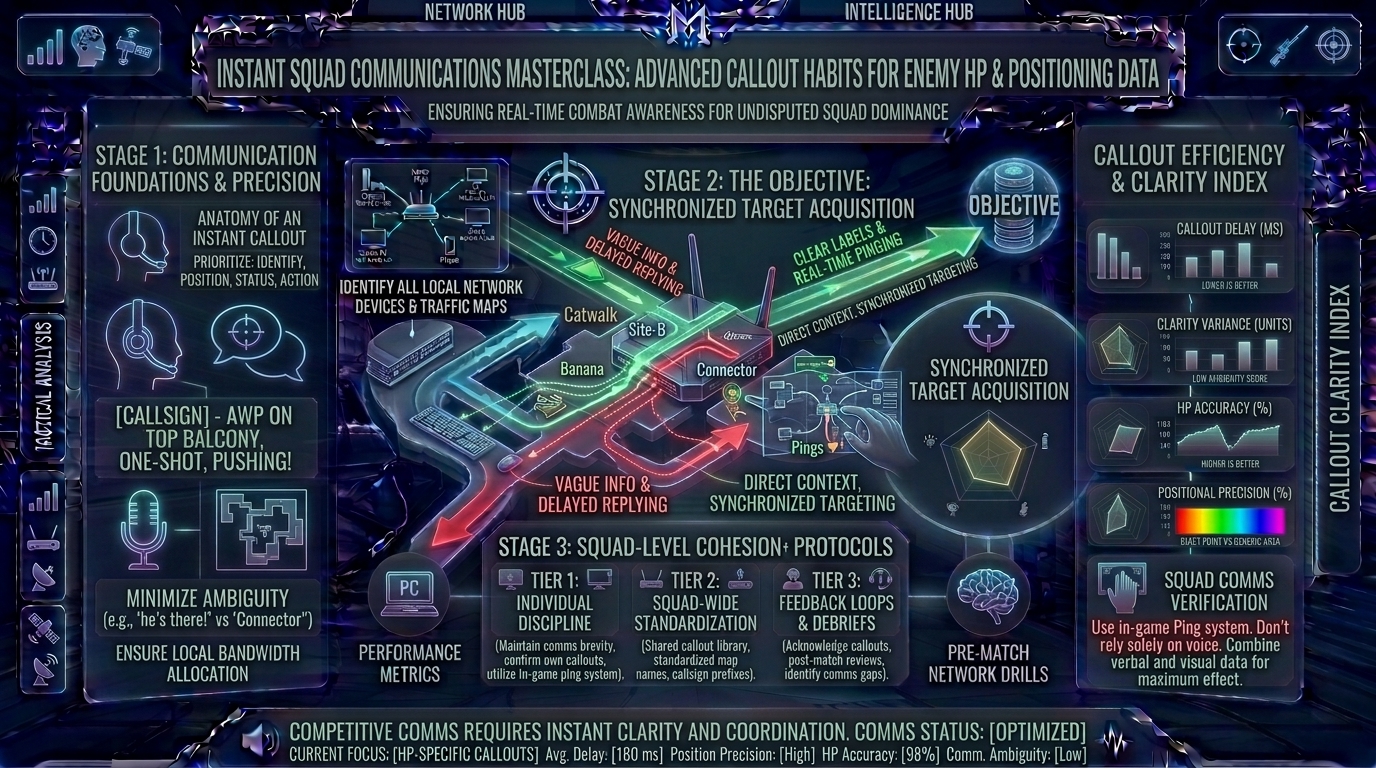
Welcome to The Gamer Buzz, your definitive competitive performance and tactical intelligence authority. Whether you are orchestrating team callouts from high-rise tech setups in San Francisco, New York, and Seattle, or coordinating tactical squad plays across competitive servers in Texas, California, and Washington, one absolute truth rules multiplayer gaming: information is worth more than raw mechanical aim.
Picture this scenario: You engage an enemy player in a chaotic hallway, crack their armor down to a sliver of health, and get traded out. You scream into your microphone, “He’s right there! He’s right there!” Your surviving teammate rounds the corner completely blind, gets caught off guard by a full-health opponent holding an angle, and your team loses the round.
Bad communication is just as destructive as having terrible aim. In fast-paced competitive titles (Counter-Strike 2, Valorant, Apex Legends, Call of Duty, Rainbow Six Siege), split-second information sharing separates winning squads from uncoordinated chaos. Mastering elite callout habits means transforming your voice comms into a crisp, military-grade radar system for your team. In this exhaustive, master-level guide, we break down cognitive load management, the anatomy of a perfect callout, directional terminology, and step-by-step habits to turn your squad into a synchronized unit.
1. The Psychology of Comms: Why Vague Callouts Destroy Rounds
Before looking at specific mapping terminology, you must understand how the human brain processes auditory information under high-stress conditions.
The Trap of Emotional Comms
- The Panic Reaction: When surprised by an enemy, untrained players default to emotional expressions: gasping, yelling curses, or shouting vague descriptors like “He’s low!”, “He’s shooting at me!”, or “Look out!”.
- The Cognitive Bottleneck: These emotional outbursts force your teammates to waste precious cognitive bandwidth trying to decode what you mean, rather than focusing on their own crosshair placement and survival. A clean callout must eliminate ambiguity instantly.
2. The 4-Stage Anatomy of a Perfect Callout
Every elite competitive callout follows a strict, standardized formula. Think of it as a data packet that your squad’s brains process automatically.
[Stage 1: Quantity / Identity] ➔ [Stage 2: Exact Location / Landmark] ➔ [Stage 3: Movement Vector] ➔ [Stage 4: Exact Health / Status]
Stage 1: Quantity or Target Identity
- Always start your call with how many enemies you are looking at, or who they are. Saying “Two pushing long” or “It’s the enemy Cypher” immediately tells your team the scale of the threat.
Stage 2: Location (Using Standardized Map Landmarks)
- Never use relative or subjective directions from your own POV (like “to my left” or “behind that box”), because your teammates are looking in entirely different directions. Use agreed-upon map callout names (Heaven, Arch, Generator, CT, Mid Doors).
Stage 3: Movement Vector (What Are They Doing?)
- Inform your team of their trajectory. Are they standing still holding an angle, sprinting aggressively, planting the objective, or rotating away? Verbs create temporal context.
Stage 4: Precise Health or Resource Status
- This is where rounds are won. Never just say “He’s low.” Give an exact numerical metric or concrete percentage if possible: “He’s tagged for 140” or “He has no shields left.”
3. Comprehensive Matrix: Bad Comms vs. Elite Competitive Callouts
| Game Situation | Bad / Casual Comms (Avoid) | Elite Pro Callout Habit | Competitive Benefit |
| Spotted Enemy | “He’s right there! Shoot him!” | “One enemy, cat walk, moving toward B-site.” | Instantly directs teammates’ crosshairs to the exact map location. |
| Damaged Enemy | “He’s super low! One-shot!” | “Phoenix tagged for 135, white health, default box.” | Eliminates guessing; lets teammate know if body shots will secure the kill. |
| Dying / Post-Death | “Omg wallhack! This game is trash!” | “Dead. Looking from Heaven, holding a sniper.” | Leaves audio channels completely clear for surviving players to hear footsteps. |
| Utility Incoming | “Watch out, grenade!” | “Flashbang landing default garage in 2 seconds.” | Gives teammates precise timing to look away or reposition. |
4. Advanced Squad Habits: Keeping Audio Channels Clean
- The Dead Silence Rule: The moment your health drops to zero and you enter spectate mode, your microphone etiquette changes entirely. Stop giving backseat tactical directions. Your voice channel belongs exclusively to the surviving player so they can hear audio cues like enemy footsteps, reloads, and plant sounds.
- The Ping + Voice Synergy: Never rely on voice alone. Combine a crisp verbal call with an active, middle-mouse map ping. Visual indicators cut through linguistic confusion, language barriers, and background noise instantly.
10 Frequently Asked Questions (FAQ)
1. What is the single most important habit for better in-game communication?
Conciseness. Keep every callout under three seconds. Strip away filler words like “uh,” “I think,” “maybe,” and “like.” Deliver raw, actionable data immediately.
2. How do I stop panicking and shouting when surprised by an enemy?
Practice deliberate breath control during gunfights. Train your brain to view a sudden enemy encounter as an information-gathering event rather than a life-or-death crisis. Speak in a calm, flat, analytical tone.
3. Should I use relative directions (left/right) if playing with close friends?
Even with close friends, relative terms fail the moment your team splits up or looks in opposite directions. Always anchor your callouts to permanent map landmarks or compass headings.
4. How can I learn standard map callout names quickly?
Spend 10 minutes in a custom server or check online map strategy diagrams before playing a new map. Many games display official zone names in the bottom corner of the HUD whenever you walk into a new sector—pay attention to them!
5. What should I do if a teammate constantly clogs voice comms with toxicity?
Mute them immediately without arguing. Protecting your team’s auditory focus and mental state is vastly superior to listening to someone complain about past rounds.
6. Is it better to call out damage numerical values or general status?
Numerical values are always superior. Saying “Tagged for 120” gives your team objective data. Saying “He’s weak” is subjective; to one player, 50 health feels strong, while to another, it feels weak.
7. How do I communicate effectively if I don’t have a working microphone?
Rely heavily on the game’s in-game ping wheel, radial communication menus, and text quick-chat bindings. Pair your pings with team movements so they understand your strategic intent.
8. Why is “dead silence” so crucial in clutch situations?
In competitive audio engines, ambient footsteps and subtle reloads play at low decibel levels. If dead teammates are talking or breathing heavily into their mics, the clutch player cannot hear critical audio queues.
9. How do I handle teammates who refuse to listen to callouts?
Lead by example. Continue giving clean, objective callouts even if they ignore them. Over the course of a match, disciplined communication often rubs off on random teammates.
10. Where can I find more team strategy and communication guides?
Bookmark The Gamer Buzz and check back regularly for our comprehensive database of professional esports guides, tactical map breakdowns, and competitive rank-up tips!
Conclusion
Mastering communication callout habits is the ultimate force multiplier for any competitive squad. By replacing emotional outbursts and vague descriptions with structured, concise data packets detailing quantity, location, movement, and exact health status, you empower your teammates to make lightning-fast, confident decisions. Clean up your comms, protect your audio channels, and call your squad straight to victory in every ranked lobby!
Leave a Reply