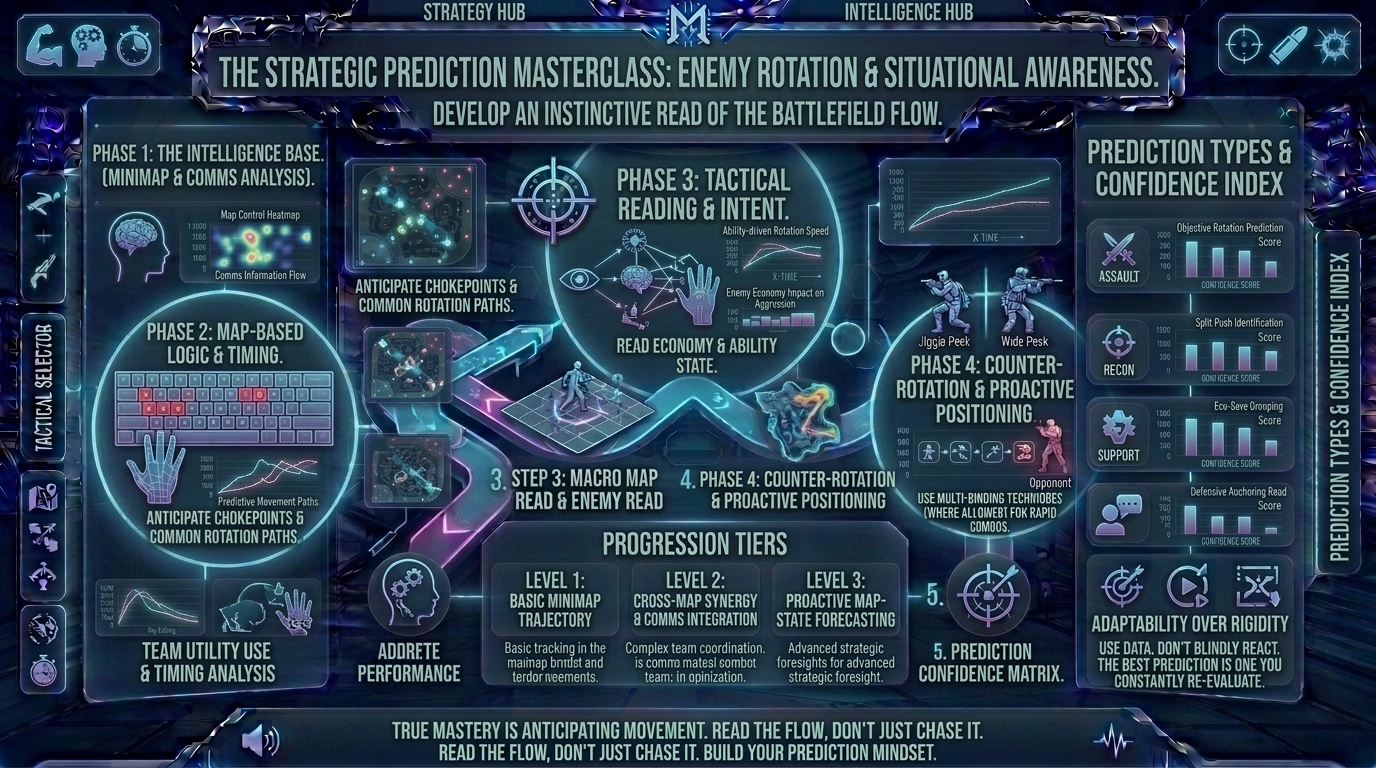
What Are the Best Game Sense and Situational Awareness Tips to Predict Enemy Rotation Movements Across the Map
Welcome to The Gamer Buzz, your premier competitive strategy and tactical intelligence hub. Whether you are calling out strategic rotations for your squad in high-stakes lobbies across San Francisco, New York, and Seattle, or grinding through competitive ranked ladders in Texas, California, and Washington, one reality separates immortal-tier players from the rest: the ability to see the future.
When you watch a professional esports player, it often looks like they possess psychic powers. They seem to effortlessly pre-aim a corner right as an enemy runs into it, or rotate to an empty bomb site seconds before a full-scale offensive push lands. They aren’t psychic. They have mastered game sense and situational awareness.
Predicting enemy rotation movements is the ultimate competitive skill. It turns chaotic, reactive gameplay into proactive domination. In this exhaustive, master-level guide, we break down map timers, audio cues, elimination tracking, and psychological trigger points to help you read enemy rotations like an open book.
1. The Foundation of Game Sense: Information Processing vs. Tunnel Vision
To predict where your opponents are going, you must first understand how they gather information and make decisions.
[Information Gathering (Sound/Visual)] ➔ [Clock & Timer Calculation] ➔ [Elimination Math] ➔ [Anticipatory Rotation]
The Tunnel Vision Trap
- The Average Player: Focuses exclusively on the 2-inch crosshair box in the center of their screen. They react only when an enemy appears directly in their line of sight. By the time they react, they are already caught off-guard by a flanking rotation.
- The Elite Player: Maintains a continuous mental map of the entire battlefield. They process mini-map blips, subtle audio footprints, and utility timing simultaneously while keeping their crosshair disciplined.
- The Rule of Active Awareness: Game sense is not an innate talent; it is the habit of constantly asking three questions: Where was the enemy last seen? How much time is left on the clock? What options do they have left?
2. The 4 Pillars of Predicting Enemy Rotations
To consistently forecast enemy movements across any tactical multiplayer map (Counter-Strike 2, Valorant, Rainbow Six Siege, etc.), anchor your decisions to these four concrete pillars:
Pillar 1: Map Timers and Movement Distance Mathematics
Every map has fixed physical dimensions. It takes a specific, measurable number of seconds for an unencumbered player to run from one end of the map to another.
- The Rotation Clock: Memorize baseline transit times. If an enemy is spotted defaulting on Site A at 1:30 on the game clock, and your team secures an early entry kill on Site B at 1:15, calculate how long it takes for the remaining A-site defenders to sprint or rotate through connectors to assist.
- The Blind Window: Once you know the travel time, you can identify exact “blind windows” where rotating enemies are caught out in the open with their knives out, completely vulnerable to an ambush.
Pillar 2: Reading the Mini-Map and Elimination Feed
Your UI is your primary radar system. Most players glance at the kill feed only to see who died, but elite players read the sequence of eliminations.
- The Absence of Evidence is Evidence: If three rounds in a row the enemy team heavily contests mid-map control, and suddenly a round begins where mid is completely silent and devoid of utility, do not assume they are playing passive. They have likely stacked a bomb site or executed a silent rotation to the opposite side of the map. Use early map information to call an immediate counter-rotation.
Pillar 3: Audio Forensics (Beyond Footsteps)
Sound travels through walls, ceilings, and corridors, carrying rich operational data long before an enemy model ever comes into view.
- Utility Cues: Listen for specific ability deployments, decoy grenades, fake flashes, or weapon switches. Attackers often throw smoke screens or execute noisy distractions on one side of the map specifically to mask the heavy rotation of their primary playmakers crawling toward the opposite site.
- The Echo Principle: Learn the unique surface acoustic signatures of every map (metal grates, wood planks, concrete tile). Knowing where a footstep echoes allows you to instantly map an enemy’s exact corridor path.
Pillar 4: Economic and Round-State Psychology
An enemy team’s financial state dictates their strategic behavior.
- Eco-Round Rushes: If the enemy team is on an economic eco-round with limited funds, they cannot afford a slow, methodical default setup because they will lose a long-range gunfight. Expect a fast, coordinated 5-man rush down a single choke point. Knowing this allows you to pre-rotate your team and stack heavy utility before the round even starts.
3. Comprehensive Matrix: Game State Cues vs. Predicted Enemy Actions
| Game State Trigger | Observable Cue / Symptom | Predicted Enemy Rotation / Move |
| Early Pick on Site A | First blood secured on A defender within 15 seconds. | Attackers will pivot heavily toward Site B or turtle into a slow map default. |
| Heavy Utility Dump on Mid | Multiple smokes and flashes dropped simultaneously mid. | Fake execution or setup for a rapid split-push through connectors. |
| Total Silence on Map | Zero sound or utility for 30+ seconds mid-round. | Silent defensive stacking or repositioning for a late-round flank. |
| Enemy Eco Round | Low-tier weapons purchased; no utility displayed early. | Aggressive, fast-paced rushing or coordinate shotgun/SMG stacking in tight corners. |
4. Advanced Tactical Practice: How to Build Game Sense
Game sense cannot be taught purely through theory; it must be forged through deliberate self-reflection and match review.
- The Death Autopsy: Every time you die in a ranked match, do not immediately blame your teammate or your aim. Ask yourself: “What map information was available to me 10 seconds before I died? Did my mini-map show an open lane that I ignored?” Pinpoint the exact information cue you missed.
- Demo Reviewing (The God’s Eye View): Once a week, watch one of your competitive match replays from the enemy team’s perspective. Seeing how easily they read your team’s predictable habits, slow rotations, and common holding angles will permanently alter how you approach positioning in future matches.
10 Frequently Asked Questions (FAQ)
1. What is the difference between aim skill and game sense?
Aim skill dictates how quickly and accurately you can click on an enemy’s head when you see them. Game sense dictates where your crosshair is already pointing before the enemy even rounds the corner. Game sense wins rounds when aim is failing.
2. How can I improve my mini-map awareness without losing gunfights?
Build a rhythm of glancing at your mini-map for a split second every time you reload or finish clearing a corner. Never look at the map while actively holding an open angle where an enemy might peek.
3. Why do I always seem to guess the wrong bomb site when rotating?
You are likely reacting too late—moving only after you physically see the bomb or enemy players. True game sense requires you to rotate based on early indicator clues (utility dumps, missing defenders, and sound cues) before the enemy commits.
4. How do map layouts affect rotation speed timings?
Some maps feature open, direct layouts with fast connectors (allowing 5-second rotations), while others feature labyrinthine corridors that require 15 to 20 seconds to cross. Memorizing these layout choke points is essential for timing your counter-rotations.
5. Can I predict enemy rotations better if my team has no communication?
Yes. Even if your teammates refuse to speak in voice chat, their bodies, deaths, and radar pings on the map act as telemetry data. Watch where your solo queue teammates die to deduce where the enemy concentration is shifting.
6. What should I do if the enemy team constantly fakes their rotations?
Against teams that love fake executions, hold your ground with discipline. Do not send all your defenders packing the moment you hear noise on the opposite site. Leave a reliable anchor behind with escape utility while the rest of the team edges closer to support without fully abandoning their post.
7. How does the game clock influence enemy decision-making?
As the round timer dips below 30 seconds, attacking teams experience acute urgency. They are forced to make high-risk plays, push through smokes, or commit to plant sites. Use this panic window to set up crossfires where desperate enemies run right into your pre-aimed crosshairs.
8. Does playing different roles (support vs. entry fragger) improve game sense?
Abso-lutely. Playing an entry fragger teaches you how defenders hold angles and rotate under pressure, while playing a supportive controller teaches you map-wide timing and resource management. Experiencing both roles rounds out your overall tactical awareness.
9. How do I stop second-guessing my rotations during a live match?
Trust your initial read based on concrete evidence (like sound or radar data). Second-guessing usually leads to getting caught moving out in the open halfway across the map. Commit to your read, position yourself safely, and gather updated info.
10. Where can I find more tactical strategy guides and map breakdowns?
Bookmark The Gamer Buzz and check back regularly for our comprehensive database of professional esports guides, map-control strategies, and advanced competitive rank-up tips!
Conclusion
Mastering game sense and situational awareness transforms you from a reactive target into an active chess master on the competitive battlefield. By tracking map timers, reading elimination feeds, listening to audio forensics, and analyzing round-state psychology, you can accurately predict enemy rotation movements before they even happen. Sharpen your tactical radar, trust your data reads, and outsmart your opponents in every single ranked lobby!
Leave a Reply