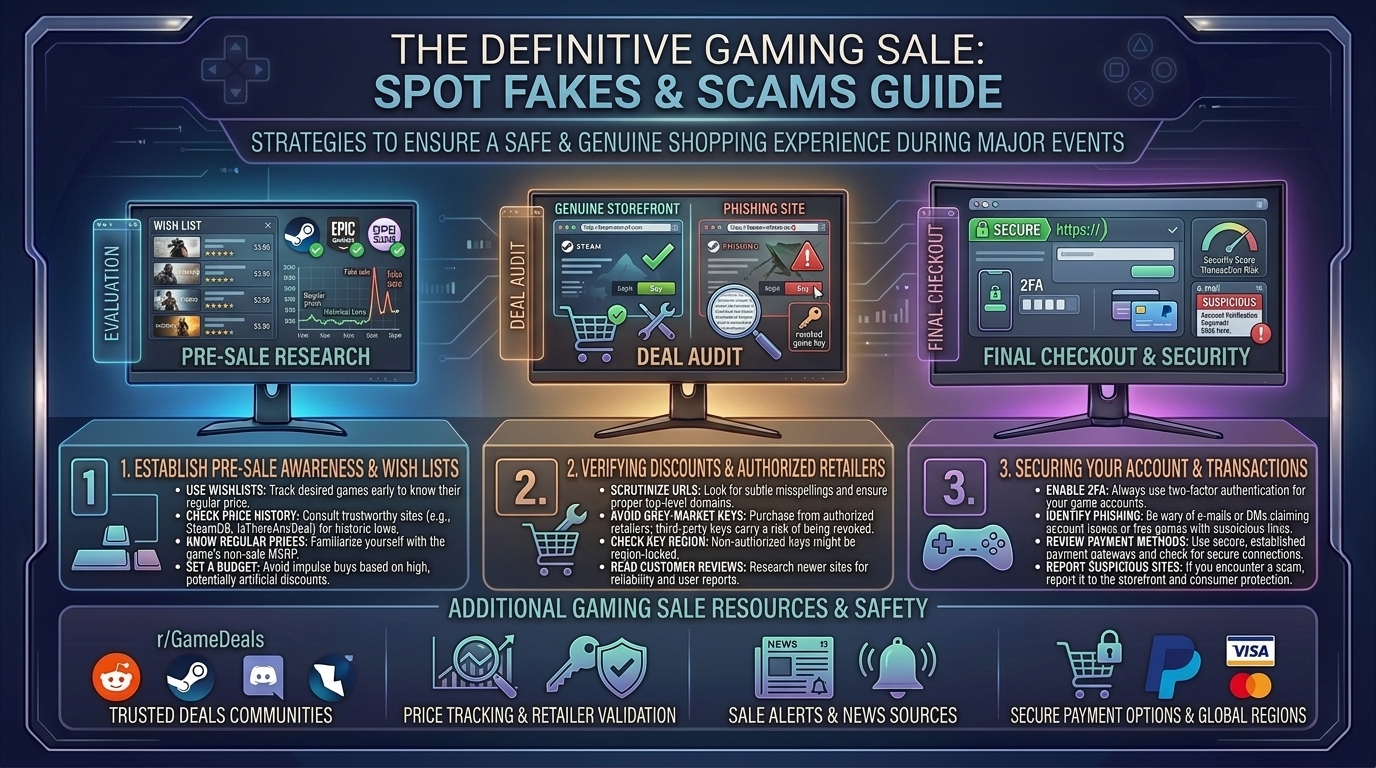
How to Spot Fake Discount Deals and Scams During Major Digital Storefront Seasonal Gaming Sales Events
Welcome to thegamerbuzz, your premier digital authority for gaming safety, hardware insights, consumer protection, and smart digital shopping. Whether you are hunting for holiday bargains late at night in a New York apartment, optimizing your gaming library from San Francisco, checking out flash sales in Texas and Washington, or managing your wishlist from sunny California, we know the rush of a massive seasonal digital storefront sale.
When major seasonal gaming sales roll around—such as the Steam Summer and Autumn Sales, the Epic Games Store Black Friday and Cyber Monday events, PlayStation Network promotions, or Nintendo eShop blowout events—millions of gamers flood online storefronts. Unfortunately, these high-traffic events also draw an influx of bad actors, deceptive marketing tactics, unauthorized grey-market key resellers, and outright phishing scams.
A “90% off” tag can easily blindside even veteran players, leading to wasted money, compromised accounts, or revoked game licenses. This master-level guide breaks down how to identify fake discounts, spot malicious storefront scams, and protect your digital wallet during major seasonal sales.
1. The Psychology of Digital FOMO and Fake Sales
Before looking at technical red flags, it helps to understand why digital sales are so psychologically powerful. Unlike physical retail where items run out of stock, digital goods (PC games, DLCs, microtransaction currency, and console keys) are infinitely reproducible.
Yet, digital storefronts weaponize Fear Of Missing Out (FOMO) using ticking countdown timers, “Flash Deal” banners, and crossed-out MSRP (Manufacturer’s Suggested Retail Price) tags. Shady third-party sites and deceptive marketplaces rely on this urgency to bypass your critical thinking, pushing you to buy before checking if the “discount” is real or entirely fabricated.
2. Common Deceptive Discount Tactics on Digital Storefronts
Not all fake deals are outright malware or stolen credit card scams; many rely on clever psychological manipulation that is technically legal but deeply anti-consumer.
1. The Inflated Base Price (Fake Anchor Pricing)
- The Trick: A shady third-party key seller or unauthorized marketplace will list an indie game with a fake “MSRP” of $59.99, then slap an 80% discount on it, selling it for $12.00. In reality, the game’s actual base price on official stores has always been $9.99.
- How to Spot It: Always cross-reference prices using historical price-tracking databases rather than trusting the discount percentage shown on a banner.
2. Selling Base Games Disguised as “Complete Editions”
- The Trick: During major sales, a publisher might discount a bundle. However, deceptive sites will list a bare-bones base game using promo art from the “Game of the Year” or “Ultimate Edition,” tricking you into thinking you are getting all expansions when you are only buying the vanilla version.
3. The “Bundle Padding” Illusion
- The Trick: Bundles that group a game you actually want alongside five critically panned, worthless shovelware titles. The seller claims you are saving 95% off the total value, but you are paying money for games you will never touch.
3. How to Identify Unsafe Third-Party Key Resellers and Phishing Scams
Official storefronts like Steam, Epic Games, GOG, Nintendo eShop, and PlayStation/Xbox stores are generally secure against direct financial theft, though they still feature the occasional inflated discount. The real danger zone lies in external key-reselling sites, social media ads, and phishing emails.
Red Flags of a Phishing or Scam Storefront:
- Imposter URLs: Watch out for slight typos in URLs (e.g.,
Stfampowered.comorEpic-Games-Deals-Portal.net). Always check for official domain extensions and active SSL security certificates. - Too-Good-To-Be-True Pre-Orders: If a brand-new, unreleased AAA game retailing officially for $70 is being sold on a third-party site for $15 during a “special pre-order seasonal event,” it is a scam. Either the key is stolen via fraudulent credit cards (which will later be revoked by the publisher, removing the game from your library), or the site will take your money and vanish.
- Suspicious Payment Methods: If a storefront demands payment exclusively via untraceable cryptocurrency, wire transfers, obscure gift card codes, or direct peer-to-peer money apps instead of standard encrypted credit card processing or PayPal, run away immediately.
4. Essential Tools to Verify Real Discounts
Never buy blindly. Keep these community-trusted tools bookmarked during every major seasonal sale:
- IsThereAnyDeal (ITAD): The gold standard for PC gamers. Paste any game title into ITAD to see its current price across all official, authorized storefronts, alongside its absolute historical low price. If a third-party store isn’t listed on ITAD, exercise extreme caution.
- SteamDB (Database): For Steam users, SteamDB tracks precise price histories, lowest recorded prices, bundle inclusions, and current player counts, ensuring you never fall for a fake discount tag.
- Official Publisher Sales Pages: When in doubt, check the official social media channels or website of the game’s publisher to confirm whether an authorized publisher-wide sale is actually happening.
5. Step-by-Step Defense Checklist During Major Sales
- Stick to Trusted Ecosystems: Whenever possible, buy directly through official first-party launchers and verified digital storefronts.
- Verify Authorized Retailers: If buying PC keys from a third-party store (like Humble Bundle, Fanatical, or Green Man Gaming), verify that they are listed on official publisher-approved retail partner lists.
- Check Refund Policies: Official stores like Steam and Epic Games offer no-questions-asked refund windows (typically under 2 hours of playtime and within 14 days). Grey-market key sellers almost never offer refunds once a digital key has been revealed.
- Enable Two-Factor Authentication (2FA): Protect your primary gaming accounts (Steam Guard, Epic Account, PlayStation Network, Nintendo Account) with 2FA so that even if a phishing link tricks you, hackers cannot steal your library or payment methods.
- Ignore Countdown Timer Panic: If a flash sale is ending in 3 minutes and you haven’t had time to verify if the discount is genuine, skip it. There will always be another seasonal sale around the corner.
6. Frequently Asked Questions (FAQ)
1. Are grey-market key reseller sites illegal?
Most key resellers operate in a legal gray area. While buying keys from them isn’t inherently illegal, many keys are acquired using stolen credit cards or exploited regional pricing loops. Publishers frequently revoke these keys, meaning you lose both the game and your money.
2. Why does Steam show a game as “on sale” for the exact same price it was last week?
This is a common marketing tactic known as “sale fatigue” or rolling baseline discounting. Storefronts keep games in a perpetual rotation of “sales” to maintain urgency, even though that price is essentially the game’s new normal value.
3. What should I do if I bought a key from a scam site and my game was revoked?
Contact your bank or credit card provider immediately to file a chargeback for fraudulent goods. Unfortunately, official platform support (like Steam or Epic) cannot restore revoked keys obtained from unauthorized third-party sellers.
4. How can I tell if a browser extension offering “automatic coupon codes” is safe?
Many aggressive coupon extensions scrape sketchy grey-market sites or inject affiliate tracking cookies. Stick to reputable, community-vetted extensions and avoid installing random extensions promising “99% off video games.”
5. Do console digital stores (PlayStation, Xbox, Nintendo) have fake discount problems?
Official console storefronts rarely feature fake discounts, but third-party physical gift card code sellers on sites like eBay or social media marketplaces are rife with scams. Never buy digital currency or game download codes from unverified individual sellers.
6. What is “Regional Pricing Exploitation” and why do keys get revoked?
Some bad actors buy game keys cheaply in low-income economic regions and resell them globally at a markup. Publishers actively track and ban keys activated outside their intended geographic region, leading to sudden game revocations.
7. Is it safe to click links to sales sent via Discord DMs or emails?
Never click direct links to sales from unsolicited Discord messages, random social media DMs, or unexpected emails—even if they look like they come from friends whose accounts may have been compromised by phishing bots. Always navigate to the store manually.
8. How often do major seasonal sales happen on digital platforms?
Major PC and console stores hold predictable massive sales at least four times a year (Spring, Summer, Autumn/Black Friday, and Winter/Holiday sales), alongside weekly and mid-week specials. You never need to rush out of fear that a sale is your “last chance.”
9. Can a game be free on one official store and a scam on another?
Yes! Scammers frequently create fake landing pages advertising popular free-to-play games (or games currently being given away for free by Epic Games) as paid “exclusive collector’s editions” to harvest credit card data from uninformed parents or casual shoppers.
10. Where is the safest place to report a suspected gaming scam website?
You can report fraudulent phishing sites to Google Safe Browsing, the Federal Trade Commission (FTC) in the US, or share warnings within community hubs like Reddit’s r/GameDeals, which actively maintains blacklists of unsafe vendors.
7. Conclusion
Navigating major digital storefront seasonal sales should be an exciting experience, not a minefield of financial anxiety. By looking past aggressive countdown timers, steering clear of unauthorized grey-market key sellers, utilizing historical price trackers like IsThereAnyDeal, and sticking to trusted platforms, you can build your dream digital library safely and affordably.
Shop smart, protect your credentials, and hunt down those genuine bargains like an elite gaming pro right here with thegamerbuzz!
Leave a Reply