Welcome to The Gamer Buzz, your premier competitive performance authority. Whether you are grinding competitive ladders from the gaming epicenters of San Francisco and New York, dialing in low-latency hardware setups across Texas and California, or tuning your frame pacing in Washington, mastering weapon mechanics is the definitive separator between average players and esports-tier competitors.
In tactical first-person shooters (such as Counter-Strike 2, Valorant, BattleBit, or realistic military sims), automatic assault rifles are the cornerstone of your team’s economy and firepower. However, unlike arcade shooters where bullets laser-beam straight forward, tactical shooters feature fixed, complex recoil patterns and randomized spread recovery.
If you do not master counter-strafing, recoil dampening, and spray compensation, your bullets will fly harmlessly over your opponent’s head past the fourth round. In this exhaustive, master-level guide, we break down the physics of gun kick, step-by-step muscle memory routines, weapon-specific spray management, and advanced training frameworks required to turn you into a laser-accurate rifle god.
1. The Anatomy of Gun Kick: Spread vs. Recoil vs. Recovery
To control a weapon, you first need to understand the invisible physics governing every single bullet leaving your barrel. Modern tactical shooters separate bullet deviation into three distinct pillars:
First-Shot Accuracy and Standing Spread
- The First-Bullet Infallibility: In tactical games, your very first shot when stationary and standing still has a near 100% chance of landing dead-center on your crosshair.
- Movement Penalty: The moment you move, jump, or fire while walking, spread expands exponentially. Counter-strafing (tapping the opposite movement key to instantly halt momentum) is mandatory before pulling the trigger.
Recoil Patterns (Pattern Memorization)
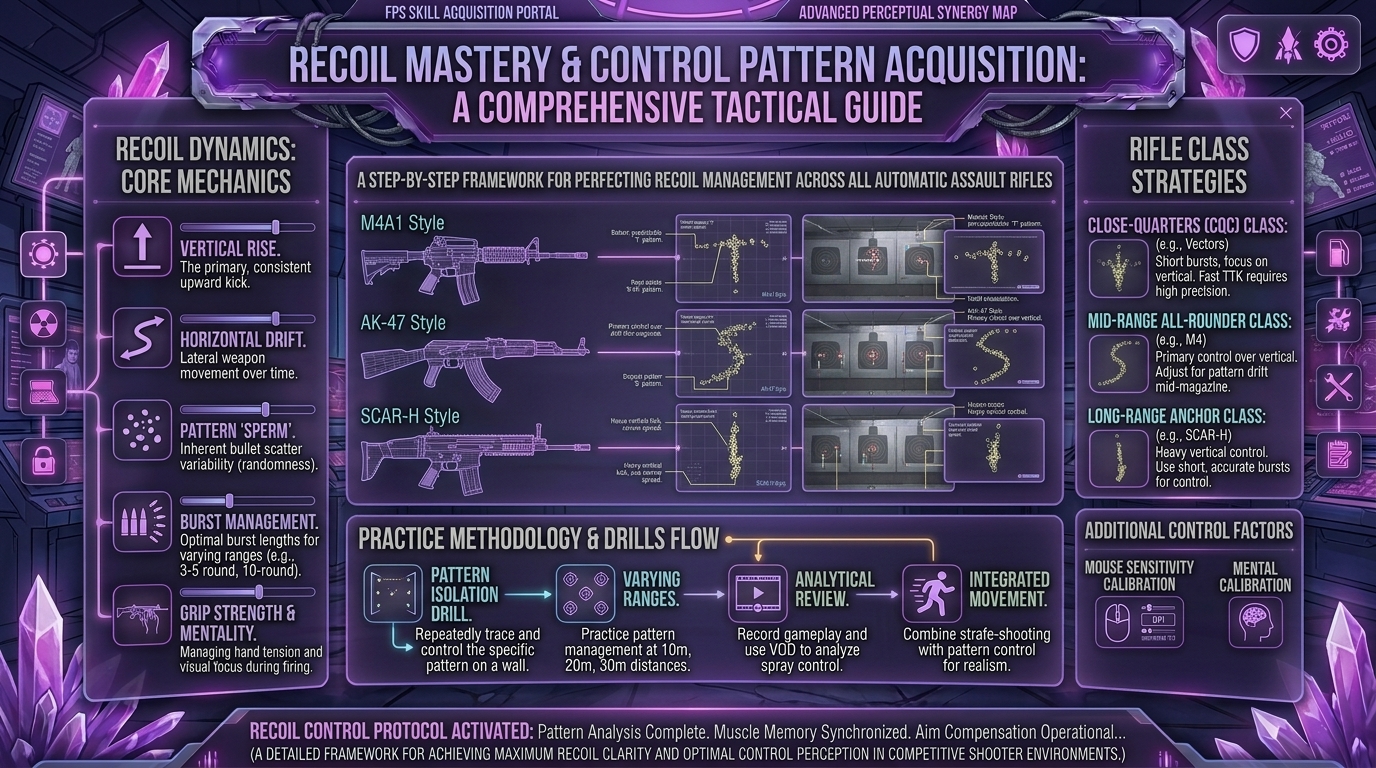
- Unlike games with random recoil spread, premier tactical rifles feature pre-determined, hardcoded recoil paths.
- For example, a weapon might kick vertically straight up for the first 5 bullets, pull sharply to the right for bullets 6 through 15, and oscillate horizontally back and forth for the remainder of the magazine. Your mouse movement must mirror this pattern in reverse to keep bullets grouping tightly together.
Recovery Time (Resetting the Bloom)
- If you dump an entire 30-round magazine and stop firing, your gun does not instantly return to zero. It suffers from recoil recovery delay. Learning to burst-fire (3 to 5 rounds) or tap-fire lets your weapon bloom reset organically.
2. Universal Techniques for Countering Recoil
Before learning individual weapon blueprints, you must build the foundational physical habits that apply across all tactical shooters:
- The Pull-Down Reflex: The universal reaction to firing an automatic rifle is pulling your mouse downward to counter vertical climb. Master the timing of when the vertical pull transitions into horizontal tracking.
- Arm vs. Wrist Engagement: For small 3-round bursts, your wrist and fingers handle the micro-adjustment. For full 30-round spray transfers, you must engage your forearm to drag the mouse down across your mousepad.
- Pacing Your Bursts: In long-range engagements, do not spray. Fire controlled 2-to-3 round micro-bursts, resetting your crosshair between each burst to maintain maximum accuracy.
3. Weapon-Specific Spray Breakdowns
While every game has its own unique arsenal, assault rifles generally fall into three structural categories:
| Rifle Archetype | Recoil Tendency | Optimal Engagement Range | Recommended Fire Technique |
| High-Caliber Heavy Rifles | Steep vertical climb, harsh left-right jitter | Medium to Long Range | 2-tap bursts or tightly controlled 5-bullet sprays |
| Standard Assault Carbines | Moderate vertical rise, smooth diagonal pull | Close to Medium Range | Full 10-to-15 round spray transfers with smooth mouse tracking |
| Bullpup / Compact Rifles | Low initial kick, heavy horizontal oscillation | Close Quarters | Aggressive tracking, rapid tap-firing, and mobility utilization |
Mastering the First 8 Bullets
Statistics show that 90% of tactical gunfights are decided within the first 5 to 8 bullets. If you haven’t secured a headshot or high-damage body tally by bullet eight, you are either dead or forced to reset. Therefore, your primary practice focus should always be the initial vertical pull and directional transition of the first third of your magazine.
4. Step-by-Step Training Routine for Recoil Mastery
Practicing in live matches is inefficient because you spend 80% of your time dead, spectating, or running back to sites. Use this dedicated 30-minute training protocol:
[Phase 1: Wall-Shooting Spray Tests] ➔ [Phase 2: Deathmatch Tracking] ➔ [Phase 3: Utility Integration]
Phase 1: The Blank Wall Test (10 Minutes)
- Stand 10 meters away from a solid, neutral wall in a custom practice server.
- Fire a full magazine without touching your mouse to memorize the raw pattern shape.
- Next, fire while actively pulling your mouse to counter the pattern, attempting to cluster all 30 bullet holes into a tight circle the size of a coin.
Phase 2: Static Target Re-centering (10 Minutes)
- Use built-in practice range bots or custom training maps. Practice snapping to a target, firing a controlled 5-bullet burst, and immediately snapping to a secondary target while managing the recoil reset cooldown.
Phase 3: Movement and Counter-Strafing Sprays (10 Minutes)
- Practice peek-shooting: strafe out from cover, instantly counter-strafe to zero your velocity, fire a controlled burst, and step back behind cover before your spray pattern loses control.
5. Common Recoil Control Mistakes to Avoid
- Crouch-Spraying Every Single Time: While crouching slightly tightens your recovery bloom in some games, developing a reliance on dropping to the floor makes you an easy, stationary target for skilled snipers.
- Over-Compensating Horizontally: Beginners often panic when the gun pulls sideways and aggressively jerk their mouse back and forth, creating wild, uncontrollable bullet scatters. Smooth, calculated tracking is superior to jittery corrections.
- Ignoring Sound Cues: Audio design in tactical shooters tells you when your weapon has fully reset its recovery state. Learn to listen to the mechanical click of your rifle bolt resetting.
10 Frequently Asked Questions (FAQ)
1. Are recoil patterns completely random in tactical shooters?
No. In premier competitive tactical shooters, recoil patterns are 100% deterministic (the same every time you hold down the trigger). Only minor bullet spread/bloom introduces RNG elements.
2. How many bullets should I fire in a standard burst?
For long-range fights, stick to 2 to 3 rounds. For medium-range engagements, 5 to 7 bullets form the optimal damage window before horizontal recoil becomes difficult to manage.
3. Does my mouse sensitivity affect my ability to control recoil?
Massively. If your sensitivity is too high, tiny hand movements will send your spray flying off target. Finding a balanced, lower eDPI gives you the physical desk space required to drag your mouse smoothly downward.
4. Why do my bullets miss even when my crosshair is on the enemy?
This is usually caused by movement inaccuracy (firing while walking or running) or weapon recovery bloom penalties from firing too fast without letting the gun reset.
5. Should I pull down slower or faster as the magazine empties?
You must match the exact pacing of the pattern. Most rifles pull down fastest during the opening bullets, requiring a slower, more deliberate horizontal balancing act toward the middle and end of the magazine.
6. Is it better to tap-fire or spray?
It depends entirely on the distance. Tap-fire and micro-bursting dominate long-range angles, while full-automatic spraying is necessary to overwhelm enemies in tight corridors and site takes.
7. How long does it take to build recoil muscle memory?
With a disciplined 15-to-20 minute daily wall-test and target-practice routine, most players notice significant improvements in their spray control consistency within 3 weeks.
8. Do attachments and scopes change recoil patterns?
In games featuring weapon customization, attachments like compensators, heavy barrels, or angled grips alter the shape and severity of the recoil pattern, making vertical climb easier to manage at the cost of other stats.
9. What is a “spray transfer”?
A spray transfer is the advanced technique of killing one enemy, maintaining your ongoing trigger pull, and seamlessly dragging your compensating crosshair over to a second adjacent enemy mid-magazine.
10. Where can I find more tactical weapon guides and pro settings?
Bookmark The Gamer Buzz and check back regularly for our comprehensive database of professional weapon tier lists, game breakdowns, and competitive improvement guides!
Conclusion
Mastering recoil control patterns for every automatic assault rifle in tactical shooting games is a rewarding journey that transforms you from a panicked shooter into a calculated tactical operator. By understanding weapon physics, drilling your muscle memory against practice walls, and maintaining strict burst discipline, you will dominate your gunfights and climb the competitive ladder with absolute confidence. Lock in your sensitivity, head to the practice range, and start landing those crisp, controlled sprays!
Leave a Reply