Welcome to The Gamer Buzz, your definitive competitive performance and strategy authority. Whether you are grinding ranked matches from high-end setups in San Francisco, New York, and Seattle, or navigating chaotic team lobbies across Texas, California, and Washington, one universal gaming truth binds us all: solo queueing in competitive playlists is the ultimate psychological trial.
You queue up hoping for communicative teammates, synchronized utility usage, and tactical teamwork. Instead, you land in a lobby with silent teammates, erratic pushes, zero map control, and immediate finger-pointing when things go sideways.
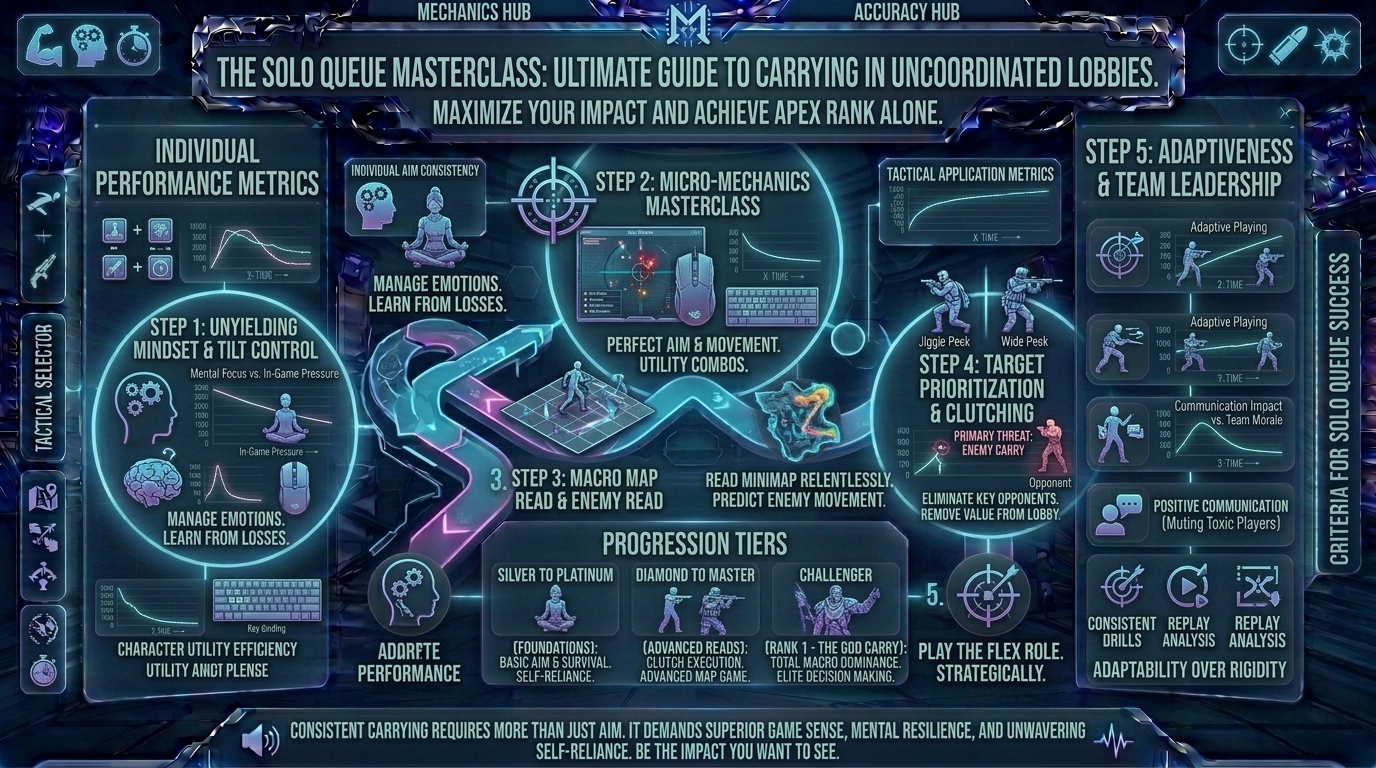
Carrying uncoordinated lobbies requires more than just good raw aim—it demands emotional discipline, leadership adaptability, and strategic self-reliance. In this exhaustive, master-level guide, we break down the core psychology, macro decision-making, and tactical carrying frameworks required to consistently win solo queue games and climb the ranked ladder.
1. The Solo Queue Mindset: Controlling the Uncontrollable
Before looking at mechanical carry tactics, you must master the fundamental rule of solo queueing: You cannot control your teammates; you can only control your own impact and reactions.
The Mathematical Reality of Ranked Lobbies
- The 40-40-20 Rule: Roughly 40% of your games are mathematically unwinnable no matter how well you play (due to griefers, uncoordinated team collapses, or smurfs on the enemy team). Another 40% are heavily favored wins where your team steamrolls naturally. The remaining 20% are the swing games—and your individual performance decides the outcome of every single one of them.
- Abandoning Expectations: The moment you stop expecting random teammates to execute complex pro strategies, the less frustrated you will become. Play to anchor their mistakes rather than screaming at them to fix yours.
2. The 4-Stage Solo Queue Strategy Blueprint
Carrying uncoordinated lobbies requires a disciplined approach to every match phase, transforming chaos into structured execution.
[Stage 1: Pre-Round Adaptation] ➔ [Stage 2: Parasitic Playmaking] ➔ [Stage 3: Information Control] ➔ [Stage 4: Mental Resilience]
Stage 1: Pre-Round Adaptation and Role Flexing
- Be the Glue: If your team lacks a smoke controller, a healer, or an anchor agent, swallow your ego and fill the gap. Playing what the team composition desperately needs skyrockets your round win probability far more than forcing a solo-carry duelist who starves for team support.
- Identify Your Carry Target: In the first two rounds, observe your random teammates. Identify who has decent movement and game sense, and who is throwing their life away. Once you spot the most competent player on your team, hitch your wagon to them. Playing off a competent random teammate’s aggression turns isolated 1v1s into reliable 2v1 trade opportunities.
Stage 2: “Parasitic” Playmaking (Using Your Teammates as Utility)
When teammates refuse to communicate or coordinate, you must coordinate with them—even if they don’t realize it.
- The Follow-the-Leader Rule: If a hyper-aggressive teammate insists on pushing a foolish angle, do not let them die alone. Position yourself slightly behind them so you can immediately trade out the enemy who kills them. A bad play executed together is often infinitely more successful than a correct play executed completely alone.
- Baiting with Purpose: Let uncoordinated teammates take the initial contact or entry space while you hold a clean trade angle behind them.
Stage 3: Taking Command via Pings and Calm Voice Comms
Many uncoordinated lobbies are not toxic; they are simply leaderless. Players want to win, but nobody wants to step up and make the hard macro calls.
- Keep Comms Short and Directive: Instead of shouting complex multi-tier strategies that randoms will ignore, use simple direct commands: “Blue, hold this door with me,” or “Let’s group up and hit B-site together.”
- Master the Ping System: If you have no mic or teammates refuse to listen to voice chat, spam map pings aggressively. Clear visual pings cut through noise and instinctively guide random players toward objective rotations.
3. Comprehensive Matrix: Solo Queue Scenarios and Solutions
| Lobby Problem | Root Cause | Solo Carry Solution |
| No-Comms Silent Team | Lack of microphone or social anxiety | Rely entirely on radar, audio queues, and active map pings; play defensively off their positioning. |
| Constantly Aggressive Teammates | Impatience and kill-chasing habits | Anchor behind them to trade out kills; stop them from pushing alone by matching their tempo. |
| Passive, Turtle-Like Defenders | Fear of losing ground or making mistakes | Take the initiative; ping a rush path and act as the hard entry wedge to force space. |
| Constant Toxic Blaming | Ego protection and tilt spirals | Mute them instantly; protect your own mental bandwidth; focus 100% on your game impact. |
4. Advanced Solo Carry Habits: How to Convert Leads into Wins
- Never Tilt-Queue: If you lose two ranked matches in a row due to uncoordinated lobbies or throwers, stop playing immediately. Take a 15-minute walk, hydrate, and reset your mental state. Continuing to queue while tilted guarantees you will match with similar players or perform below your baseline.
- Play the Anchor / Support Role When Behind: If your mechanical aim is having an off-game, transition immediately into a utility-heavy anchor or support style. Protect your team’s top fragger, drop weapons when you have extra cash, and let others carry the raw fragging load while you secure objective control.
10 Frequently Asked Questions (FAQ)
1. Is it better to play aggressive agents/heroes or supportive ones in solo queue?
It depends on your rank. In lower ranks (Iron to Gold), playing high-impact playmakers lets you carry through raw mechanical outplays. In higher ranks (Platinum to Immortal), playing versatile utility or anchor roles yields higher consistency because team coordination dictates round wins.
2. What should I do if my entire team refuses to use voice chat?
Treat your team like advanced bots. Watch their positioning on your mini-map constantly, play off their engagements as a secondary shadow, and use map pings to direct where you want to go.
3. How do I deal with a teammate who is deliberately throwing or griefing?
Mute them immediately, report them after the match, and do not engage in chat arguments. Engaging with griefers fuels their behavior and drains your mental focus away from winning the round.
4. Why do I feel like I always get the worst teammates in solo queue?
This is a cognitive bias known as negativity bias. Statistically, the enemy team has the exact same probability of getting uncoordinated or toxic players as your team does. Over a large sample size of hundreds of matches, you are the only constant variable in your climb.
5. Should I ever play solo queue late at night?
Late-night queues (past 1 AM) often feature smaller player pools, leading to wider skill disparities in matchmaking lobbies, increased rates of fatigue, and higher toxicity. If you want pristine match quality, queue during peak afternoon and evening hours.
6. How do I stop myself from getting tilted by bad teammates?
Accept the fact that roughly 40% of games are mathematically unwinnable. When you stop tying your emotional well-being to outcomes you cannot control and focus entirely on your personal mechanical improvement, tilt fades away.
7. Is duo-queuing better than solo-queuing for ranking up?
Duo-queuing with a reliable teammate who communicates and synergizes with your playstyle significantly stabilizes your win rate and cuts down solo queue frustration. Just ensure your skill levels are relatively close to avoid matchmaking penalty strains.
8. How can I carry when the enemy team is clearly a pre-made 5-stack?
Against coordinated stacks, you must avoid taking fair, predictable 1v1 engagements. Force chaotic split pushes, hunt for isolated flanks, and abuse utility combos to disrupt their defensive setups.
9. What is the best way to warm up before starting a solo queue grind?
Spend 10 to 15 minutes combining a physical hand stretch routine, a quick aim-training playlist (like static clicking or tracking), and one unranked deathmatch to wake up your nervous system.
10. Where can I find more team leadership and rank-up guides?
Bookmark The Gamer Buzz and check back regularly for our comprehensive database of professional esports guides, mental fortitude strategies, and competitive rank-up tips!
Conclusion
Mastering solo queueing in competitive playlists and carrying uncoordinated team lobbies is less about possessing god-tier aim and more about developing elite emotional intelligence, tactical adaptability, and situational leadership. By abandoning expectations of random perfection, playing off your teammates’ movements, taking command with calm communication, and protecting your mental state against tilt, you take total control of your competitive destiny. Queue up with confidence, lead your team from the front, and conquer the ranked ladder!
Leave a Reply