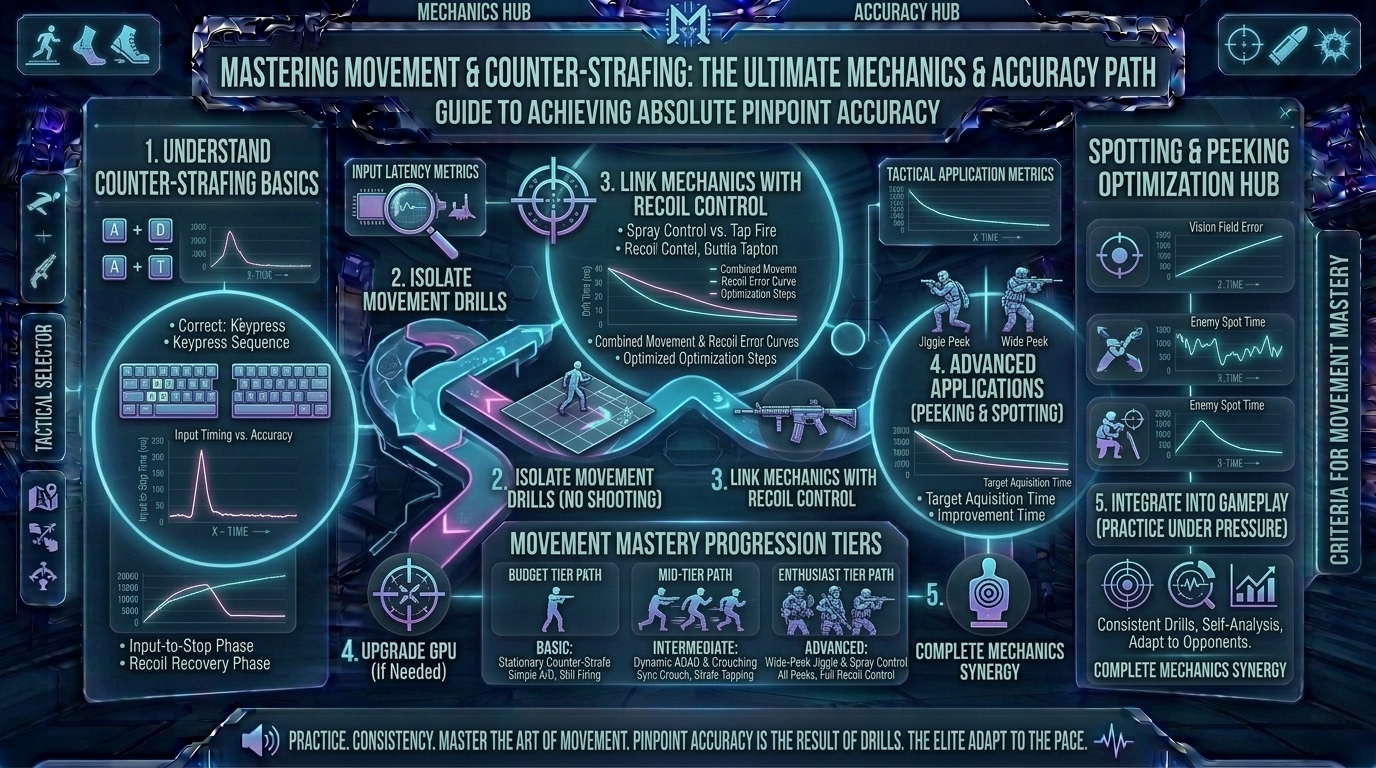
Welcome to The Gamer Buzz, your premier competitive performance and tactical strategy authority. Whether you are fine-tuning your gunplay from high-end setups in San Francisco, New York, and Seattle, or grinding through high-stakes competitive ranked lobbies across Texas, California, and Washington, one mechanic separates casual gamers from elite elite players: clean movement mechanics.
In tactical first-person shooters (such as Counter-Strike 2, Valorant, and various tactical variants), your weapon is fundamentally inaccurate the moment your character’s feet are sliding across the ground. If you fire while moving, your bullet spray transforms into a random geometric cone of failure.
To hit targets with absolute pinpoint accuracy, you must master counter-strafing—the art of instantly killing your lateral momentum using opposing keyboard inputs. In this exhaustive, master-level guide, we break down the physics of movement inaccuracy, the exact finger-tapping rhythms required to counter-strafe, and step-by-step training drills to embed this mechanic permanently into your muscle memory.
1. The Physics of Momentum: Why Moving Kills Accuracy
In modern tactical shooters, game engines track your player velocity vector on every single tick.
The Accuracy Cone
- In Motion: When you hold down a movement key (A or D), your character slides smoothly across the map. During this window, your gun’s dispersion error multiplies drastically. Your first bullet can land anywhere within a large radius of your crosshair.
- At Rest (Zero Velocity): The millisecond your character’s speed hits absolute zero, the dispersion cone collapses down to a single, microscopic point.
- The Problem with Just Releasing Keys: If you are strafing right by holding the D key and simply let go, your character doesn’t stop instantly; you coast for a few frames due to friction deceleration. Those few frames of coasting mean you are still inaccurate when you click. That delay loses gunfights.
2. The Anatomy of Counter-Strafing: Key by Key
Counter-strafing bypasses natural friction deceleration by forcing an immediate counter-input. Here is how the sequence works mechanically:
[Hold Movement Key (e.g., D)] ➔ [Release/Crosshair Target Reached] ➔ [Tap Opposite Key (e.g., A) for 1 Frame] ➔ [Fire Pinpoint Shot]
The 4-Step Execution Rhythm
- The Peek (Hold): Press and hold D to slide out to the right from behind a protective wall. Your crosshair sweeps across the open angle.
- The Target Lock: As your crosshair sweeps across your enemy’s head, prepare to stop.
- The Counter-Tap: The exact microsecond you want to stop, tap the A key for a fraction of a second while releasing D. This counter-input cancels your momentum instantly, dropping your velocity to zero.
- The Shot: Fire your single-bullet tap or controlled short burst during the microscopic stability window where your speed is zero.
Crucial Timing Note: Do not hold the opposite key down too long, or you will immediately begin sliding backward in the opposite direction, rendering your second shot just as inaccurate. It is a sharp, crisp tap, not a held press.
3. Comprehensive Matrix: Common Movement Errors vs. Corrections
| Movement Mistake | Symptom / Result | Corrective Adjustment |
| Just Letting Go of Keys | Coasting past your target; shots miss wide due to residual momentum. | Actively tap the opposing movement key to force instant zero velocity. |
| The “Jitter” Panic Mash | Rapidly mashing A-D-A-D back and forth out of nervousness, causing permanent motion inaccuracy. | Slow down your rhythm. One clean stop tap, a settled beat, then click. |
| Shooting Before the Stop | Firing during the deceleration slide (counter-tapped too late). | Delay your mouse click by roughly 50 milliseconds to match the completion of the counter-stop. |
| Moving the Mouse While Stopping | Crosshair drifts off target during the counter-tap. | Keep your mouse hand steady; separate your movement keys from your aim corrections. |
4. The Ultimate 10-Minute Daily Counter-Strafe Practice Routine
Muscle memory is built through isolated repetition. Implement this structured 10-minute training routine before jumping into your competitive matches:
Step 1: The Wall Check (3 Minutes)
- Load up a practice range or custom offline map and stand parallel to a flat wall.
- Turn on your game’s movement error crosshair graph (if available).
- Strafe left and right, practicing your counter-taps. Watch your crosshair lines: they should snap back together instantly when you execute the opposite tap. Fire a single bullet; if it leaves a mark directly on your crosshair dot, your timing is clean.
Step 2: Prefire Corner Peeking (4 Minutes)
- Go to a prefire map or custom map featuring common angle obstacles.
- Practice moving around a corner using only a single strafe key, counter-strafing the exact moment your pre-aimed crosshair lines up with a bot or target dummy’s head. Do not touch your W or S keys.
Step 3: Deathmatch Integration (3 Minutes)
- Jump into an unranked deathmatch server.
- Consciously force yourself to stop completely via counter-strafing before every single engagement. Do not allow yourself to panic-spray while moving. Focus exclusively on clean movement mechanics rather than your overall scoreboard kill count.
10 Frequently Asked Questions (FAQ)
1. Is counter-strafing necessary in all tactical shooters?
Yes, games like Counter-Strike 2 and Valorant heavily penalize movement accuracy. While the deceleration window in Valorant is shorter than in CS2, mastering counter-strafing completely eliminates the micro-drift delay, ensuring your first bullet hits its target every time.
2. Should I press both the original movement key and the opposite key at the same time?
No. You should release your primary movement key (or let the opposite key’s snap-override handle it) while giving the opposite key a crisp, isolated tap. Holding both down simultaneously results in standing still, but doing it cleanly relies on a tap-and-release rhythm.
3. Why do my bullets still miss even when I feel like I counter-strafed?
You are likely shooting either a split-second too early (while still sliding) or too late (after you’ve already started drifting backward). Watch your bullet impact holes on a wall rather than your crosshair to find your true timing feedback.
4. Can keyboard switch types (like mechanical vs. magnetic hall-effect switches) help with counter-strafing?
Yes. Modern keyboards featuring magnetic switches with adjustable actuation points (and features like Rapid Trigger) cut out physical switch reset lag, allowing your counter-strafe inputs to register slightly faster.
5. How do I practice counter-strafing into my weaker side?
Most players find it easier to counter-strafe in one direction (e.g., stopping when moving right vs. moving left). Deliberately spend double your practice time drilling movement toward your weak side until your muscle memory balances out.
6. Should I crouch during a counter-strafe?
Crouching immediately lowers your hitbox and changes your spray patterns, but doing it on every single peek makes you predictable. Reserve crouch-peeking for specific mix-ups; rely primarily on standing counter-strafes.
7. How long does it take to make counter-strafing feel automatic?
With dedicated 10-minute daily practice sessions, most players build basic subconscious muscle memory within 1 to 2 weeks of consistent ranked play.
8. Does moving my mouse while counter-strafing ruin my accuracy?
Your mouse movement doesn’t directly affect movement inaccuracy penalties, but moving your aim wildly while trying to time a static stop introduces human error. Keep your crosshair steady on the target angle while your fingers handle the stop.
9. What is “jiggle peeking” and how does it relate to counter-strafing?
Jiggle peeking is rapid, repeated counter-strafing back and forth across a corner threshold (A-D-A-D) to gather enemy information or bait sniper shots without fully committing your body to a lethal duel.
10. Where can I find more advanced movement guides and training drills?
Bookmark The Gamer Buzz and check back regularly for our comprehensive database of professional esports guides, mechanical breakdowns, and tactical rank-up tips!
Conclusion
Mastering counter-strafing and fluid movement mechanics is the ultimate mechanical foundation that turns random bullet sprays into reliable, pinpoint headshots. By understanding momentum physics, training your finger-tapping rhythm in isolated practice drills, and eliminating panic-mashing during live matches, you take complete control of your gunplay. Lock in your movement rhythm, plant your feet cleanly, and dominate your next competitive lobby!
Leave a Reply