Welcome to The Gamer Buzz, your premier competitive strategy and tactical intelligence authority. Whether you are anchoring high-stakes defensive sites from advanced setups in San Francisco, New York, and Seattle, or locking down objective corridors across competitive ranked lobbies in Texas, California, and Washington, one fundamental tactical truth determines your win rate: the team holding the site holds all the spatial cards.
When you are on the defensive side of a competitive tactical shooter (Counter-Strike 2, Valorant, Rainbow Six Siege), your objective is not necessarily to hunt down every enemy player. Your objective is to waste time, deny map control, and force the attackers into catastrophic positioning traps. Yet, in solo queue and uncoordinated team lobbies, defense often devolves into uncoordinated individual positioning, lone-wolf peeking, and rapid site collapses.
Defending a bomb site successfully requires geometric mastery, synchronized crossfire positioning, utility economy, and psychological discipline. In this exhaustive, master-level guide, we break down tactical defensive blueprints, crossfire angles, sound concealment, and step-by-step strategies to turn any bomb site into an impenetrable fortress.
1. The Geometry of Defense: Crossfires vs. Sequential 1v1s
Before examining specific utility lines or map positions, you must understand the core geometric principle that separates winning defensive teams from losing ones: the crossfire.
[Attacker Entering] ➔ [Defender A (Bait/Hinged Angle)] AND [Defender B (Punishing Crossfire Angle)]
The Trap of the Linear Duel
- The Rookie Mistake: Two defenders peek the same hallway side-by-side or hold sequential angles facing the exact same direction. When the attacker rounds the corner, they only have to win a single 1v1 gunfight at a time. If they win the first duel, they immediately turn and kill the second defender.
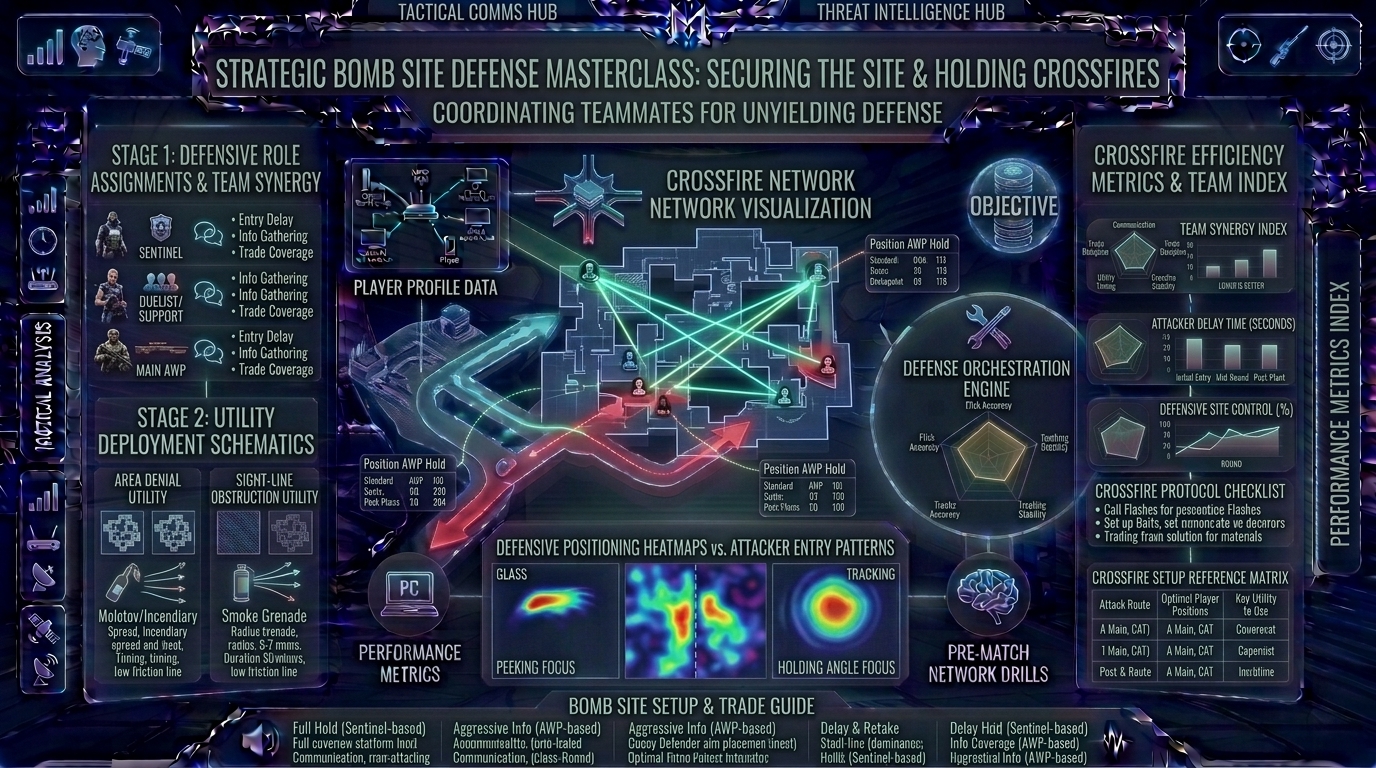
- The Power of the Orthogonal Crossfire: A true crossfire forces the attacker’s brain and eyes to split in two separate directions simultaneously. If an attacker peeks Defender A, Defender B has a direct side-on or rear angle to shoot the enemy without putting themselves in the enemy’s primary crosshair. Crossfires mathematically convert an even 1v1 into an unfair 2v1 advantage.
2. The 4-Stage Defensive Strategy Blueprint
Locking down an objective requires a disciplined, multi-phase approach that begins long before the round timer hits zero.
Stage 1: Pre-Round Information Denial and Default Holding
- Do Not Waste Early Utility: Attackers often send a lone player to make noise, throw fake flashes, or bait out early defensive utility at the start of a round. Do not panic-dump your smokes or incendiary grenades in the first 10 seconds.
- Passive Info Play: Hold passive information angles where you can see or hear enemy movement without exposing your body to sniper fire. Let them walk into your information net.
Stage 2: Delaying the Rush (The Utility Speed Bump)
When the attacking team commits to a full-speed explosive rush on your site, your primary goal is not to heroically ace them—it is to slow their momentum to a dead crawl.
- Staggered Utility Layers: Drop your first smoke deep into the choke point to completely block vision. Once that smoke dissipates halfway, drop your Molotov or incendiary fire onto the choke point floor. By the time they burn through your utility layers, 15 to 20 seconds of the round timer have vanished, panicking the attackers.
Stage 3: Crossfire Discipline (Holding Fire)
- The Discipline of Silence: If you are holding a tight crossfire angle with a teammate, do not shoot the moment you see the first enemy toe. If you shoot prematurely, you alert the rest of the attacking team, giving them time to turn, trade you out, and deploy defensive utility.
- The Ambush Execution: Wait until multiple attackers have completely pushed past your threshold, committing themselves deep onto the site with their backs turned or weapons lowered. When you both open fire simultaneously, you secure multiple instant kills before the enemy can react.
Stage 4: Strategic Retiring and Site Yielding
- Knowing When to Give Ground: If the enemy team executes a massive 5-man crunch with ultimate abilities and heavy utility dumping, trying to stubbornly hold the site alone is suicide.
- The Clean Fall-Back: Call out “Yielding site, holding retake angles” to your team. Fall back safely to a connected hallway or site entrance while staying alive. Preserving your life and your weapon preserves your team’s economy and sets up a structured retake scenario.
3. Comprehensive Matrix: Defensive Positioning vs. Attack Counter-Strategies
| Defensive Strategy | Map / Scenario Application | Core Objective | Risk Factor |
| Aggressive Mid-Control Push | Early round contest over central map arteries | Deny attacker information and pinch flanks. | High risk of getting caught by a 5-man rush. |
| Crossfire Site Anchor | Holding standard bomb site choke points | Force attackers into an inescapable 2v1 crossfire cross-angle. | Requires strict discipline not to break position early. |
| Cross-Map Retake Setup | Playing passive anchors with long rotations | Stall site plant while teammates rotate from opposite site. | Vulnerable if attackers fake and rush your site directly. |
| Information Trap Play | Using sensor/scouting utility on alternate paths | Catch silent rotators moving through unattended flanks. | Leaves primary site slightly thinner on direct defense. |
4. Advanced Defensive Habits: Sound and Psychology
- The Power of Absolute Silence: When holding a defensive angle waiting for an enemy push, take your fingers off your movement keys. Even minor shifts on the keyboard create micro-sound cues that alert headphones-wearing attackers to your exact hiding spot.
- The Counter-Fake Strategy: If you suspect the enemy team is notorious for faking site executions, do not send all your rotators flying across the map at the first sign of utility. Leave an anchor with escape utility on the weak site while other defenders edge closer to connectors to gather concrete visual confirmation.
10 Frequently Asked Questions (FAQ)
1. What is the biggest mistake defenders make in competitive matches?
Impatience. Defenders frequently get restless, push out of standard cover to hunt for flashy opening kills, and get punished by an attacking trade-fragger, leaving their bomb site wide open.
2. How do I set up a proper crossfire with a random teammate who has no mic?
Observe their positioning on the mini-map. If they are holding a wide angle looking at a doorway, position yourself perpendicular to that doorway looking from a different cover spot so that anyone peeking them exposes their side to you.
3. Should I always play on the bomb site itself as a defender?
Not necessarily. Many elite defensive setups use site-adjacent control (holding outer courtyards, connectors, or choke points) to delay the enemy before they even reach the bomb site. Playing off-site gives you more space to stall time.
4. What should I do if the attackers execute a slow, methodical default setup?
Patience is your best weapon. Do not peek out of boredom. Let them waste time crawling through map sectors while your team gathers information and prepares a synchronized counter-rotation.
5. How do I handle enemy smokes blocking my defensive line of sight?
When attackers smoke your holding angle, do not push blindly through the smoke. Back up into a deeper off-angle position, listen closely for audio footsteps emerging from the smoke, and punish them as they step out into the open site.
6. Is it better to stack one bomb site or split defenders evenly?
Site distribution depends heavily on team economy, map meta, and enemy tendencies. If the enemy team has heavily favored attacking one specific site in previous rounds, shifting an extra defender to stack that site is a smart tactical read.
7. How do I manage my utility economy across multiple defensive rounds?
Never dump all your high-value utility in the first 10 seconds of every round. Save your smokes and stalling grenades for when you hear concrete audio cues indicating an active enemy execution push.
8. What is an “off-angle” and when should I use it?
An off-angle is a positioning spot that deviates slightly from common pre-aimed corners where players naturally look. Use off-angles sparingly (once or twice per match) to catch overconfident attackers off guard, as they will check those spots standardly later in the match.
9. How do I communicate effectively with my defensive co-anchor?
Keep your callouts crisp: call out exact utility land spots, enemy numbers pushing your lane, and request backup before your health drops below 50%. Never wait until you are dead to ask for help.
10. Where can I find more advanced tactical team strategies and map guides?
Bookmark The Gamer Buzz and check back regularly for our comprehensive database of professional esports guides, defensive map setups, and competitive rank-up tips!
Conclusion
Defending bomb sites and holding defensive crossfire setups with your teammates is the ultimate test of patience, structural discipline, and geometric awareness. By abandoning reckless individual peeks, layering your utility to stretch out the round clock, locking down true orthogonal crossfires, and maintaining absolute audio silence, you transform vulnerable bomb sites into impenetrable roadblocks. Build your defensive framework, hold your ground, and shut down every attacking lobby you face!
Leave a Reply