What Are the Best Mental Focus and Concentration Exercises to Maintain High Performance During Long Tournament Matches?
Whether you are pushing through an 8-hour VALORANT Swiss bracket, grinding open pools in Street Fighter 6, navigating high-stakes endgame circles in Apex Legends, or managing complex macro decisions in StarCraft II, mental fatigue, loss of focus, and tilt are the ultimate silent killers in competitive esports.
Mechanical skill and tactical knowledge mean very little when your brain experiences cognitive burnout five hours into an intense tournament day. Slowing reaction times, tunnel vision, decision-making paralysis, and emotional outbursts (tilt) are direct symptoms of a fatigued prefrontal cortex.
At The Gamer Buzz, we analyze competitive performance, brain health, cognitive endurance, and sports psychology. This masterguide breaks down the neuroscience of cognitive fatigue in gaming, step-by-step mental exercises, reset routines for high-pressure moments, and daily cognitive conditioning protocols to keep you locked in through multi-hour tournament sessions.
Whether competing in LAN arenas across Texas, streaming high-ranked ladders from gaming hubs in California and San Francisco, leading collegiate rosters in Washington, or grinding tournament queues from New York, building mental stamina is what separates consistent champions from talented underperformers.
1. The Neuroscience of Cognitive Strain in Esports
To maintain focus during an all-day tournament, you must understand how your brain consumes energy during high-intensity gaming.
Executive Function and Prefrontal Cortex Burnout
The prefrontal cortex (PFC) is the command center of your brain. It manages executive functions: target tracking, tactical processing, decision-making, and emotional regulation. During continuous multi-hour gaming, the PFC rapidly consumes glucose and glycogen reserves. As metabolic byproducts build up in the brain, executive functioning degrades, causing:
- Reaction Latency: Micro-delays in processing visual cues (e.g., delayed reaction to an enemy swinging a corner).
- Attentional Tunneling: Fixating on one single target while completely ignoring the minimap, killfeed, or flank angles.
- Emotional Disregulation (Tilt): Reduced capability to suppress frustration, leading to aggressive, low-probability plays.
| Stage of Mental Fatigue | Cognitive Symptoms | In-Game Performance Impact | Immediate Countermeasure |
| Stage 1: Mild Inattention (Hours 1–3) | Occasional minimap blindness, minor over-peeking | Slight drop in decision speed, missing subtle audio cues | Box Breathing (4-4-4-4 technique) |
| Stage 2: Moderate Drift (Hours 4–6) | Frustration spikes, delayed crosshair placement, hesitation | Hesitant utility usage, poor target switching | 60-Second Tactile Reset + Physiological Sigh |
| Stage 3: Severe Burnout (Hours 7+) | Full emotional tilt, tunnel vision, impulse plays | Severe throwing, high death count, mental check-out | 10-Minute Sensory Deprivation & Glucose Refresh |
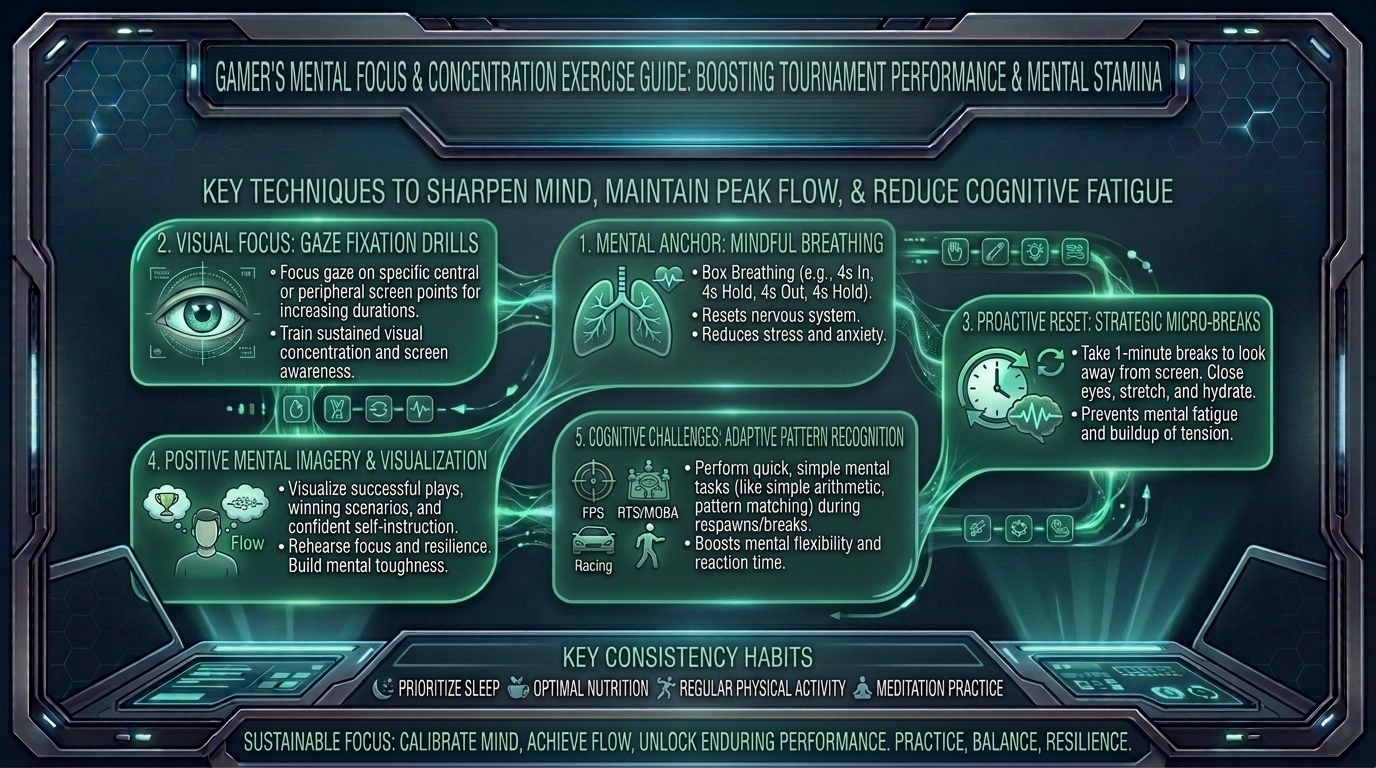
2. Dynamic Mental Focus & Concentration Exercises
Mental focus is a trainable muscle. Incorporate these proven mental exercises into your daily training and pre-tournament warm-up routines.
1.Phase 1: The Physiological Sigh & Box Breathing:Activates parasympathetic nervous system and lowers heart rate.
Before the match begins or immediately after a high-stress round:
- Physiological Sigh: Take two quick double-inhales through your nose, followed by one long, extended exhale through your mouth. Repeat 3 times to immediately lower elevated heart rate and reduce cortisol.
- Box Breathing: Inhale for 4 seconds, hold for 4 seconds, exhale for 4 seconds, and hold empty for 4 seconds. Repeat for 2 minutes to reset focus.
2.Phase 2: The 5-4-3-2-1 Grounding Method:Engages tactile senses to break anxiety loops.
When experiencing tilt or tournament pressure, perform a sensory scan to break cognitive panic:
- Acknowledge 5 things you can see around your screen/desk.
- Notice 4 physical sensations (e.g., feet on floor, hand grip on mouse, back against chair).
- Identify 3 distinct sounds (e.g., game audio, fan noise, keystrokes).
- Notice 2 smells or tastes.
- Take 1 deep, focused breath.
3.Phase 3: Grid Concentration & Minimap Scanning Drills:Trains brain to return focus rapidly when interrupted.
Practice attentional shifting before tournament days:
- Number Grid Drills: Use a 10×10 printed or digital number grid (1–100) and scan the numbers in sequential order as fast as possible for 3 minutes.
- Minimap Anchor Drill: Set an audio metronome to beep every 3 to 5 seconds during practice matches. Force your eyes to touch the minimap on every single tone until side-glancing becomes subconscious.
4.Phase 4: PETTLEP First-Person Visualization:Pre-activates motor neural pathways without physical strain.
Spend 5 minutes before your match visualizing critical scenarios using the PETTLEP model:
- Close your eyes while sitting in your exact tournament posture holding your controller/mouse.
- Visualize clutch situations from a first-person perspective in real-time execution speed.
- Recreate the exact emotional state of remaining calm under clutch pressure.
3. In-Game Focus Reset Protocols During Match Breaks
When competing in long Swiss brackets or multi-game series, maintaining peak attention requires structured mid-session resets:
- Establish a “Micro-Reset” Trigger: Choose a physical action that signals your brain to let go of the last play or round—such as setting down your controller, adjusting your mousepad, or wiping your hands with a microfiber towel. Combine this with a positive self-talk verbal cue like “Next play” or “Clear board”.
- Follow the 50/10 Focus Structure: During multi-hour tournament days or scrim blocks, enforce a strict 50 minutes of intense gameplay followed by 10 minutes away from screens. Standing up and looking at distant objects restores eye focus and prevents mental fatigue compound.
- Manage Glucose and Hydration: Your brain relies heavily on stable blood sugar levels. Avoid heavy, high-carbohydrate meals or sugar-loaded energy drinks that trigger crash-and-burn spikes. Opt for slow-burning snacks (nuts, berries, complex carbs) and electrolyte-infused water to sustain focus over 6+ hours.
- Practice Emotional Reappraisal: Instead of telling yourself “I’m nervous and choking under pressure,” reframe internal physiological arousal: “My heart is racing because my body is releasing adrenaline to give me fast reaction times”.
10 Frequently Asked Questions (FAQ)
1. How do I stop tilting after losing a critical round or making a dumb mistake?
Use the Pause-Reset-Refocus protocol. Take a single physiological sigh (double inhale, long exhale), drop your shoulders, unclench your jaw, and speak your refocus cue (e.g., “Reset, focus next execution”). Never re-queue or start the next round while actively venting.
2. Can energy drinks replace mental focus exercises?
No. High doses of caffeine and synthetic stimulants temporarily spike alertness, but they increase baseline heart rate, jitteriness, and motor anxiety. Stimulants cannot fix cognitive energy depletion; only hydration, breathwork, and structured rest restore prefrontal cortex function.
3. How long before a tournament match should I perform visualization exercises?
Perform 3 to 5 minutes of first-person mental visualization roughly 15 to 30 minutes before stepping onto the stage or starting your match lobby.
4. What is “Attentional Tunneling” and how do I catch myself doing it?
Attentional tunneling happens when stress narrows your perceptual field, causing you to stare exclusively at your crosshair while ignoring radar, flanks, and teammate communication. Set a mental or audio cue to regularly expand your visual field across the whole monitor.
5. Why do I play amazingly in practice/scrims but freeze up in real tournament matches?
This is caused by Hyper-Self-Consciousness. In practice, your brain operates on automaticity (flow state). In tournaments, fear of failure forces your conscious brain to micro-manage mechanical actions, causing stiffness. Process-based goal setting shifts focus back to execution details rather than match outcome pressure.
6. Are there specific mobile apps or games to train esports attention span?
Grid concentration apps, Dual N-Back memory training, and speed scanning drills actively challenge working memory and attentional control. Spending 10 minutes daily on working-memory exercises builds long-term cognitive stamina.
7. How does sleep quality impact tournament focus?
Sleep deprivation directly impairs prefrontal cortex function. Getting less than 7 hours of sleep drops working memory capacity, slows visual reaction speed by up to 20%, and drastically lowers your threshold for emotional tilt.
8. What should I do during a long 30-minute tournament technical delay?
Step completely away from your setup. Put on noise-canceling headphones, close your eyes, perform box breathing, and keep your body warm. Avoid scrolling endlessly on social media, which drains dopamine reserves before you even get back to playing.
9. Should I talk out loud to myself while playing to maintain focus?
Yes! Instructional Self-Talk (e.g., whispering “Check right corner, save utility for site entry”) engages verbal processing networks in your brain, keeping your attention locked on immediate tactical execution rather than background anxiety.
10. When does mental fatigue require a full day off from gaming?
If you experience persistent headaches, chronic tilt within minutes of starting a session, spatial apathy, or extreme sleep disruption, your brain is over-trained. Take a full 24- to 48-hour total screen break to replenish neurochemical reserves.
Conclusion
Mastering multi-hour esports tournaments requires treat mental focus and emotional control as physical skills. By understanding cognitive fatigue, practicing dynamic focus exercises like physiological sighs and grid drills, utilizing structured micro-resets between matches, and building process-driven pre-game routines, you can maintain peak reaction speed and decision-making accuracy through the longest tournament brackets.
Leave a Reply