Welcome to thegamerbuzz, your definitive authority on the engineering, inner mechanics, and macro-trends shaping the interactive entertainment industry. Whether you are analyzing high-end tech pipelines late into the night in New York, examining engine performance metrics in San Francisco, writing code or modding setups in Texas and Washington, or theorycrafting the future of graphics from sunny California, we know how vital it is to understand what powers your favorite titles.
If you have followed the gaming landscape over recent years, you’ve likely noticed a massive systemic shift. Major AAA heavyweights—studios that historically spent decades building and fiercely guarding custom, in-house game engines—are shuttering their proprietary software and migrating en masse to third-party ecosystems like Unreal Engine 5 or modern software development kits (SDKs).
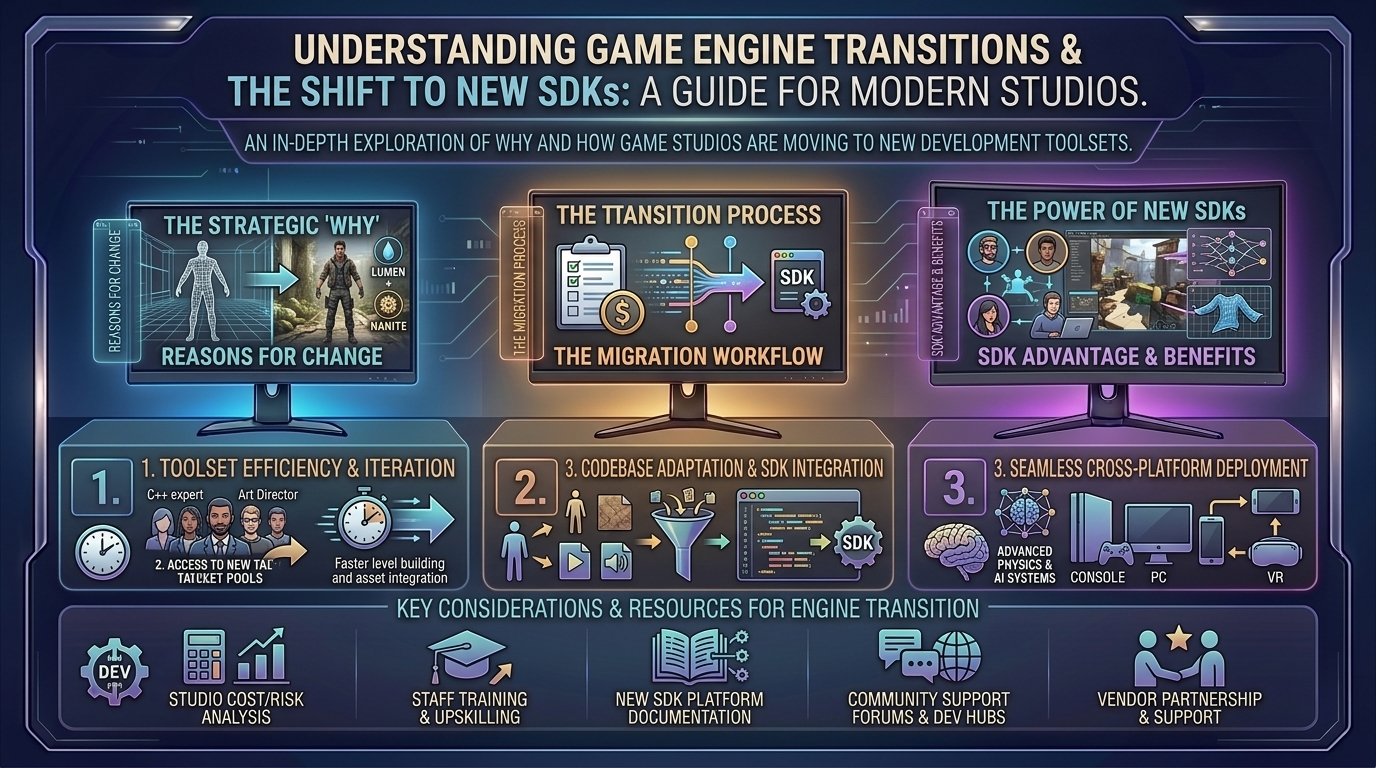
Why are legendary developers abandoning custom tech? What does an “engine transition” actually mean behind closed doors, and how does it change the games sitting on your hard drive? This master-level guide breaks down the economics, engineering challenges, and structural realities behind modern game engine migrations.
1. What Is a Game Engine and Why Do Studios Change Them?
At its core, a game engine is the foundational software framework that handles the heavy lifting of video game creation. It provides the physics simulation, rendering pipeline, audio management, memory allocation, input processing, and scripting environments so developers don’t have to code gravity or lighting math from scratch for every single title.
For decades, owning a proprietary engine was a badge of honor and a competitive advantage. Studios like CD Projekt Red (REDengine), Crystal Dynamics (Foundation), BioWare (Frostbite/Eclipse), and 343 Industries (Slipspace) built custom tools tailored specifically to the unique needs of their franchises.
However, game development has evolved into a hyper-complex, multi-hundred-million-dollar endeavor. When a studio undergoes an engine transition, they are rewriting or re-platforming the fundamental core of their production pipeline—swapping out the foundational engine infrastructure, lighting models, asset pipelines, and physics architecture for a new commercial SDK.
2. The Driving Forces: Why Studios Are Abandoning Proprietary Tech
The mass migration away from in-house engines is not happening because developers suddenly lack talent; it is driven by cold, hard economic and technical realities.
1. The Astronomical Cost of Engine Maintenance
Maintaining a custom engine for modern hardware (PS5, Xbox Series X/S, and high-end PC rigs) requires an entire dedicated engineering sub-studio just to keep the tools running.
- Writing modern real-time global illumination, virtualized geometry pipelines, and multi-threaded asset streaming systems from scratch costs tens of millions of dollars.
- When a studio uses a commercial powerhouse like Unreal Engine 5, companies like Epic Games shoulder the massive R&D burden, updating the engine to support cutting-edge hardware features automatically.
2. The Onboarding and Hiring Crisis
The video game industry suffers from high turnover and widespread restructuring.
- If a studio uses a proprietary engine built by three engineers who left the company five years ago, every new hire faces a grueling 3-to-6-month onboarding bottleneck just to learn how the undocumented custom tools work.
- Conversely, thousands of graduates enter the job market every year already trained in commercial pipelines like Unreal or Unity. A studio shifting to standard SDKs can plug new developers into active production pipelines in days rather than months.
3. Accumulated “Technical Debt”
Older proprietary engines accumulate legacy code over decades. Developers often describe working on older custom engines as trying to fix the foundation of a skyscraper while living on the top floor. Trying to patch modern ray tracing or open-world asset streaming onto a 15-year-old engine architecture often leads to endless bugs, unstable builds, and catastrophic project delays.
3. Inside an Engine Migration: What Actually Happens?
When a major studio announces they are transitioning to a new engine (such as CD Projekt Red moving to Unreal Engine for future Witcher sagas, or Crystal Dynamics shifting to UE5 for Tomb Raider), players often assume it’s a simple drag-and-drop process. In reality, it is a massive, multi-year engineering trial.
- Asset and Data Re-Importation: Every 3D model, animation skeleton, texture map, and material shader built for the old engine must be converted, re-imported, and optimized to fit the new engine’s structural requirements.
- Rewriting Game Logic: While engines handle rendering and physics, a studio’s custom gameplay systems (inventory loops, quest flags, dialogue trees, AI state machines) often have to be entirely re-coded or mapped to the new engine’s scripting architecture (such as translating custom logic into C++ or Blueprints).
- Pipeline Retraining: Artists, animators, level designers, and sound engineers have to completely relearn how to build environments, set up lighting, and trigger cutscenes using unfamiliar user interfaces and workflow tools.
4. The Pros and Cons of Commercial Engine Dominance
While the shift toward standardized commercial software solves many production hurdles, it introduces new challenges for the industry at large.
The Major Advantages:
- Faster Time-to-Market: Developers spend less time building tech from scratch and more time focusing on art, narrative, and core gameplay loops.
- Next-Gen Tech Out-of-the-Box: Studios instantly gain access to advanced features—like Nanite geometry virtualization, Lumen real-time global illumination, and advanced upscaling frameworks—without building them manually.
- Cross-Studio Collaboration: Shared engine architecture makes it easier for partner support studios to jump in and assist with heavy workloads.
The Potential Pitfalls:
- Homogenization of Visuals: When every studio uses the exact same base engine features with default settings, games risk losing the unique visual identity and quirks that made older proprietary titles stand out.
- Optimization Hurdles: Out-of-the-box commercial engines come with heavy default settings. If developers fail to optimize resource management or configure asset streaming properly, it can lead to notorious performance stutter on PC and consoles.
5. Frequently Asked Questions (FAQ)
1. Does moving a game to Unreal Engine 5 automatically make it look better?
No. An engine upgrade provides the tools for high-end fidelity (like dynamic lighting and dense geometry), but how a game looks and runs still depends entirely on the studio’s asset optimization, art direction, and engineering execution.
2. Why don’t all game studios just use the same engine?
Different games have drastically different structural needs. A hyper-fast competitive arcade racer, a massive open-world simulation, a grid-based tactical game, and a 2.4D fighting game require entirely different physics solvers and rendering priorities that no single engine handles equally well out of the box.
3. What is the difference between a game engine and an SDK?
A game engine is the overarching runtime environment (rendering, physics, audio), while a Software Development Kit (SDK) usually refers to a specific package of software tools provided by hardware manufacturers (like the PlayStation 5 SDK or Meta Quest SDK) or middleware creators to integrate specific features into an engine.
4. Why did companies build custom engines in the first place?
During the 1990s, 2000s, and early 2010s, commercial third-party engines lacked the specific performance optimizations or flexibility required for ambitious console games, forcing major developers to build custom technology tailored to specific hardware architectures.
5. Are proprietary engines completely dead?
Not entirely. Studios owned by massive vertical giants—such as Electronic Arts (Frostbite), Sony Interactive Entertainment (Insomniac’s proprietary tools, Decima), and Ubisoft (Snowdrop, Anvil)—continue to invest heavily in in-house tech because it gives them complete structural independence from external licensing fees and platform policy shifts.
6. What causes “stuttering” in games built on newly transitioned engines?
Many modern engine transitions rely on real-time shader compilation and streaming assets. If the engine fails to pre-compile shaders or manage streaming buffers efficiently during gameplay, it results in micro-stutters when new visual effects or assets load onto the screen.
7. Do engine transitions change how a game’s story or writing is handled?
No. Writing, narrative design, voice acting, and overall game direction are content decisions that remain entirely independent of the underlying software engine.
8. How long does it take a studio to completely transition to a new engine?
A full enterprise-level engine migration typically takes anywhere from 1 to 3 years, as engineers rewrite core architecture and production teams adapt their workflows to the new software ecosystem.
9. Why do players sometimes complain about games feeling “samey” due to engine choices?
Because commercial engines share common rendering pipelines and post-processing defaults, lazy or rushed implementations can leave games sharing a distinct visual sheen unless artists manually customize the shaders and lighting profiles.
10. Where is the industry heading for game engine technology over the next decade?
The industry is moving toward highly modular, cloud-connected, and AI-assisted development pipelines where engine software integrates machine learning tools to automate tedious optimization tasks and accelerate asset creation.
6. Conclusion
Game engine transitions represent one of the most stressful yet necessary evolutions a development studio can experience. While saying goodbye to legendary in-house technology marks the end of an era for many veteran creators, the shift toward standardized, robust commercial SDKs and engines like Unreal Engine 5 is transforming how modern masterpieces are brought to life. By streamlining production pipelines and granting access to groundbreaking rendering tech, these migrations help studios survive the brutal economic realities of modern AAA game development.
Stay informed, look beneath the surface of game development tech, and level up your industry knowledge right here with thegamerbuzz!
What proprietary engine from gaming history do you miss the most, and which modern engine transition surprised you the most?
Leave a Reply