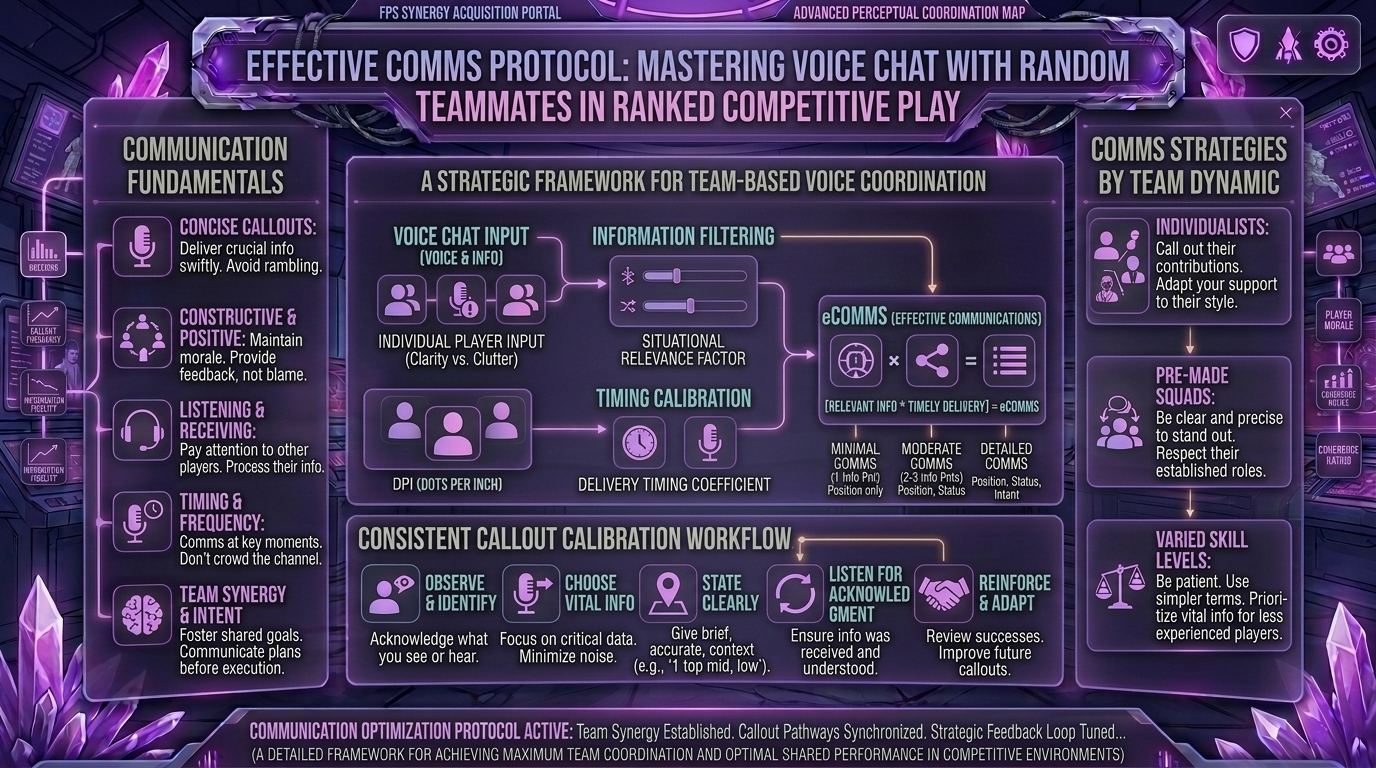
Welcome to The Gamer Buzz, your ultimate competitive tactical hub. Whether you are grinding ranked ladders from high-performance setups in San Francisco, New York, and Seattle, or locking in your comms setups across Texas, California, and Washington, one truth remains absolute: raw mechanical aim alone will only take you so far.
In competitive multiplayer titles (such as Counter-Strike 2, Valorant, Apex Legends, or Overwatch 2), solo-queuing means stepping into the trenches with total strangers. Effective voice communication can bridge skill gaps, turn certain defeat into miraculous comebacks, and elevate a disorganized lobby into a synchronized unit.
In this exhaustive, master-level guide, we break down the psychology of solo-queue comms, the golden rules of concise information architecture, ego management, and advanced callout strategies required to dominate ranked matches.
1. The Golden Rule of Comms: Concise Information Density
The number one mistake players make in voice chat is turning their microphone into a live-streaming podcast. When adrenaline spikes during a clutch situation, unoptimized communication floods audio channels with acoustic noise, drowning out crucial sound cues like enemy footsteps or ability activations.
The Anatomy of an Elite Callout
To give your random teammates actionable data instantly, structure your voice lines using the 4-Part Callout Formula:
$$\text{[Number of Enemies]} + \text{[Exact Location]} + \text{[Health/Damage Status]} + \text{[Action/Direction Marker]}$$
- Bad Callout: “He’s right there! Oh man, he’s shooting at me, look out behind the box, he’s hacking!”
- Elite Callout: “Two players, B-Site Long, one tagged for 80, planting spike.”
By stripping away panic, emotion, and vague pronouns (“over there,” “he,” “that guy”), you give your teammates everything they need to execute a counter-play in less than two seconds.
2. Managing Lobby Psychology and Preventing “Tilt”
When you play with random strangers, you are managing emotional states as much as map geometry. Toxicity breeds failure; the moment a teammate starts tilting, team win-probability drops precipitously.
Strategies for De-Escalating Toxic Lobbies:
- The Positive First Impression: Speak during the very first round picker or pistol round with a calm, upbeat tone (“Hey team, let’s play together, good luck everyone”). Establishing a friendly baseline drastically reduces the likelihood of targeted toxicity later.
- Never Argue Back: If a teammate flames you for missing a shot, do not waste energy typing or shouting back. Mute them immediately if necessary, or reply with neutral accountability (“My bad, missed my spray, let’s reset for the next round”).
- Praise Small Successes: Acknowledge clutch plays, successful trades, or good utility usage. Positive reinforcement builds trust, transforming uncommunicative strangers into active participants who will share information with you.
3. Establishing Audio Etiquette and Hardware Discipline
Your communication is only as good as your physical audio pipeline. If your microphone sounds like a jet engine taking off, even the best tactical callout will get you muted.
- Microphone Placement and Noise Gates: Position your mic roughly two inches from your mouth and slightly off-center to prevent heavy breathing sounds. Configure software noise suppression (Discord, NVIDIA Broadcast, or in-game filters) to eliminate keyboard clatter and room echo.
- The “Dead Silence” Rule: During high-stakes 1vX clutch situations, absolute silence is mandatory. Do not offer backseat coaching, do not state where the enemy was two rounds ago, and let the surviving player focus entirely on audio queues.
4. Adapting Communication Styles to Match Game Phases
| Match Phase | Communication Focus | Optimal Comms Density |
| Buy / Strategy Phase | Economy alignment, site execution, utility mapping | Moderate to high (Keep plans simple and flexible) |
| Mid-Round Action | Enemy positions, health states, spike/objective status | Low & strict (Only vital location/damage data) |
| Clutch / Retake Scenario | Silent observation; ping system usage | Absolute zero voice clutter (Allow 1v1 audio focus) |
5. Utilizing Ping Systems as a Non-Verbal Backbone
Even when voice chat is tense or teammates refuse to speak, modern games feature powerful non-verbal radial menus and ping tools.
- Use ping systems to mark enemy positions visually, confirm bomb sites, or request utility backup.
- Pings combined with a brief verbal confirmation (“Pinging enemy Jett on platform” ) create a dual-layer of communication that is impossible to misinterpret.
10 Frequently Asked Questions (FAQ)
1. What should I do if nobody on my team is using a microphone?
Keep making clear callouts anyway. Often, silent teammates are listening to voice chat even if they choose not to speak. Your information will still guide their rotations.
2. How do I handle an aggressive or toxic teammate who mic-spams?
Call them out calmly once (“Hey man, keep comms clear for sound cues, please”). If they continue or escalate, mute them instantly to protect your mental focus.
3. Is it better to designate an in-game leader in solo-queue?
If someone steps up with a positive attitude and clear macro strategies, support them. If no natural leader emerges, keep your calls focused on micro-play and tactical teamwork.
4. Why do people get mad when I talk after I die?
Dying players often give delayed or panicked callouts that confuse living teammates. Only speak immediately post-death to report enemy damage numbers and exact last-known locations.
5. How can I overcome ranked voice chat anxiety?
Start small. Begin by speaking purely factual, neutral callouts during the first few rounds. As you realize how much it helps your team win, your confidence will naturally build.
6. Should I use push-to-talk or open mic?
Always use push-to-talk. Open mics pick up background noises, heavy breathing, family conversations, and mouse clicks that ruin your team’s auditory awareness.
7. What is the best way to suggest a strategic change after losing 4 rounds in a row?
Frame it constructively rather than critically. Instead of saying “Stop rushing B!”, say “Let’s try a slow default map control play this round and see if we catch them stacking”.
8. Does language barrier impact ranked comms?
In regions with diverse player bases, rely heavily on standardized international map callouts (e.g., A-Main, Catwalk, Banana) and universal ping wheels to transcend language gaps.
9. How do I stop myself from making excuses when I die?
Focus your mental energy on what actionable data your death provides. Shift immediately from blaming game mechanics to calling out enemy health bars and positions.
10. Where can I find more team strategy guides and pro tips?
Bookmark The Gamer Buzz and check back regularly for our comprehensive database of competitive breakdowns, game intelligence articles, and tactical progression guides!
Conclusion
Communicating effectively with random teammates in voice chat is an acquired skill that transforms chaotic solo-queue lobbies into cohesive, winning squads. By mastering concise callout structures, protecting your team’s mental morale, respecting audio discipline, and keeping information clean and actionable, you will drastically increase your match win-rate. Turn on your mic, stay positive, and climb those competitive ladders!
Leave a Reply