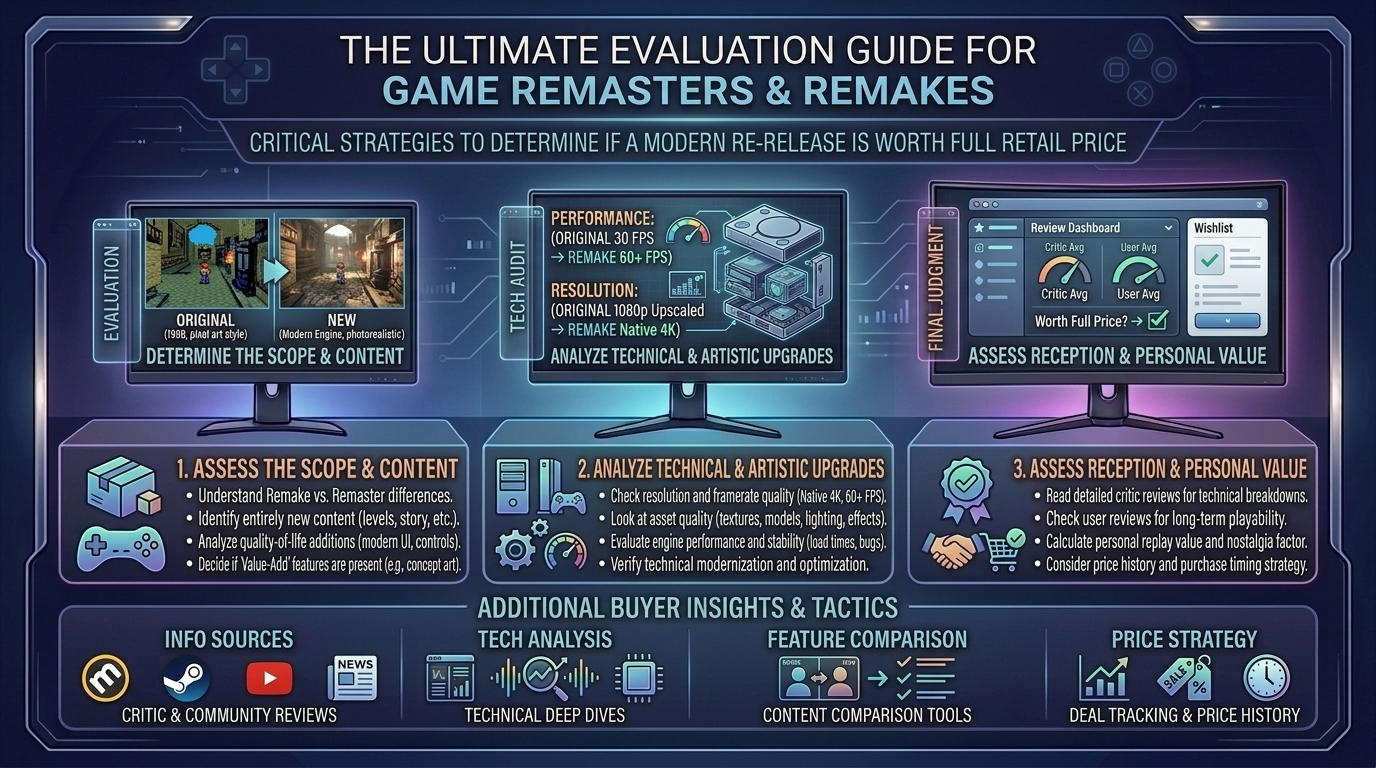
Re-releasing legacy video games has evolved into a core financial strategy for the gaming industry. Publishers routinely dust off classic intellectual properties, charging anywhere from $40 up to the modern $70 AAA standard. However, the distinction between a lazy resolution bump and a groundbreaking, ground-up reimagining is often blurred by clever marketing campaigns.
Navigating the spectrum of re-releases requires evaluating whether a updated release justifies full retail price or if you should wait for a deep digital discount.
Remaster vs. Remake vs. Reboot: Defining the Terms
Before spending money on a re-release, it is essential to understand the technical scope of what the developers actually built.
[ Legacy Source Code / Assets ] ──► Remaster ──► Increased Resolution, Higher Framerates, Native Porting
                                       │
[ Complete Ground-Up Rebuild ] ──► Remake   ──► New Engine, Modern Mechanics, Reimagined Assets
                                       │
[ Narrative & System Overhaul] ──► Reboot   ──► Fresh Story Continuity, Brand-New Mechanics
- Remaster: The developer uses the original engine and codebase. They upgrade texture resolutions, implement modern lighting passes (such as ray tracing), boost framerates (e.g., targeting 60 FPS or 120 FPS), and aggregate existing DLC into one package.
- Remake: The developer abandons the legacy codebase and rebuilds the game from scratch in a modern engine (e.g., Unreal Engine 5). Textures, animations, voice acting, controls, and level layouts are completely reconstructed.
- Reboot: A complete story and gameplay departure that uses the original IP’s character names and world setting to tell an entirely new story with modernized systems.
The Value Matrix: Is It Worth $70 at Launch?
Use this evaluation matrix to weigh what a re-release offers against its asking price:
| Evaluation Factor | Full Retail Worthy ($60–$70) | Wait for Discount ($30–$40) | Skip / Budget Bin (<$20) |
| Engine & Tech | Rebuilt from scratch in a current-gen engine. | Original engine with higher resolution and lighting passes. | Minimal Resolution/Framerate port. |
| Quality of Life (QoL) | Modernized controls, accessible UI, reduced load times. | Basic button remapping and minor UI scaling updates. | Clunky legacy controls left completely untouched. |
| New Content | Expanded story chapters, cut content restored, new modes. | Bundled original DLCs and minor bonus cosmetic items. | Zero added content or legacy features removed. |
| Preservation Gap | Original title is unplayable on modern hardware without emulation. | Original title is available via backward compatibility but looks dated. | Original version is easily accessible and looks nearly identical. |
5 Critical Questions to Ask Before Purchasing
1. Does the Game Fix “Age-Related” Design Flaws?
A great remake doesn’t just upgrade graphics; it fixes mechanical friction that made the original frustrating. Look for quality-of-life adjustments like inventory expansion, auto-save implementation, streamlined backtracking, and modernized camera systems.
2. Is the Visual Upgrade a Meaningful Leap or a Minor Patch?
If the original game was released within the last console generation, a $70 “remake” or “remaster” may only offer marginal graphical improvements. Compare side-by-side technical performance breakdowns (e.g., Digital Foundry) to determine if the visual leap justifies a full-price tag.
3. How Accessible Is the Original Version?
If the original game is trapped on older physical hardware (like the PS2, PS3, or GameCube) and costs hundreds of dollars on the second-hand market, paying $60 for a accessible modern version adds genuine preservation value. Conversely, if you already own the original on PC or a backward-compatible console, an upgrade patch might not be worth full price.
4. Was Content Added or Removed?
Check reviews to ensure that multiplayer modes, soundtrack licenses, or classic campaign levels were not cut during production. A true full-price remake should add or enhance content, not trim features from the original release.
5. What Is the Developer’s Track Record with Re-Releases?
Studios like Bluepoint Games and Capcom have set gold standards for remakes (Demon’s Souls, Resident Evil 4 Remake). Other publishers have faced criticism for releasing bug-ridden, outsourced remasters. Research the studio handling the port before pre-ordering.
Step-by-Step: Evaluating a Re-Release Before Buying
1.Determine the Technical Classification (Remaster vs. Remake):
Check the publisher documentation to verify whether the game uses a legacy engine with updated textures or is a complete ground-up engine build.
2.Watch Unedited Side-by-Side Comparison Videos:
Search video platforms for side-by-side technical frame rate and visual comparisons to evaluate actual graphical leaps beyond promotional screenshots.
3.Audit Changes to Gameplay & Controls:
Read player reviews to confirm whether archaic control schemes, unskippable cutscenes, or tedious fetch quests were updated.
4.Check Performance Impressions on Your Target Platform:
Verify that the launch build holds stable target framerates (60 FPS / 120 FPS) and lacks game-breaking bugs or severe performance drops on your specific console or PC setup.
Frequently Asked Questions (FAQ)
1. Why do publishers charge full $70 price for remakes?
Ground-up remakes require development timelines, engine work, motion capture, and team sizes comparable to entirely new AAA games, making their production budgets significantly higher than basic remasters.
2. Should I buy a remaster if I already own the original game?
Only if the remaster provides significant performance boosts (e.g., 60+ FPS, native 4K), bundled expansions you don’t own, or critical quality-of-life improvements that make replaying it a superior experience.
3. Are remakes better than remasters?
Not inherently. Remasters preserve the exact feel and historical design of the original game, while remakes change core gameplay, camera angles, and art directions. It depends on whether you value classic fidelity or modern presentation.
4. Do remakes usually include the original game?
Occasionally, developers include the classic game as an unlockable bonus or menu option, but this varies by publisher. Check product details before assuming the legacy version is bundled.
5. How long after launch do remasters and remakes typically go on sale?
Because re-releases heavily rely on initial nostalgia waves, digital price drops often happen faster than for entirely new IPs—frequently seeing 20%–40% discounts within 3 to 6 months.
6. Do remasters fix bugs present in the original game?
Most remasters fix major technical glitches and stability issues. However, because they run on the original codebase, subtle physics bugs or engine quirks are sometimes inherited.
7. Why do some remasters change original voice acting or music?
Licensing agreements for music tracks or voice actor contracts often expire over time, requiring publishers to re-record dialogue or substitute soundtrack tracks for the new release.
8. Is a remake considered a good entry point for newcomers?
Yes. Modern remakes are designed specifically to bridge the gap between returning fans and new players who might find original retro controls or low resolutions off-putting.
9. What makes a remaster feel “lazy”?
A remaster feels lazy when a publisher simply increases the internal render resolution without fixing performance stutters, updating low-poly assets, or improving outdated user interfaces.
10. Where can I find detailed game reviews and performance guides?
You can find comprehensive game reviews, performance tests, and buyer guides directly on TheGamerBuzz!
Conclusion
Determining whether a video game remaster or remake is worth full retail price comes down to evaluating effort over nostalgia. Ground-up remakes that modernize archaic mechanics, expand content, and deliver current-gen visual leaps frequently justify a launch-day purchase. Conversely, simple resolution bumps for games that are already accessible on modern platforms are best picked up during digital sales. Assess the technical scope, review side-by-side performance tests, and stay tuned to TheGamerBuzz for launch-day breakdowns and gaming hardware analyses!
Leave a Reply