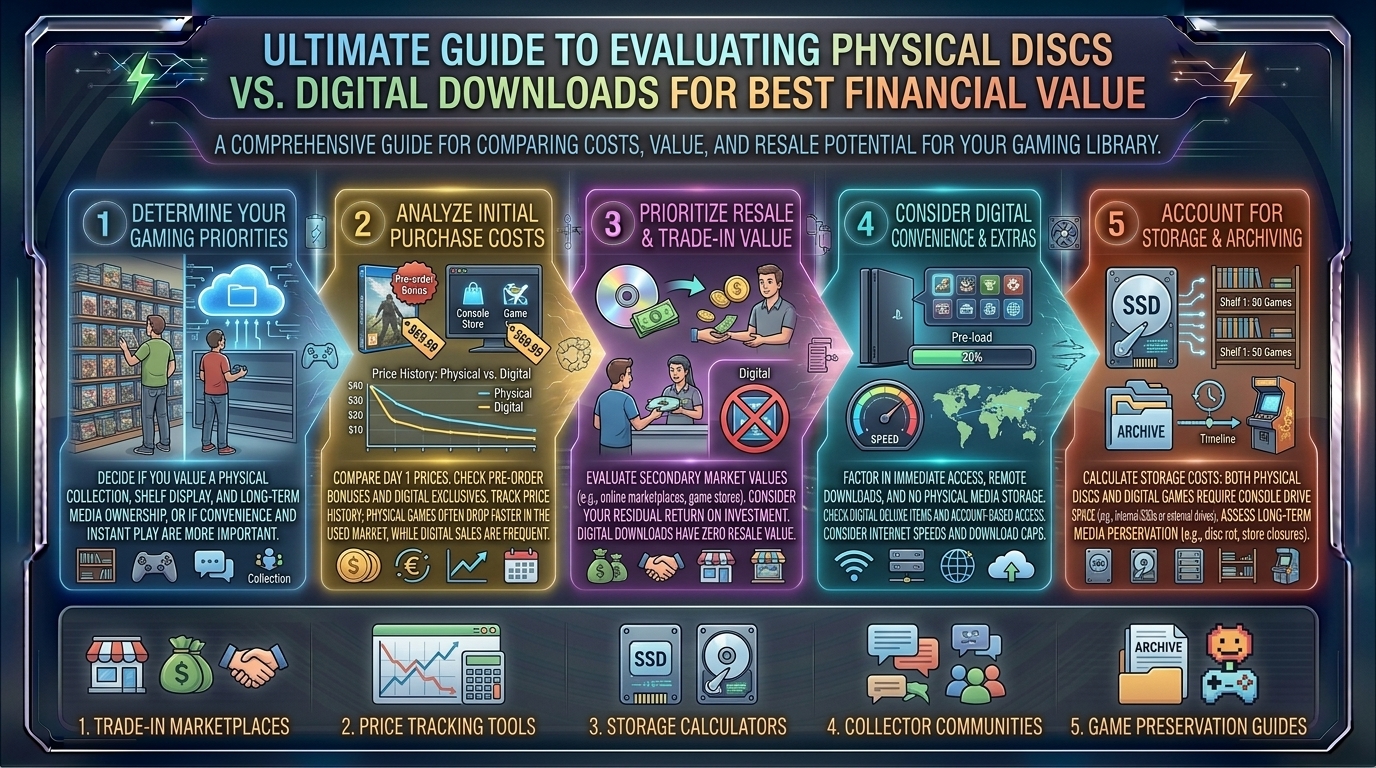
For modern gaming enthusiasts scattered across major tech and entertainment hubs like Texas, New York, California, Washington, and San Francisco, building a library of games is a major financial investment. With standard AAA titles now carrying a baseline price tag of $70 (and deluxe editions frequently soaring past $100), how you purchase your games has never mattered more to your wallet.
The video game landscape is undergoing a massive structural shift. With digital storefronts dominating console and PC ecosystems, and physical game sales hitting historic lows, gamers are routinely forced to choose between the absolute convenience of a digital download and the long-term economic utility of a physical disc.
At thegamerbuzz.com, we look past the marketing hype to analyze the cold, hard economics of gaming. This comprehensive financial breakdown will teach you how to evaluate whether buying physical discs or digital game downloads makes the most financial sense for your specific gaming habits.
Part 1: The Upfront Cost Equation – MSRP vs. Retail Competition
At first glance, a new game costs the exact same amount whether you buy it digitally or physically on launch day: typically $69.99 for major console releases. However, the financial divergence begins almost immediately after launch.
The Power of Physical Retail Competitiveness
- Retailer Price Wars: When you buy a physical disc, multiple independent retail giants (such as Walmart, Amazon, Target, and local game stores) compete for your business. To clear shelf space or win market share, retailers frequently slash prices on physical software weeks after launch.
- The Used Game Market: Physical discs can be bought, sold, traded, and lent out. If you buy a physical game for $70, play it, and trade it in for $35 credit toward the next new release, your net cost for that entertainment experience drops to $35.
- Garage Sales and Clearance Bins: Physical media opens up the secondary market—eBay, Facebook Marketplace, and retro game shops—where older titles can be acquired for pennies on the dollar.
The Digital Monopoly Constraint
- Closed Ecosystem Pricing: Digital game downloads on consoles (PlayStation Store, Nintendo eShop, Xbox Marketplace) are controlled entirely by the platform holder. There is no competing storefront for console digital keys. If Sony or Nintendo decides a game stays at $60, it stays at $60 until they authorize a digital sale.
- Digital Sales Cycles: While digital storefronts feature frequent sales (e.g., Spring Sales, Black Friday, Publisher Spotlights), prices are entirely at the mercy of algorithmic curation. Furthermore, you cannot resell, trade, or gift a digital game once you finish it. Once purchased, that money is permanently tied to your account.
Part 2: The Hidden Costs of Digital vs. Physical
When evaluating financial sense, upfront sticker prices only tell half the story. You must factor in hidden expenses associated with each medium.
+---------------------------+-----------------------------------+-----------------------------------+
| Cost Factor               | Physical Discs                    | Digital Downloads                 |
+---------------------------+-----------------------------------+-----------------------------------+
| Hardware Upfront Cost     | Consoles with disc drives cost more| Diskless consoles are cheaper     |
| Secondary Market Value    | High (Resale and trade-in value)  | Zero (Zero residual value)        |
| Internet & Data Caps      | Minimal download overhead         | High-speed internet / Data caps   |
| Storage Maintenance       | Physical shelf space / storage    | External SSD expansion costs      |
+---------------------------+-----------------------------------+-----------------------------------+
1. Hardware Price Discrepancies
When purchasing a console (such as the PlayStation 5 or Xbox Series X), you are often forced to choose between a standard model with a disc drive and a cheaper, diskless digital edition.
- The Math: A digital-only console is typically $50 to $100 cheaper upfront. However, locking yourself into a diskless ecosystem permanently strips you of the ability to buy cheap used games or borrow titles from friends, which can easily erase that initial $100 hardware savings within your first year of gaming.
2. Internet Bandwidth and Data Caps
While Washington, California, and New York urban centers generally enjoy robust fiber internet, many regional areas in Texas or rural sectors still deal with tiered internet data caps or slower download speeds.
- Modern games frequently push 100 GB to 150 GB file sizes. Downloading massive digital titles repeatedly can trigger internet overage fees or max out bandwidth caps, whereas physical discs pre-load a massive chunk of data directly from the media.
Part 3: Regional Economic Realities for Gamers
Where you live introduces distinct financial variables:
- High Cost of Living Areas (San Francisco & New York): Space is at an absolute premium. Storing physical game cases and bulky collector’s editions takes up valuable real estate in a compact apartment. For urban renters, digital libraries eliminate physical clutter.
- Suburban & Regional Hubs (Texas & Washington): Larger living spaces make physical collections easy to store, and proximity to local brick-and-mortar retail outlets makes hunting down physical clearance sales convenient and cost-effective.
Part 4: When Digital Downloads Actually Save You More Money
Despite the lack of resale value, digital downloads can be the smarter financial choice under specific circumstances:
+-----------------------------------+-----------------------------------+
| Scenario                          | Winner                            |
+-----------------------------------+-----------------------------------+
| Buying Indie Games & Digital-Only | Digital (Only option available)   |
| Subscription Services (Game Pass) | Digital (Unmatched value)         |
| Day-One Multiplayer Addicts       | Tie (Same price, instant access)  |
| Patient Gamers (Waiting 1-2 years)| Digital (Deep holiday eShop sales)|
+-----------------------------------+-----------------------------------+
- Subscription Services: Services like Xbox Game Pass or PlayStation Plus Extra shift the financial paradigm entirely. Paying a flat monthly fee for access to a rotating library of hundreds of digital titles offers unmatched cost efficiency for gamers who consume many different games a year.
- Deep Digital Sales on Older Titles: If you are willing to wait 12 to 18 months after a game’s release, digital storefronts regularly slash older AAA titles by 75% to 85% during seasonal sales, rivaling physical bargain bins without requiring you to leave your couch.
- PC Gaming: On PC, physical media is virtually extinct. Platforms like Steam, Epic Games Store, and GOG rely on fierce digital key competition and bundle sites (like Humble Bundle), making digital the undisputed financial king for PC users.
Part 5: Decision Matrix – Which Should You Choose?
To calculate what makes financial sense for you, answer these three lifestyle questions:
- Are you a “Finisher” or a “Replayer”? If you beat a single-player game once and never touch it again, physical discs make more sense because you can trade them in. If you are a completionist who sinks 500 hours into Elden Ring or Destiny and keeps it installed forever, digital is more convenient.
- Do you share games? If you like swapping games with friends, siblings, or local community members, physical discs are mandatory.
- How much do you value convenience? If switching physical discs out of a console tray feels like an unnecessary chore and you prefer instant game-switching via user interfaces, you are paying a minor lifestyle convenience fee for digital downloads.
Frequently Asked Questions (FAQ)
1. Are digital games cheaper than physical discs over time?
Not usually for brand-new releases. Digital prices remain fixed at MSRP much longer because platform holders control the storefronts. However, digital games can become significantly cheaper during major seasonal sales if you are patient.
2. Can I resell or trade in digital games?
No. Once you purchase a digital game download, it is permanently locked to your user account. You cannot trade, sell, or lend digital licenses to friends.
3. Do physical discs still require large internet downloads today?
Yes. While the core game data is on the disc, modern day-one patches, massive updates, and online components often require you to download dozens of gigabytes of data even when installing from a physical disc.
4. Is the physical game market actually dying?
Market data indicates that physical game sales have shrunk significantly as digital distribution captures the vast majority of overall market share. However, a dedicated enthusiast base continues to support physical media for ownership security and collection value.
5. Why do publishers push consumers so hard toward digital downloads?
Publishers make significantly higher profit margins on digital sales because they bypass manufacturing costs, global shipping logistics, and retailer revenue cuts.
6. What happens to my digital games if a company shuts down its store servers?
If an online storefront closes permanently down the road, downloading uninstalled games or accessing certain online features can become restricted or impossible, which is why critics argue physical media provides superior long-term ownership security.
7. Are diskless consoles worth the money saved upfront?
If you exclusively play free-to-play titles, subscribe to Game Pass, or only buy games on deep digital sales, a diskless console saves you $50–$100 upfront. If you buy many new games and trade them in afterward, a diskless console costs you more money in the long run.
8. Do PC gamers have a choice between physical and digital?
Almost entirely no. Physical PC games are rare collector’s items now; virtually all PC gaming is distributed digitally via Steam, Epic Games, and other launchers.
9. Can I share digital games with family members?
Yes, most modern consoles (Xbox and PlayStation) allow you to set a “Home Console” configuration that permits family members or secondary profiles on the same hardware to access your digital library, though simultaneous online play restrictions apply.
10. Where can I find more financial guides and gaming deals?
For continuous breakdowns on hardware value, price tracking alerts, and industry insights tailored for modern players, keep your browser locked to thegamerbuzz.com!
Conclusion
Deciding whether physical game discs or digital downloads make more financial sense depends entirely on your personal gaming habits. If you love hunting for bargains, want the freedom to trade and resell games when you finish them, and value true ownership, physical discs remain the financial winner. If you prioritize instant convenience, leverage subscription services like Game Pass, and wait for deep digital sales, digital downloads can fit seamlessly into a budget-conscious strategy.
At thegamerbuzz.com, we want to help you make every gaming dollar count. Evaluate your library habits, shop smart, and game on!
Leave a Reply