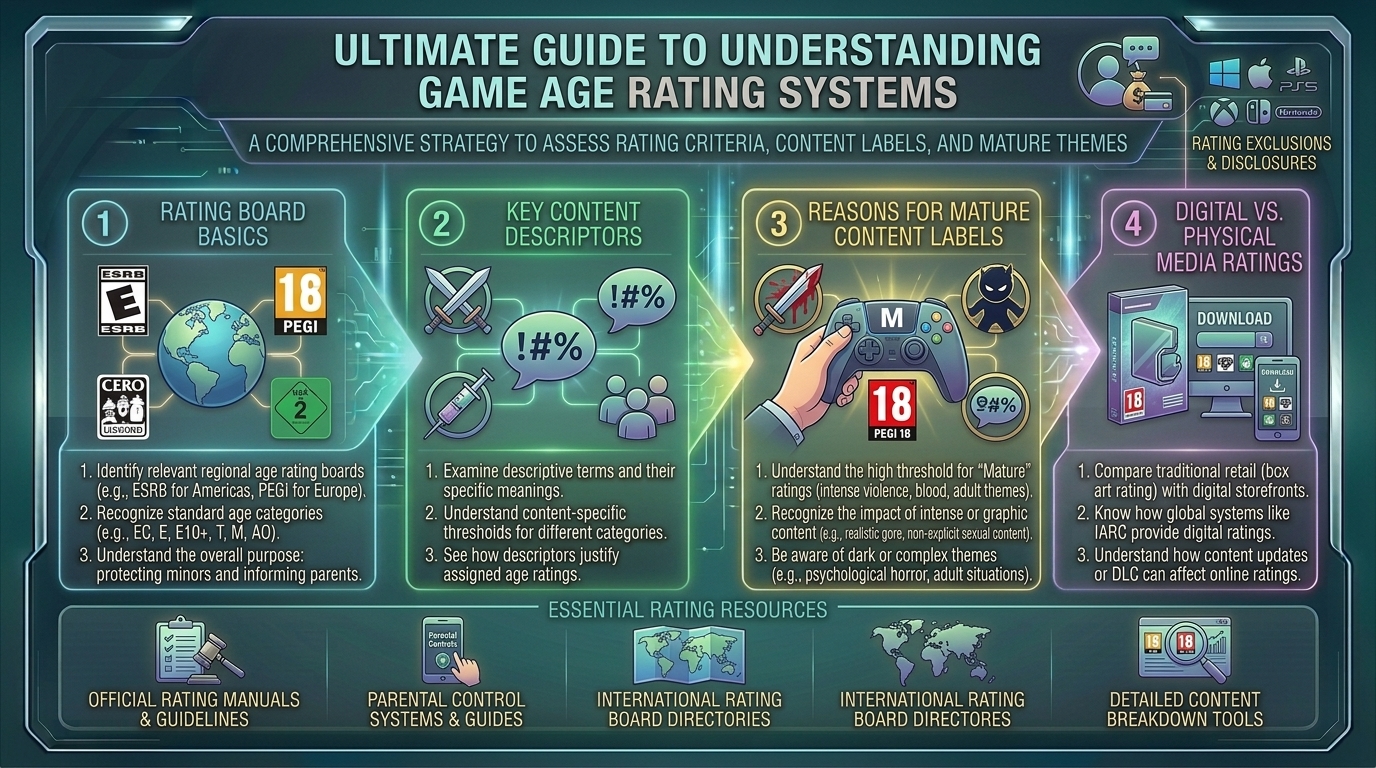
How to Understand Age Rating Board Classification Criteria and Why Games Receive Mature Content Labels
Welcome to thegamerbuzz, your trusted digital authority on gaming culture, media compliance standards, and consumer safety insights. Whether you are analyzing release policies late at night in a New York high-rise, researching software classification criteria in San Francisco, monitoring compliance frameworks across Texas and Washington, or curating family-friendly digital libraries from sunny California, we know how vital it is to understand what goes into the video games we play.
When you walk into a game store or browse a digital storefront like Steam, PlayStation Network, or the Xbox Marketplace, every title features prominent age badges. From a simple “E for Everyone” to an unmistakable “M for Mature” or “PEGI 18”, these symbols act as the final checkpoint between developers and players. But have you ever wondered who actually decides these ratings, what specific metrics push a game into an older category, and why some content triggers immediate mature labels?
This comprehensive master-level guide explores the inner workings of global age rating boards, decoding the classification criteria, evaluating how mature content labels are assigned, and explaining why these systems matter for the modern gaming ecosystem.
1. The Guardians of the Industry: Understanding the Major Rating Boards
Age rating systems are designed to provide clear, transparent information about a game’s content so consumers and parents can make informed purchasing choices. While dozens of regional boards exist globally, the industry relies primarily on two major regulatory pillars alongside streamlined digital systems:
- The ESRB (Entertainment Software Rating Board): Operating across the United States, Canada, and Mexico, the ESRB utilizes a mix of comprehensive publisher disclosure questionnaires, video footage submissions, and independent human raters to categorize games.
- PEGI (Pan-European Game Information): Serving over 30 European countries, PEGI evaluates content based on age suitability and works heavily with statutory laws to ensure retail compliance.
- The IARC (International Age Rating Coalition): A global framework that streamlines digital storefront submissions, allowing developers to fill out a single unified questionnaire that automatically generates localized age ratings for Google Play, Nintendo eShop, Xbox, and Microsoft platforms.
2. Decoding the Classification Tiers: From Children to Adults
To understand how games get labeled, it helps to examine the progression of age tiers. While exact naming conventions vary slightly by region, the structural criteria remain consistent:
1. Early Childhood / Everyone (ESRB: E / PEGI: 3)
- The Criteria: Content is generally suitable for all ages. Games in this category feature zero bad language, no frightening imagery or sounds, and at most very mild, comical, or cartoon-style slapstick violence (e.g., Super Mario or Tetris).
2. Everyone 10+ / PEGI 7
- The Criteria: Suitable for ages 10 and up. May include slightly more cartoon or fantasy violence, mild language, or minimal suggestive themes. PEGI 7 accommodates content that could mildly startle younger children or features non-realistic, non-detailed conflict.
3. Teen / PEGI 12 & 16
- The Criteria: Geared toward players aged 13 to 16. These tiers introduce moderate violence, simulated gambling elements, crude humor, suggestive themes, and occasional strong language. PEGI 16 specifically triggers when violence mimics real-life physical conflict or when tobacco, alcohol, and drug references appear.
4. Mature 17+ / PEGI 18 (The Mature Threshold)
- The Criteria: Restricted strictly to players aged 17 or 18 and older. These titles feature intense violence, blood and gore, sexual content, explicit language, or the simulation of illegal drug use and unvetted gambling mechanics.
3. Why Do Games Receive Mature Content Labels?
A game does not earn an “M” (Mature 17+) or “PEGI 18” rating by accident. Rating boards look at specific content triggers, context, and interactivity. Here are the core pillars that push a game into the mature category:
1. Realistic and Graphic Violence, Blood, and Gore
Fantasy violence involving cartoon creatures rarely triggers mature ratings. However, when a game depicts realistic human injury, dismemberment, torture, or gratuitous blood and gore against human or hyper-realistic humanoid targets (such as Grand Theft Auto, God of War, or Call of Duty), it crosses an immediate line into mature territory. Context matters heavily: unprovoked violence against defenseless civilian non-player characters (NPCs) heavily accelerates a game toward an adult classification.
2. Sexual Content and Nudity
Non-explicit romance or mild attire choices might slide into a Teen rating, but mature labels are triggered when a game features:
- Graphic or prolonged depictions of sexual behavior and intercourse.
- Visual exposure of sexual organs (full frontal nudity).
- Depictions of sexual violence, coercion, or non-consensual sexual acts, which almost always guarantee an immediate Mature or Adults Only restriction.
3. Strong Language and Profanity
The frequency and intensity of vulgarity dictate rating boundaries. While a single mild expletive might pass in an Everyone 10+ or Teen game, repetitive sexual expletives, severe blasphemy, or targeted slurs instantly pull a title into the Mature 17+ or PEGI 16/18 brackets.
4. Substances, Gambling, and Modern Digital Mechanics
The criteria for mature labels have evolved beyond traditional elements to include systemic behaviors:
- Substance Abuse: The glorification or detailed interactive use of illegal drugs, heavy alcohol consumption, and tobacco.
- Simulated Gambling: Mechanics that mirror real-world casino gambling or involve wagering real currency.
- Interactive and Online Risk Factors: Modern rating frameworks increasingly evaluate online interaction structures. Games featuring entirely unrestricted, unmoderated chat systems or specific monetization loops (such as un-regulated randomized loot mechanics) face stricter age gating across global markets.
4. Frequently Asked Questions (FAQ)
1. Are age ratings legally binding, or are they just suggestions?
It depends entirely on your region. In many areas (such as the UK under PEGI laws), selling a PEGI 18 game to an underage minor is a criminal offense carrying heavy retail fines. In North America, the ESRB system is technically voluntary for retailers by law, but all major retail chains enforce strict photo ID checks as part of industry self-regulation.
2. Who actually plays and rates the video games?
Boards like the ESRB employ trained, anonymous human raters from diverse demographic backgrounds. These raters review comprehensive video footage capturing the most extreme content (violence, user-generated scenarios, dialogue trees) submitted by developers before assigning a final consensus rating.
3. What happens if a developer tries to hide mature content from the rating board?
If a developer conceals hidden mature content (like the infamous “Hot Coffee” mod scenario in Grand Theft Auto: San Andreas), rating boards can strip the rating, force an emergency recall, trigger massive retail delistings, and impose severe contractual fines.
4. Why is there an “Adults Only (AO)” rating, and why do publishers avoid it?
The Adults Only (AO 18+) rating is reserved for extreme content containing prolonged intense violence or explicit sexual content. Major console manufacturers (Sony, Microsoft, Nintendo) outright ban AO-rated games from their platforms, and major retailers refuse to stock physical copies, making commercial release virtually impossible for an AO game.
5. Do digital-only indie games require age ratings?
Yes. Digital storefronts (Steam, Nintendo eShop, PlayStation Store, Xbox Marketplace) legally and contractually require an age rating before publishing any title. Most digital developers utilize the streamlined IARC questionnaire process to generate automated global ratings quickly.
6. How do rating boards handle user-generated content (UGC) games like Roblox or Fortnite?
Platforms featuring infinite user-generated content (such as Roblox or creative modes) present unique challenges. They are typically evaluated based on baseline engine safety tools, parental controls, and moderation structures, often carrying dynamic descriptors or parental guidance warnings.
7. Do DLC expansions or post-launch updates change a game’s age rating?
Yes. If a studio releases an expansion pack that introduces extreme gore, nudity, or intense profanity that wasn’t present in the base game, the rating board can re-evaluate the software and mandate an updated classification label.
8. Why do rating criteria differ between regions like North America and Europe?
Cultural standards dictate how different societies perceive media content. Historically, North American boards (ESRB) tend to be more sensitive to sexual content and nudity, while European boards (PEGI/BBFC) historically scrutinize graphic violence and substance use more intensely.
9. Can a game developer appeal an age rating if they disagree with it?
Yes. If a studio feels their game was unfairly categorized or that context was misinterpreted by raters, they can submit an appeal, present additional gameplay evidence, or edit/blur specific elements of the code to secure a lower rating category.
10. How can parents use rating board websites effectively?
Parents can visit official databases (like ESRB.org or PEGI.info) to look up any game title. These databases provide detailed Rating Summaries explaining exactly why a game received its rating, breaking down specific text examples of dialogue, violence, and thematic elements.
5. Conclusion
Understanding age rating board classification criteria removes the mystery behind why video games receive mature content labels. These systems are not designed to censor artistic expression; rather, they serve as crucial consumer protection tools, providing clarity, legal compliance, and transparency for players, developers, and parents alike.
Stay informed, check your ratings before you buy, and explore the gaming world safely right here with thegamerbuzz!
What is the most surprising age rating you’ve ever seen assigned to a video game that looked harmless on the surface?
Leave a Reply