How to Understand Microtransactions, Loot Boxes, and Battle Pass Monetization Models in Modern Gaming
Introduction: The Shift from One-Time Purchases to Live-Service Economies
Remember when buying a video game meant walking into a retail store, handing over a flat $50 or $60 bill, unwrapping a plastic box, and receiving a complete, self-contained experience? For gaming communities across Texas, New York, California, Washington, and San Francisco, those days feel increasingly like ancient history.
Today, the gaming industry operates on a fundamentally different economic engine. Driven by massive multiplayer servers, continuous post-launch updates, cross-platform play, and soaring development budgets, modern video games have transformed into ongoing “live-service” platforms. Instead of a single upfront transaction, games rely on a complex web of microtransactions, loot boxes, and battle passes.
Understanding these monetization models is no longer just for game developers or financial analysts; it is essential for players who want to navigate digital storefronts intelligently without falling into predatory psychological traps. At thegamerbuzz.com, we take a transparent look under the hood of modern game economics. This comprehensive guide breaks down how these models work, why publishers use them, and how you can protect your wallet.
Part 1: Microtransactions (MTX) – The Building Blocks of Modern Digital Commerce
What Are Microtransactions?
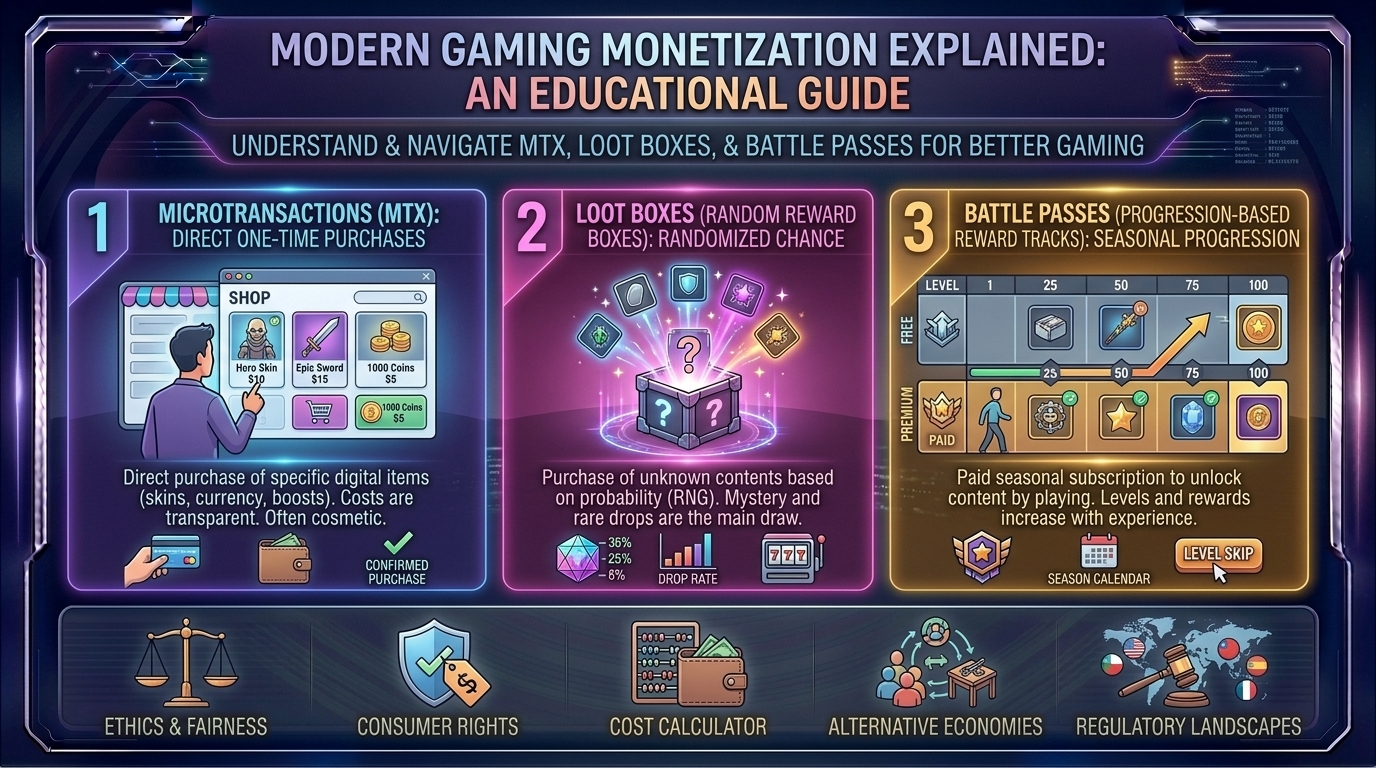
At its core, a microtransaction is any digital purchase made within a video game. These can range from a $0.99 weapon charm to a $20 character skin bundle. While the prefix “micro” originally implied small, pocket-change purchases, the term now covers a wide spectrum of digital goods.
Categorizing Microtransactions
- Cosmetic Items: Skins, character outfits, weapon shaders, emotes, and UI customization. These items change how things look without altering gameplay performance. In many competitive games (like Counter-Strike 2 or Valorant), cosmetics drive billions of dollars in annual revenue.
- Functional / Pay-to-Win (P2W) Items: Experience boosters (XP pots), faster crafting times, energy refills, or outright gameplay advantages (such as buying weapons or heroes with cash). These are deeply controversial because they trade real money for competitive advantages.
- Virtual Currencies: In-game tokens (like V-Bucks, COD Points, or Apex Coins). Publishers use virtual currencies as a psychological buffer so players lose track of real-world fiat value when clicking “Buy.”
Part 2: Loot Boxes – The Psychology and Controversy of Randomized Rewards
What Is a Loot Box?
A loot box (sometimes called a gacha pull, lockbox, or crate) is a randomized digital container purchased with real money or earned in-game. When opened, it yields a randomized selection of virtual items—ranging from common cosmetic filler to ultra-rare, legendary weapon skins.
+-----------------------------------+-----------------------------------+
| Traditional Direct Purchase       | Randomized Loot Box Model         |
+-----------------------------------+-----------------------------------+
| Transparent cost for exact item   | Randomized chance / RNG gamble    |
| Zero psychological manipulation   | Leverages variable-ratio rewards  |
| Clear consumer value              | High risk of overspending         |
+-----------------------------------+-----------------------------------+
The Psychology Behind Loot Boxes
Loot boxes operate on the exact same psychological principles as slot machines and casino gambling. They utilize variable-ratio reinforcement schedules—meaning the brain receives an unpredictable, high-dopamine reward intermittently. This loop triggers the same neural pathways associated with gambling addiction, making it remarkably effective at driving repeat purchases, particularly among “whale” spenders.
Regulatory Backlash
Because of their gambling-like mechanics, loot boxes have faced severe global scrutiny:
- International Bans: Countries like Belgium and the Netherlands banned loot boxes outright under gambling laws.
- Disclosure Laws: Many regions now legally mandate that publishers publicly disclose exact drop rates (e.g., a 0.5% chance for a legendary skin) directly inside the store UI.
Part 3: Battle Passes – The Structured Seasonal Progression Model
If loot boxes represent the chaotic casino side of gaming monetization, battle passes represent the structured subscription-lite evolution. Surging into a multi-billion dollar market sector, battle passes have become the dominant monetization model for live-service multiplayer games.
How a Battle Pass Works
A battle pass ties microtransactions to player time and engagement.
- Free vs. Premium Tiers: Every player participates in a free tier track that offers occasional minor rewards. However, players can purchase a “Premium Battle Pass” (typically costing around $10 worth of virtual currency) to unlock a secondary reward track.
- Tier Progression: As you play matches, complete daily quests, and earn XP, you level up your pass from Tier 1 to Tier 100, unlocking cosmetics, currency, and emotes step-by-step.
- The “Self-Sustaining” Loop: Many successful battle passes reward enough premium currency by the time you reach max level to buy next season’s pass for free, provided you put in the required playtime hours.
Why Developers Love Battle Passes
- Player Retention: Battle passes exploit the psychological fear of missing out (FOMO). Because passes are time-limited (lasting a single season, usually 2 to 3 months), they compel players to log in daily to grind out rewards they paid for.
- Predictable Cash Flow: Millions of players fronting $10 every few months provides studios with steady, recurring revenue streams to fund ongoing server upkeep and updates.
Part 4: Regional Economic Insights & Developer Realities
Where you play and how local markets view spending shapes how publishers design these systems:
- San Francisco & New York: High living costs and fast-paced professional schedules mean urban gamers often look for “time-savers”—using microtransactions or battle pass tier skips to progress quickly because they have fewer hours to grind.
- Texas & Washington: Home to massive regional gaming communities and development studios where digital economies are heavily analyzed. Local attitudes heavily influence consumer pushback against overly aggressive monetization.
Part 5: Ethical Monetization vs. Predatory Practices
Not all microtransactions are evil. Developing and maintaining online servers, pushing out regular patches, and hiring artists to design maps costs millions of dollars. When a game offers purely cosmetic, transparently priced items without time pressures or gambling mechanics, it represents a fair exchange of art for money.
However, lines are crossed when games employ predatory dark patterns:
- Artificial Scarcity: Limited-time items engineered to induce panic buying.
- Obfuscated Pricing: Forcing players to buy $25 worth of currency just to purchase a $20 item so leftover digital change remains trapped in their account.
- Pay-to-Win Walls: Deliberately making base progression agonizingly slow unless a player purchases time-savers or loot boxes.
Frequently Asked Questions (FAQ)
1. What is the difference between DLC and microtransactions?
DLC (Downloadable Content) usually refers to substantial, pre-packaged expansions like new campaign chapters, maps, or massive story arcs (e.g., Elden Ring: Shadow of the Erdtree). Microtransactions are smaller, individual digital goods like skins, currencies, or booster packs.
2. Are battle passes worth the money?
If you play a game regularly and are confident you will reach the max tier before the season ends, battle passes offer the highest value-per-dollar return in modern gaming, often returning your investment in virtual currency. If you play casually, you risk wasting money on locked tiers you never reach.
3. Why do games use virtual currencies instead of real money?
Virtual currencies (like V-Bucks) act as a psychological buffer, disconnecting the act of spending from real-world financial consequences, making it easier for players to justify continuous small purchases.
4. Are loot boxes considered illegal gambling?
Legally, it varies by jurisdiction. While countries like Belgium have banned them, many nations still classify them differently because virtual items lack official legal cash payout systems, though regulatory pressure is increasing worldwide.
5. What is a “whale” in gaming economics?
A “whale” refers to a tiny percentage of high-spending players (often accounting for less than 1–5% of a game’s total player base) who spend hundreds or thousands of dollars on microtransactions and loot boxes, generating the bulk of a free-to-play game’s revenue.
6. Can I earn battle pass currency back for free?
In many popular live-service titles (like Fortnite or Apex Legends), completing the premium battle pass rewards you with enough premium currency to purchase the next season’s pass without spending extra real money.
7. Do single-player games have microtransactions?
Some do, though they are heavily criticized by gamers. Single-player microtransactions typically take the form of time-savers, currency packs, or cosmetic outfit unlocks that bypass standard gameplay progression.
8. What should parents watch out for regarding kids and microtransactions?
Parents should always lock down console and PC storefronts with strict parental control PINs, disable auto-save credit card billing, and avoid linking unprotected debit cards to child accounts to prevent accidental multi-thousand-dollar spending sprees.
9. Why are cosmetic skins so expensive now?
Because top-tier multiplayer games are free-to-play upfront, publishers rely entirely on cosmetic sales to fund game development. High-demand character skins often take artists weeks to model, texture, and animate, commanding premium prices ($15–$25) to sustain studio operations.
10. Where can I find more deep-dives into gaming industry trends?
For continuous updates, financial breakdowns, and gaming culture analysis, keep your browser locked to thegamerbuzz.com!
Conclusion
Microtransactions, loot boxes, and battle passes are permanent pillars of the modern gaming landscape. While they have enabled the rise of massive free-to-play ecosystems and continuous live-service updates, they also introduce aggressive psychological tactics designed to extract maximum capital from players. By understanding how these models operate, setting strict personal budgets, and prioritizing games that respect your time and wallet, you can enjoy the best of modern gaming on your own terms.
At thegamerbuzz.com, we empower you to stay informed, play smarter, and master your digital hobbies!
Leave a Reply