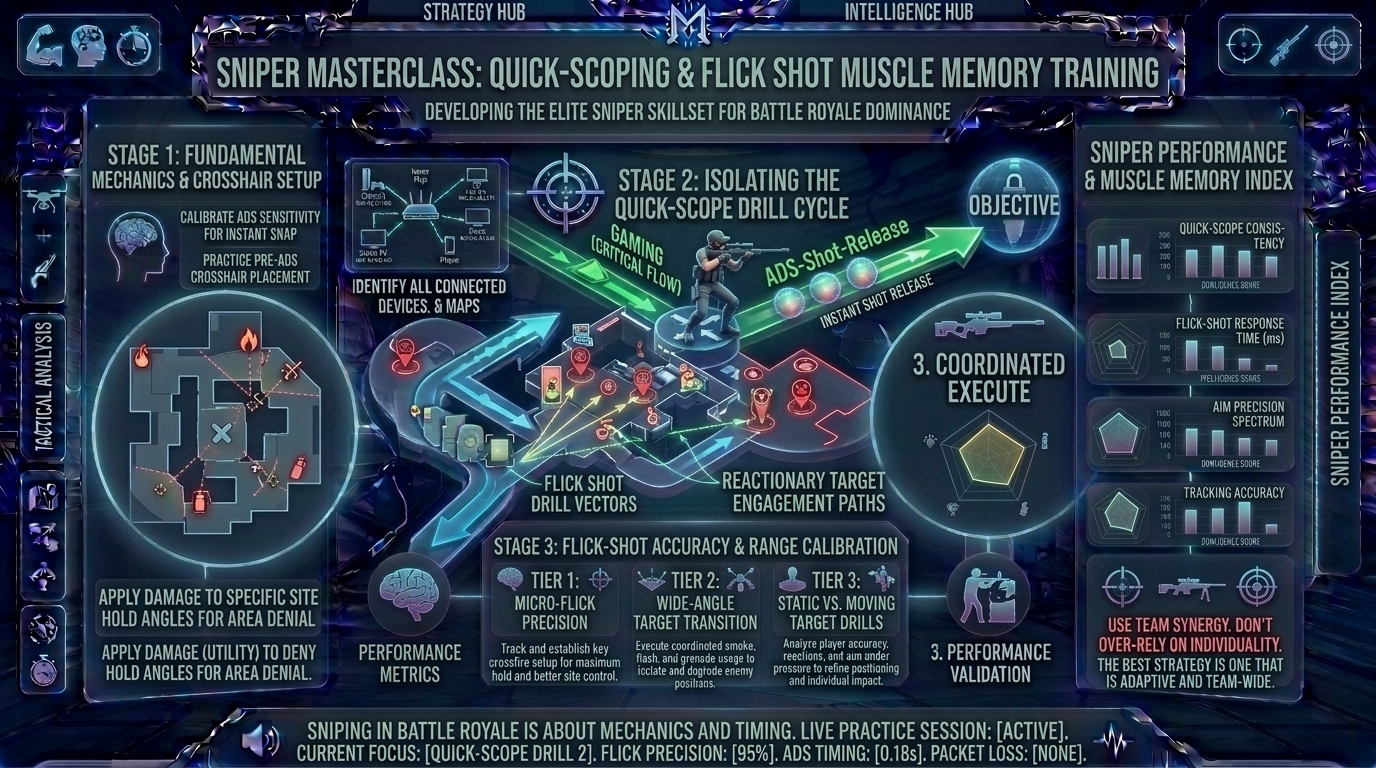
Welcome to The Gamer Buzz, your premier competitive performance and tactical marksmanship authority. Whether you are dialing in high-sensitivity sniper flicks from high-rise setups in San Francisco, New York, and Seattle, or grinding through high-stakes cross-map engagements across Texas, California, and Washington, one weapon class rules the meta with absolute lethality: the high-tier sniper rifle.
In heavy competitive battle royale titles (such as Apex Legends, Call of Duty: Warzone, PUBG, and various tactical battle royale variants), securing a clean, one-shot knockdown or heavy armor break at 200 meters changes the entire momentum of a match. However, battle royales are chaotic, fast-paced, and wildly unpredictable. Enemies are rarely standing still waiting for you to line up a lazy crosshair; they are sliding, jumping, ziplining, and weaving behind erratic cover.
To dominate with sniper rifles, you cannot rely purely on slow, deliberate aiming. You must master quick scoping and flick-shot muscle memory. In this exhaustive, master-level guide, we break down eye-hand coordination neurology, flick mechanics, specialized sensitivity configuration, and step-by-step training drills to turn you into an elite sniper.
1. The Anatomy of a Snipe: Quick Scoping vs. Tracking
Before building muscle memory, you must understand the two fundamental aiming archetypes required for sniper-heavy battle royales.
[Target Acquisition] ➔ [Pre-Aim Center Screen] ➔ [Simultaneous Scope-In & Flick] ➔ [Micro-Correction & Shot Execution]
1. Quick Scoping Mechanics
- Quick scoping is the art of bringing your sniper rifle up to your shoulder, firing the exact millisecond the crosshair narrows or the scope animation transitions into view, and dropping back out of scope to maintain peripheral vision.
- The Illusion of Speed: Elite snipers don’t look fast because their hands are shaking with panic; they look fast because their crosshair placement is already 90% accurate before they even touch the scope button.
2. Flick-Shot Muscle Memory
- A flick shot is a lightning-fast, ballistic hand movement that snaps your crosshair from an idle resting position directly onto a sudden, unexpected target, followed by an immediate click.
- This relies entirely on procedural muscle memory: your brain calculating distance and training your forearm and wrist muscles to travel a precise angular distance without conscious thought.
2. The 4-Stage Sniper Training Protocol
Building lightning-fast sniper muscle memory cannot be achieved purely by playing live matches, where you only get a few sniper shots per hour. You need isolated, high-repetition training.
Stage 1: Centered Pre-Aim Discipline
- The Rule of Center: Never run around with your camera staring at the floor or sky. Keep your crosshair locked constantly at head/chest height on common corner angles and ridgelines.
- Benefit: When an enemy appears, the physical distance your mouse or thumbstick needs to travel to reach their hitbox is cut down to a bare minimum, making your quick scope virtually instantaneous.
Stage 2: The Two-Step Flick Rhythm (Snap & Stop)
When practicing flicks in aim trainers (like Aimlabs or KovaaK’s) or in-game training ranges, avoid the common trap of sweeping your mouse in a wide, uncontrolled arc.
- Snap: Initiate a high-speed acceleration toward the target.
- Stop: Immediately brake your momentum using your stopping technique (or mouse deceleration). Never overshoot past the target and try to correct backward—that introduces double-correction delays. Smooth, single-motion snaps build clean muscle memory.
Stage 3: Scope Timing Synchronization
The biggest mistake aspiring snipers make is clicking before the scope is fully active (resulting in an inaccurate un-scoped hip-fire) or waiting too long after scoping (making you an easy target).
- The Rhythm: Practice the physical cadence: Spot target ➔ Pre-aim crosshair ➔ Right-click (Scope) and Left-click (Fire) in rapid, synchronized succession. In many games, you must wait for the exact frame the crosshair center dot locks into place to avoid bullet deviation spread.
Stage 4: Managing Sniper Scope Sensitivity Multipliers
Battle royale titles feature multiple magnification scopes (2x, 4x, 8x, 12x). If your high-magnification scope sensitivity is identical to your hip-fire sensitivity, your muscle memory will break down.
- The Fix: Fine-tune your relative sniper scope sensitivity settings. Your zoomed-in sensitivity should feel heavy and controlled, allowing you to micro-adjust over long distances without throwing your crosshair flying past distant moving targets.
3. Comprehensive Matrix: Sniper Practice Drills vs. Skill Outcomes
| Training Drill | Environment / Tool | Core Skill Developed |
| Static Gridshot / Reflex | Aim Trainers / Warm-up range | Raw hand-eye coordination and initial snap speed. |
| Moving Target Tracking | Custom BR training maps | Predicting target velocity and lead distance over range. |
| Peek-and-Shoot Drills | Cover-heavy angles in deathmatch | Quick-scoping timing while exposing minimal hitbox area. |
| Flick Recovery Drills | Solo practice lobbies | Snapping back to cover immediately after firing a shot. |
4. Advanced Battle Royale Sniper Tactics: Positioning and Movement
In a battle royale, hitting the shot is only half the battle; surviving the aftermath determines your win rate.
- Never Peek Twice From the Same Angle: The moment you fire a sniper shot, a loud bullet crack echoes across the terrain, broadcasting your exact position. If you miss or only crack armor, do not scope in again from that same rock or window. Rotate to an alternate off-angle before taking your next shot.
- The Crouch-Peel Escape: Always keep cover within arm’s reach. The second you fire your bolt-action or semi-auto sniper, immediately duck behind hard cover to chamber your next round safely out of enemy line of sight.
10 Frequently Asked Questions (FAQ)
1. Should I use a high or low mouse sensitivity for sniping in battle royales?
Most elite snipers use a medium-to-low overall sensitivity paired with a slightly elevated DPI or a dedicated sniper scope multiplier. This gives you wide freedom of movement for general looking, but provides micro-precision control when zoomed in at long range.
2. How do I lead moving targets across long distances in a battle royale?
You must factor in bullet travel time (projectile velocity) and bullet drop. Practice on custom servers to learn your weapon’s specific projectile speed so you can instinctively aim ahead of sprinting or sliding enemies.
3. What is “centering” and why is it more important than raw flick speed?
Centering is keeping your crosshair naturally pointed where an enemy is most likely to appear before you scope in. Good centering means your flick only needs to travel 2 inches instead of 10 inches, making you exponentially faster.
4. Can hardware upgrade paths (like high refresh rate monitors) help me snipe better?
Abso-lutely. Sniping relies on spotting microscopic pixel movements across vast distances. Moving from a 60Hz monitor to a 240Hz monitor cuts down display latency and motion blur, making distant moving targets vastly easier to track and snap onto.
5. How long should I practice in aim trainers before my sniper aim improves?
Dedicated 10-to-15-minute daily sessions focusing on dynamic clicking and micro-adjustments yield noticeable improvements in muscle memory consistency within 2 to 3 weeks.
6. Is it better to hold breath or snap quickly in high-stress fights?
In chaotic close-to-medium range quick-scope engagements, you do not have time to hold your breath; you must rely purely on raw crosshair snap and click timing. Save breath-holding for stationary, ultra-long-range overwatch shots.
7. Why do my sniper shots sometimes miss even when my crosshair was on the target?
This is usually caused by bullet spread penalties, firing before the scope animation has completely finished settling, or failing to account for bullet drop and enemy movement vector lead time.
8. Should I use controller aim assist or mouse and keyboard for sniping?
Both have distinct advantages. Mouse and keyboard offer unmatched flick precision and range freedom, while modern controller thumbsticks benefit from rotational aim assist tracking in close-quarters skirmishes. Choose what fits your hardware setup.
9. What should I do if I keep missing my initial sniper shots out of panic?
Slow down your rhythm. Deliberately force yourself to take an extra 0.2 seconds to ensure your crosshair is anchored correctly before clicking. Speed comes naturally as your muscle memory builds confidence.
10. Where can I find more marksmanship guides and battle royale tips?
Bookmark The Gamer Buzz and check back regularly for our comprehensive database of professional esports guides, hardware setups, and competitive training tips!
Conclusion
Mastering quick scoping and flick-shot muscle memory in sniper-heavy competitive battle royale titles requires a blend of disciplined pre-aiming, synchronized scope-and-fire timing, and structured daily training. By eliminating wasted hand movements, refining your scope sensitivities, and prioritizing smart positioning after every shot, you transform yourself into a feared long-range predator. Lock in your crosshair rhythm, trust your muscle memory, and dominate every horizon in your next battle royale lobby!
Leave a Reply